
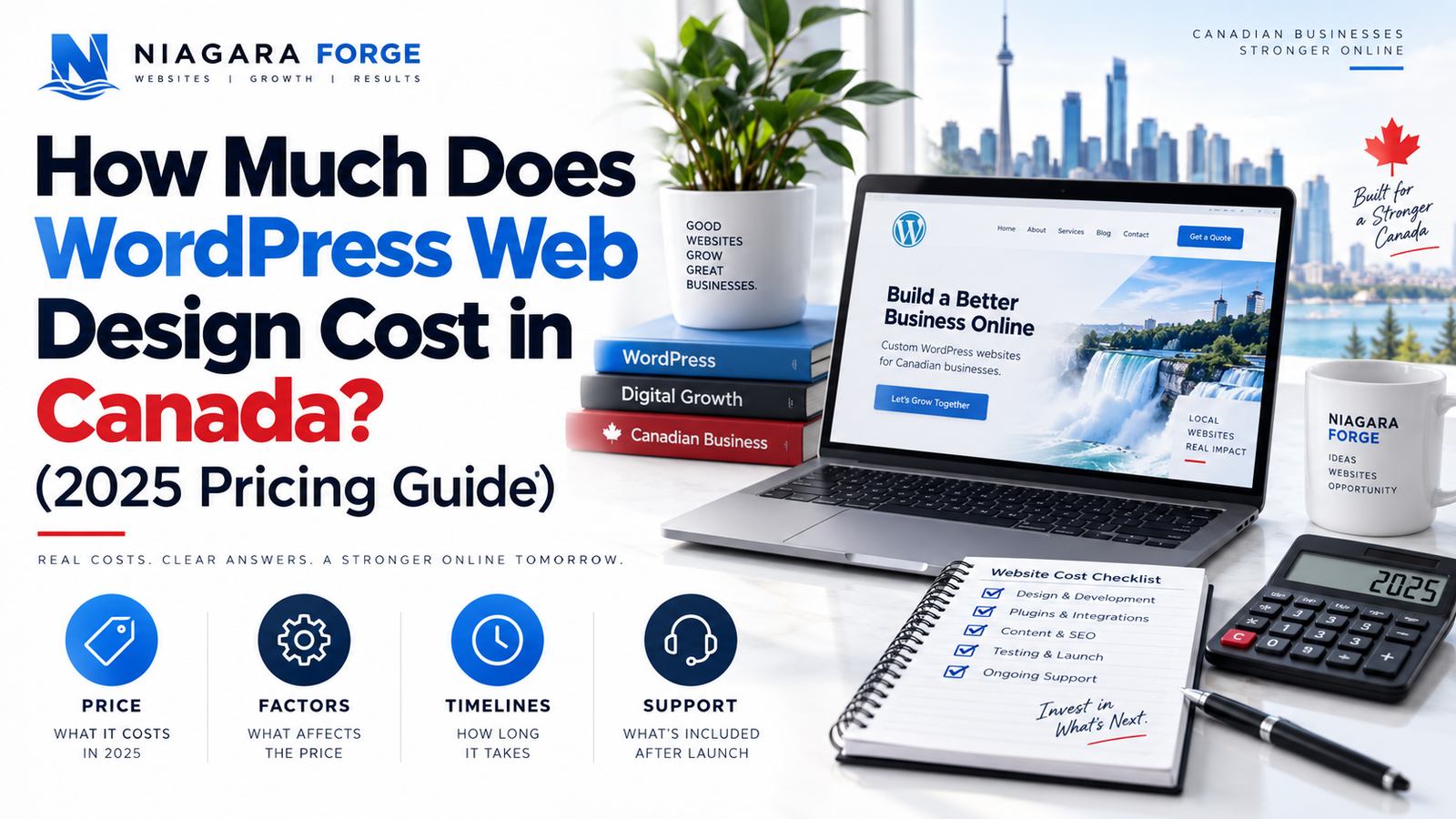
Introduction: Understanding WordPress Web Design Costs in Canada
If you are planning a new website for your Canadian business, one of the first questions you will ask is: how much does WordPress <a href=”https://niagaraforge.ca/service/web-design/”>web design cost in Canada? The honest answer is that it depends. A simple brochure site built by a freelancer in Moncton might cost a few hundred dollars, while a fully custom e-commerce platform developed by a Toronto agency can run into tens of thousands. That wide range exists because “WordPress web design” covers everything from a quick template setup to a complex, multi-language digital experience.
WordPress powers a large share of websites worldwide, and Canadian businesses have embraced it for good reason. It is flexible, search-engine friendly, and supported by a massive community of developers, designers, and plugin creators. Whether you run a bakery in Halifax, a law firm in Calgary, or a SaaS startup in Vancouver, WordPress can be shaped to fit your goals. But that flexibility also means pricing is not one-size-fits-all.
This guide breaks down the factors that influence WordPress web design costs in Canada so you can budget with confidence. We will look at the difference between do-it-yourself builds and agency projects, the ongoing costs you should expect, and how to decide what level of investment makes sense for your business.
Why WordPress Dominates the Canadian Web Design Market
WordPress is not just popular globally; it is a dominant force in Canada’s web design market. Several practical reasons explain why:
- Low barrier to entry: The core software is free and open source, so you only pay for hosting, a domain, and your design or development time.
- Huge talent pool: Canadian freelancers and agencies specialize in WordPress, making it easy to find help in cities like Toronto, Montreal, and Vancouver, or remotely across provinces.
- Scalability: A site can start small and grow into a membership portal, online store, or multilingual platform without starting over.
- SEO and content tools: Plugins such as Yoast and Rank Math help Canadian businesses target local search terms and comply with bilingual content needs.
- Ecosystem of plugins and themes: From WooCommerce for e-commerce to WPML for French-English sites, there is a solution for nearly every requirement.
Because WordPress is so widely used, competition among designers keeps pricing relatively transparent, but it also means quality varies dramatically. Two quotes for the “same” WordPress site can differ by thousands of dollars depending on strategy, custom design, and technical expertise.
The Importance of Budgeting for Your Website Project
A website is a business asset, not a one-time expense. Budgeting properly helps you avoid common pitfalls: choosing the cheapest option and rebuilding later, underestimating ongoing costs, or overspending on features you do not need. A realistic budget should account for:
- Initial design and development: The cost to plan, design, build, and launch your site.
- Content creation: Copywriting, photography, and translation for English and French audiences.
- Hosting and domain: Canadian hosting typically ranges from a few dollars to over a hundred dollars per month depending on traffic and performance needs.
- Maintenance and updates: Security patches, backups, plugin renewals, and small changes.
- Marketing integration: SEO setup, analytics, email tools, and advertising landing pages.
Setting a budget range before you request quotes gives you leverage. It also helps you compare proposals fairly, because you can see what each provider includes and what they leave out.
Overview of Cost Ranges: From DIY to Full-Service Agencies
To give you a starting point, here is a simplified overview of typical WordPress web design cost ranges in Canada. These are general estimates and vary by province, project complexity, and provider experience.
| Approach | Typical Cost Range (CAD) | Best For |
|---|---|---|
| DIY with a template | $100 – $500 | Hobby sites, very small budgets, simple landing pages |
| Freelancer with a premium theme | $1,500 – $5,000 | Small businesses needing a professional but straightforward site |
| Small agency or studio | $5,000 – $15,000 | Growing businesses needing custom design, SEO, and integrations |
| Full-service agency | $15,000 – $50,000+ | E-commerce, membership sites, multilingual or enterprise projects |
These figures usually cover design and development only. Hosting, domains, premium plugins, and ongoing maintenance are often billed separately. In the sections that follow, we will explore each factor in detail so you can match your budget to your business goals.
Key Factors That Influence WordPress Web Design Costs
When Canadian business owners ask how much a WordPress website costs, the honest answer is that it depends. Two businesses can request a WordPress site in the same city, receive quotes that differ by thousands of dollars, and both quotes can be entirely reasonable. The price reflects the work required, not a standard rate card. Understanding the variables behind those numbers helps you compare proposals fairly and budget with confidence.
Project Scope and Complexity: From Simple Blogs to E-commerce Stores
Scope is the single biggest driver of cost. A small brochure site with five pages needs far less planning, design, development, and testing than a store selling hundreds of products across multiple currencies. Complexity compounds as you add functionality: membership areas, booking systems, multilingual content, custom post types, third-party integrations, and user roles all require additional build and quality assurance time.
As a rough framework, projects generally fall into these tiers:
| Project Type | Typical Characteristics | Relative Cost |
|---|---|---|
| Personal blog or landing page | One to five pages, standard theme, minimal plugins | Lowest |
| Business brochure site | Five to fifteen pages, custom styling, contact forms, SEO setup | Moderate |
| Membership or booking site | User accounts, payments, scheduling, gated content | Higher |
| E-commerce store | Product catalogue, checkout, shipping, tax rules, inventory | Highest |
Each added requirement increases the hours needed for discovery, development, and testing, which is why a clear scope document is one of the most valuable things you can bring to a quote request.
Design Customization vs. Template-Based Approaches
How your site looks and behaves also shapes the price. A premium template adapted with your logo, colours, and content is the most affordable route. It is fast to launch and perfectly suitable for many small businesses.
A fully custom design costs more because it involves wireframes, unique layouts, responsive behaviour across devices, accessibility considerations, and possibly custom blocks or theme code. If your project needs a bespoke component, a developer may add it through a child theme. For example, registering a custom block pattern in functions.php might look like this:
register_block_pattern(
    'mytheme/hero-cta',
    array(
        'title'   => __( 'Hero with Call to Action', 'mytheme' ),
        'content' => '<!-- wp:heading --><h2>Grow your business</h2><!-- /wp:heading -->',
    )
);
Work like this is skilled and time-consuming, and it is priced accordingly. The trade-off is a site that fits your brand precisely rather than one that looks like thousands of others.
Ongoing Maintenance and Support Requirements
Launch day is not the end of the cost story. WordPress sites require updates to core, themes, and plugins, plus backups, security monitoring, performance checks, and occasional fixes. Some clients handle this internally; others pay a monthly retainer or hourly rate for peace of mind.
- Essential care: updates, backups, uptime monitoring, and basic security.
- Growth support: content updates, new pages, conversion improvements, and analytics reviews.
- Emergency support: malware cleanup, broken plugin recovery, or hosting migration.
Because no two projects are alike, the only reliable way to know your cost is to define your goals, features, and timeline, then request itemised quotes from Canadian designers and developers. A transparent quote will separate one-time build costs from ongoing support, so you can see exactly what you are paying for.
DIY WordPress Design: Costs and Considerations
Building a WordPress site yourself is often the cheapest route on paper. You avoid agency retainers and freelancer hourly rates, and you keep full control over the finished product. But “cheap” and “low-cost” are not the same thing. The real price of DIY WordPress design is a mix of modest cash outlays and a substantial investment of your own time. Understanding both sides of that ledger helps you decide whether DIY is genuinely economical or simply shifts the cost from your wallet to your calendar.
Essential Expenses: Hosting, Domain, and Themes
Every WordPress site, no matter who builds it, requires three core purchases: a domain name, web hosting, and a theme. Domain registration in Canada typically runs between $15 and $25 per year for a .ca address, with .com often priced similarly. Hosting is the larger ongoing expense. Shared hosting can start as low as a few dollars per month on promotional pricing, while managed WordPress hosting, which handles updates, caching, and security for you, commonly ranges from roughly $10 to $40 or more per month depending on traffic and resources.
Themes add another layer. WordPress ships with free default themes that are fast, accessible, and perfectly serviceable. Premium themes, by contrast, usually cost a one-time fee or an annual license and often bundle page builders, support, and update access. A typical breakdown looks like this:
| Expense | Typical Canadian Cost | Billing Frequency |
|---|---|---|
| Domain name (.ca or .com) | $15–$25 | Annual |
| Shared hosting | $3–$12 | Monthly |
| Managed WordPress hosting | $10–$40+ | Monthly |
| Premium theme license | $50–$100 | Annual or one-time |
| SSL certificate | $0–$100 | Annual |
Many hosts include a free SSL certificate, but some still charge for it, so it is worth confirming before you commit.
Free vs. Premium Plugins: Balancing Features and Budget
Plugins extend WordPress with contact forms, SEO tools, caching, backups, and e-commerce. The free versions in the WordPress repository are genuinely capable, and a simple brochure site can often be built with zero plugin spending. However, free plugins frequently limit features, slow down support response times, or lack automatic updates.
Premium plugins usually cost between $30 and $200 per year each. A site needing advanced forms, e-commerce, and SEO could easily add $300 or more annually in licenses. The balance point is straightforward: pay for plugins that directly generate revenue or protect your site, and use free alternatives for everything else. Be cautious about stacking dozens of free plugins, since each one adds maintenance and potential security risk.
Time Investment: The Hidden Cost of DIY
The largest DIY expense never appears on an invoice. A first-time builder can expect to spend 40 to 100 hours or more on design, content entry, plugin configuration, testing, and troubleshooting. Valued at even $25 per hour, that is $1,000 to $2,500 in opportunity cost. Ongoing maintenance, updates, backups, and security monitoring add a few hours every month.
Hidden costs also include premium add-ons you discover mid-build, paid stock images, and the risk of a security breach if updates are neglected. DIY WordPress design is a smart choice when your budget is tight, your timeline is flexible, and you are willing to learn. If your time is better spent elsewhere, the low sticker price may be misleading.
Freelancer vs. Agency: Cost Differences and What to Expect
When budgeting for a WordPress website in Canada, one of the first decisions you will face is whether to hire a freelancer or a full-service agency. Both can deliver excellent results, but their pricing models, service levels, and overall experience differ significantly. Understanding these differences helps you match your project to the right provider without overspending or cutting corners.
Freelance Web Designers: Affordable but Variable Pricing
Freelancers are independent professionals who typically handle design, development, and sometimes content on their own. Because they carry lower overhead costs than agencies, their rates are usually more accessible. In Canada, freelance WordPress designers generally charge between $40 and $100 per hour, or a flat project fee ranging from $1,500 to $6,000 for a standard business site. More complex builds with custom functionality can exceed $10,000.
What to expect from a freelancer:
- Direct communication: You speak with the person doing the work, which can speed up decisions.
- Flexible pricing: Many offer fixed quotes or hourly rates, making budgeting straightforward.
- Limited availability: A solo designer may juggle multiple clients, so timelines can shift.
- Variable expertise: Skill levels range from talented generalists to niche specialists. Vetting is essential.
- Minimal project management: You may need to coordinate hosting, domains, and third-party tools yourself.
Agencies: Higher Costs for Comprehensive Services
Agencies bring a team of designers, developers, project managers, and marketers under one roof. This structure supports larger, more complex projects and provides continuity if one team member is unavailable. The trade-off is cost. Canadian agencies often charge $100 to $200 per hour, with typical WordPress projects starting around $8,000 and reaching $50,000 or more for enterprise-level builds.
What your agency investment typically covers:
- Dedicated project management: A single point of contact keeps timelines, budgets, and deliverables on track.
- Specialized roles: UX designers, developers, SEO specialists, and copywriters contribute as needed.
- Quality assurance: Testing, accessibility checks, and performance optimization are built into the process.
- Post-launch support: Maintenance plans, security updates, and ongoing improvements are often available.
- Scalability: Agencies can handle multi-site networks, integrations, and enterprise requirements.
How to Choose Based on Your Budget and Needs
Use the following comparison to guide your decision:
| Factor | Freelancer | Agency |
|---|---|---|
| Typical project cost | $1,500 – $10,000 | $8,000 – $50,000+ |
| Best for | Small businesses, simple sites | Complex builds, ongoing support |
| Project management | Minimal | Dedicated manager |
| Team expertise | Single skill set | Multi-disciplinary |
If your budget is tight and your site is straightforward, a skilled freelancer can deliver strong value. If you need custom features, integrations, or long-term growth support, an agency’s higher cost often reflects reduced risk and a more polished final product. Either way, request detailed quotes, review portfolios, and confirm what is included before signing an agreement.
Typical Price Ranges for WordPress Web Design in Canada
Understanding what a WordPress website should cost in Canada is rarely as simple as finding a single number. Pricing depends on the number of pages, the complexity of the design, the features required, and whether you are working with a freelancer, a small studio, or a full-service agency. The figures below are commonly observed ranges rather than fixed quotes, and they can shift based on your location, timeline, and the level of ongoing support you need. Use them as a budgeting reference, then request detailed proposals from at least two or three providers before committing.
Basic Brochure Sites: $1,000 – $5,000
A basic brochure site is the digital equivalent of a business card: a handful of pages that introduce your company, describe your services, and provide contact information. These projects typically use a pre-built theme, a page builder such as Elementor or Divi, and a small set of plugins for contact forms and basic SEO. Because the structure is straightforward, a freelancer can often complete the work in two to four weeks.
At the lower end of this range, you may receive a template-based site with minimal customization. At the higher end, you can expect a custom colour palette, refined typography, responsive layouts, and basic on-page SEO. Typical inclusions are:
- Three to eight pages, such as Home, About, Services, and Contact
- Mobile-responsive design and cross-browser testing
- Contact form and Google Maps integration
- Basic security and caching plugins
- One round of revisions and a short training session
Keep in mind that premium themes, stock photography, and copywriting are sometimes billed separately, which can push the final cost toward the upper limit.
Custom Business Sites: $5,000 – $15,000
When a brochure site no longer reflects the scale of your business, a custom WordPress build becomes necessary. These projects involve a tailored design that matches your brand guidelines, a content architecture planned around user journeys, and often a custom theme or child theme rather than an off-the-shelf template. Developers may also build custom post types, advanced search functionality, and integrations with CRM or marketing automation tools.
This range usually includes discovery and strategy, wireframes, design mockups, development, quality assurance, and launch support. A typical custom business site might feature:
- Ten to thirty pages with a structured navigation and internal linking plan
- Custom design components and reusable blocks in the WordPress editor
- Blog, portfolio, or resource library with filtering
- Third-party integrations such as HubSpot, Mailchimp, or Salesforce
- Performance optimization, accessibility checks, and SEO foundations
- Two to three revision rounds and post-launch training
Costs rise when the project requires multilingual support, complex user roles, or a bespoke booking system. Agencies in major Canadian cities such as Toronto and Vancouver tend to quote at the higher end of this band, while freelancers in smaller markets may sit closer to the lower end.
E-commerce and Membership Sites: $10,000 – $30,000+
Online stores and membership platforms are the most involved WordPress projects because they combine design, development, payment processing, user management, and compliance. WooCommerce is the most common e-commerce solution in Canada, while membership sites often rely on plugins such as MemberPress or LearnDash. The scope can vary enormously, which is why the upper limit of this range is open-ended.
At the lower end, you might launch a small store with twenty to fifty products, standard shipping options, and a single payment gateway. At the higher end, you may need multi-currency support, subscription billing, tax automation for Canadian provinces, custom product configurators, and a learning management system with quizzes and certificates. Common cost drivers include:
- Product catalogue size and complexity, including variable products
- Payment gateways such as Stripe, PayPal, or Moneris
- Shipping, tax, and inventory integrations
- Membership tiers, gated content, and recurring billing
- Custom dashboards for customers or administrators
- Ongoing maintenance, security hardening, and performance tuning
Because these projects are rarely one-time builds, many Canadian agencies bundle development with a monthly care plan. That recurring fee covers updates, backups, security monitoring, and small content changes, and it should be factored into your total cost of ownership.
Across all three categories, the final price reflects the value of strategy, design, and technical execution rather than the number of pages alone. A clear brief, organized content, and prompt feedback are the most effective ways to keep a WordPress project within its estimated range.
The Role of Themes and Plugins in Your Budget
When people ask how much WordPress web design costs in Canada, the answer rarely comes down to a single number. Labour, strategy, and hosting all play a part, but the theme and plugin stack you choose can swing your total budget by hundreds or even thousands of dollars. A theme controls how your site looks and behaves, while plugins add the features users expect, such as contact forms, e-commerce, SEO tools, and security. Each choice carries its own price tag, and those costs compound quickly.
Premium Themes: One-Time Costs and Customization Limitations
Premium themes typically range from roughly CAD $40 to $200 for a single-site licence, with multi-site or agency licences costing more. That one-time fee often includes updates and support for a year, after which you renew. The appeal is obvious: a polished, responsive design without building from scratch.
The hidden cost is customization. Premium themes are built for a broad audience, so bending one to match a unique brand often means hiring a developer. You may also need page-builder add-ons, child theme work, or paid extensions just to unlock features the theme advertises as “pro.” In practice, a $79 theme can lead to $500 or more in customization labour. Free themes avoid the licence fee but usually offer less support, weaker accessibility, and fewer updates, which can create maintenance costs later.
Must-Have Plugins for Functionality and Security
Most Canadian WordPress sites rely on a core set of plugins. Licensing fees are usually annual, not one-time, so they belong in your recurring budget rather than your launch budget.
| Plugin category | Typical annual cost (CAD) | Why it matters |
|---|---|---|
| Security and firewall | $100–$400 | Blocks attacks, scans for malware, and supports recovery |
| SEO | $0–$150 | Handles metadata, sitemaps, and schema markup |
| Forms and lead capture | $60–$300 | Powers contact forms, quotes, and email integrations |
| E-commerce | $150–$500+ | Adds payments, shipping, taxes, and product management |
| Backup and performance | $80–$300 | Protects data and keeps Core Web Vitals in check |
Stack five or six of these and you can easily spend $400–$1,500 per year before touching hosting. For Canadian businesses selling online, add GST/HST configuration and payment gateway fees to the equation.
Custom Plugin Development: When and Why It’s Worth It
Off-the-shelf plugins are cost-effective until they are not. Custom development makes sense when:
- Your workflow is unique and no plugin fits without heavy workarounds.
- You need tight integration with a CRM, ERP, or Canadian payment or tax system.
- Performance or security requirements rule out bloated third-party code.
- You want to avoid licence fees and dependency on a vendor that may disappear.
Custom plugin work is billed at developer rates, commonly $75–$150 per hour in Canada, and a focused plugin might take 20–80 hours. That is a significant upfront cost, but it can reduce long-term licensing, eliminate plugin conflicts, and give you code you own outright.
To estimate your plugin stack before development, you can list active plugins and their update status from the command line using WP-CLI:
wp plugin list --status=active --fields=name,version,updateRunning this periodically shows which licensed plugins are active and which need renewal, helping you forecast annual costs instead of discovering them at checkout.
Hidden Costs: What Canadians Often Overlook
When Canadians ask how much WordPress web design costs in Canada, the answer they receive is usually a single project figure. That quote often covers strategy, design, theme setup, plugin configuration, and launch. What it rarely covers are the recurring and variable expenses that continue long after the site goes live. Overlooking these line items is one of the most common reasons a web project feels affordable at signing and surprisingly expensive six months later. Budgeting for them upfront keeps your total cost of ownership predictable.
Domain, Hosting, and SSL Certificate Fees
Your domain name is your address on the web, and it is rented, not purchased outright. Expect an annual renewal fee, and note that Canadian registrants using a .ca domain deal with CIRA-accredited registrars, while .com and other extensions are priced by the registrar you choose. Introductory pricing frequently jumps at renewal, so check the standard rate before committing.
Hosting is the other unavoidable recurring cost. Shared hosting is the cheapest option, but Canadian businesses with e-commerce, membership areas, or high traffic often need managed WordPress hosting or a VPS. Prices vary widely based on storage, bandwidth, server location, and support quality. A Canadian data centre can improve load times for local visitors, but it may cost more than a budget plan hosted elsewhere.
SSL certificates encrypt traffic between your visitors and your site. Many hosts now include a free Let’s Encrypt certificate, but premium certificates, wildcard certificates for subdomains, and extended validation options carry annual fees. If your host charges separately for SSL, add it to your budget.
| Expense | Typical Billing Cycle | Why It Matters |
|---|---|---|
| Domain registration | Annual | Losing it can take your site offline and damage your brand |
| Web hosting | Monthly or annual | Affects speed, uptime, and security |
| SSL certificate | Annual or included | Required for trust, SEO, and secure checkout |
Ongoing Maintenance and Security Updates
WordPress is not a set-it-and-forget-it platform. Core software, themes, and plugins release updates regularly, and each one can introduce compatibility issues or security patches. Skipping updates leaves your site vulnerable to malware, defacement, and data loss.
Maintenance plans typically include:
- Core, theme, and plugin updates
- Regular backups stored off-site
- Security scanning and malware removal
- Uptime monitoring and performance checks
- Minor bug fixes and technical support hours
You can handle some of this yourself, but many Canadian business owners prefer a retainer so nothing is missed. Even a modest monthly maintenance fee adds up over a year, and emergency cleanup after a hack usually costs far more than prevention.
Content Creation and Copywriting Expenses
A beautiful design still needs words, images, and structure. If your quote includes only page templates, you may be responsible for writing every headline, service description, and blog post yourself. Professional copywriting, SEO research, photography, and graphic design are separate services with separate invoices.
Content costs also recur. Blogs, landing pages, product descriptions, and seasonal promotions need refreshing to stay relevant in search results. Canadian businesses targeting both English and French audiences may need translation or bilingual copywriting, which adds another layer of expense. Factor content into your initial budget rather than treating it as an afterthought, because thin or outdated content undermines even the best-designed WordPress site.
Ongoing Maintenance and Support Costs
Launching a WordPress site in Canada is only the beginning of the investment. WordPress powers a large share of the web, which makes it a frequent target for automated attacks, plugin vulnerabilities, and spam. Core software, themes, and plugins release updates continuously, and skipping them can break functionality, expose customer data, or cause downtime that costs far more than routine care. Budgeting for maintenance is therefore not optional for a business site; it is part of the true cost of WordPress web design in Canada.
Maintenance generally covers core and plugin updates, security monitoring and malware removal, backups, uptime checks, performance tuning, and occasional content or design tweaks. Canadian businesses typically choose one of three approaches: handling it in-house, signing a monthly retainer, or paying for support by the hour.
DIY Maintenance: Saving Money but Costing Time
DIY maintenance has the lowest direct cost because you pay only for hosting, premium plugin licences, and backup or security tools. A small business might spend roughly $150 to $600 per year on those essentials, depending on the hosting plan and whether premium security and backup services are used.
The hidden cost is time. A disciplined owner or staff member may need two to five hours per month for updates, testing, backups, and troubleshooting. At a modest internal value of $30 to $50 per hour, that is $720 to $3,000 per year in staff time. DIY also carries risk: an untested update can take a site offline, and recovery without a recent backup can be expensive. DIY suits simple brochure sites with low traffic, but it becomes risky for e-commerce, membership, or lead-generation sites.
Retainer Agreements: Predictable Monthly Costs
Retainer agreements bundle maintenance into a fixed monthly fee, giving predictable budgeting and priority support. Typical Canadian plans range from about $100 to $500 per month for small and mid-sized sites, while complex WooCommerce or custom-built sites often run $500 to $1,500 or more per month. Higher tiers usually include more update hours, faster response times, and stronger security monitoring.
Retainers usually include:
- Core, theme, and plugin updates with testing
- Daily or weekly backups stored off-site
- Security scans, firewall management, and malware cleanup
- Uptime monitoring and performance checks
- A set number of support hours for content or minor fixes
The main trade-off is paying a steady fee even in quiet months, but many businesses prefer that certainty to unpredictable repair bills.
Hourly Support Rates: What to Expect in Canada
Hourly support works well for occasional fixes or businesses that already handle routine updates. Rates vary by region, specialization, and agency size, but the ranges below reflect common Canadian market expectations.
| Support Provider | Typical Hourly Rate (CAD) | Best For |
|---|---|---|
| Freelance developer | $50 – $100 | Small fixes, content changes |
| Specialist WordPress agency | $100 – $175 | Security, performance, complex plugins |
| Full-service digital agency | $125 – $250+ | Enterprise sites, integrations, strategy |
Emergency or after-hours work often carries a premium, and many providers bill in 30- or 60-minute minimums. For budgeting, a realistic annual maintenance figure for a Canadian business site is roughly $1,200 to $6,000, whether paid through a retainer or accumulated hourly work.
How to Get Accurate Quotes and Avoid Overpaying
Getting an accurate WordPress web design quote in Canada starts with being a well-prepared buyer. Before you contact anyone, write down your goals, the number of pages you need, whether you require e-commerce, and any special features such as booking systems or multilingual support. The clearer your brief, the more precise the quotes you will receive. Vague requests often lead to vague estimates, which later turn into expensive change orders.
Reach out to at least three designers or agencies. Mix freelancers, small studios, and larger firms to see how pricing and service levels differ. Ask each to provide a written proposal rather than a single number. A detailed proposal should break down discovery, design, development, content migration, testing, launch, and post-launch support. It should also state what is excluded, such as copywriting, premium plugins, or hosting.
Questions to Ask Potential Designers
Use these questions to compare providers on equal footing:
- What is your experience with WordPress specifically, and can you share recent Canadian examples?
- Is the quote fixed-price or hourly, and what happens if the project scope changes?
- Who owns the design files and the completed website after launch?
- Will you use a custom theme or a premium theme, and are theme and plugin licences included?
- How do you handle content entry, SEO setup, and mobile responsiveness?
- What is your timeline, and how many revision rounds are included?
- Do you offer training, maintenance, and security updates after launch?
Comparing Quotes: What to Look For Beyond Price
A low quote can be misleading if it excludes essential work. Compare proposals line by line. Look for whether the provider includes responsive design, accessibility checks, speed optimisation, and analytics setup. Check the number of revision rounds and the process for requesting changes. Also consider the quality of communication: did they ask thoughtful questions about your business, or simply send a price?
| Item | What to Confirm |
|---|---|
| Scope | Number of pages, custom features, integrations |
| Timeline | Start date, milestones, launch date |
| Ownership | Who owns the site, files, and accounts |
| Support | Warranty period, maintenance fees, response times |
If a provider cannot explain their process in plain language, that is a warning sign. Good Canadian designers will happily walk you through their workflow and provide references.
Red Flags: When a Quote Seems Too Good to Be True
Be cautious if a quote is dramatically lower than the others without a clear reason. Common red flags include no written contract, pressure to pay a large deposit upfront, unclear ownership of the final site, use of pirated plugins, and no mention of testing or launch support. Another warning is a provider who promises a fully custom WordPress site in a few days for a few hundred dollars. That usually means a pre-made template with minimal customisation and little regard for performance or security.
To protect yourself, request a milestone-based payment schedule and a simple written agreement. For example, a typical schedule might be 30% to start, 40% at design approval, and 30% at launch. If you are comparing technical proposals that mention server configurations, ask for a clear explanation rather than accepting jargon. A trustworthy provider will translate technical details into business terms. Ultimately, the best quote is not the cheapest one, but the one that clearly matches your needs, timeline, and budget while leaving no surprises.
Conclusion: Making an Informed Decision for Your Canadian Business
Understanding how much WordPress web design costs in Canada is less about finding a single magic number and more about recognizing that pricing reflects a combination of scope, strategy, and long-term support. Across Canada, quotes for a WordPress website can range from a few hundred dollars for a basic template setup to tens of thousands for a fully custom, integrated platform. The right figure for your business sits somewhere within that spectrum, shaped by your specific objectives rather than by the lowest available price.
Recap of Cost Factors and Ranges
Throughout this guide, several recurring cost drivers have emerged. Keeping them in view helps you compare quotes fairly and spot estimates that are either unrealistically low or unnecessarily inflated.
- Project scope: A simple brochure site with a handful of pages costs far less than a large site with hundreds of pages, custom post types, or complex navigation.
- Design approach: Pre-built themes are economical, while custom design and branding require more strategy, wireframing, and development time.
- Functionality: E-commerce, membership systems, booking tools, multilingual support, and third-party integrations each add development hours.
- Content and SEO: Copywriting, photography, migration, and on-page search optimization are often quoted separately from design.
- Ongoing costs: Hosting, domain renewal, premium plugins, security, backups, and maintenance retainers continue after launch.
- Provider type: Freelancers, boutique studios, and full-service agencies in Canada price differently based on overhead, experience, and service depth.
As a broad reference, a basic WordPress site from a freelancer might start in the low thousands, a professionally designed small business site commonly falls in the mid four figures, and custom builds with advanced features can exceed five figures. These ranges shift with your region, timeline, and the competitiveness of the Canadian market.
Aligning Your Website Investment with Business Goals
A website is not merely a design expense; it is a business asset expected to generate leads, sales, or credibility. Before committing to a budget, clarify what success looks like for your organization. A local service business may prioritize local SEO and easy contact options, while an online retailer needs robust e-commerce and inventory management. Matching your investment to measurable goals prevents overspending on features you will never use and underspending on capabilities that drive revenue.
Consider the total cost of ownership rather than the initial invoice alone. A cheaper build that requires constant fixes or fails to convert visitors can cost more over time than a well-planned site that performs reliably. Conversely, paying for enterprise-level complexity when a streamlined site would suffice ties up capital that could support marketing or operations.
Next Steps: Research, Consult, and Plan
With cost factors and goals clarified, move forward deliberately:
- Research providers: Review Canadian freelancers and agencies, examine their portfolios, and ask for references from clients in similar industries.
- Request detailed quotes: Insist on itemized proposals that separate design, development, content, and ongoing maintenance.
- Consult before deciding: Discuss your goals openly so providers can recommend a realistic scope instead of a one-size-fits-all package.
- Plan for the long term: Budget for hosting, updates, security, and periodic improvements from the outset.
By assessing your needs, budget, and long-term goals together, you can choose a WordPress web design path in Canada that delivers genuine value, supports your growth, and reflects a cost you understand and can justify.
Frequently Asked Questions
How much does a basic WordPress website cost in Canada?
A basic WordPress website in Canada typically costs between $2,000 and $5,000 when built by a freelancer or small agency. This usually includes a simple theme, essential plugins, basic SEO, and mobile responsiveness. DIY options using templates can cost under $1,000 but require your time. Larger businesses often spend $8,000 to $15,000 for custom designs with advanced functionality. Ongoing costs like hosting and maintenance are separate and can range from $200 to $1,000 annually.
What is the average hourly rate for WordPress developers in Canada?
Freelance WordPress developers in Canada charge roughly $50 to $120 per hour, while agencies bill $100 to $200 per hour. Rates vary by province: Ontario and British Columbia tend to be higher, while Atlantic Canada is more affordable. Specialized skills like WooCommerce or custom plugin development command premium rates. Many projects are quoted as fixed fees rather than hourly, so ask for a detailed breakdown. Always request a contract that specifies deliverables, timelines, and revision limits.
Are there hidden costs after launching a WordPress site in Canada?
Yes, common ongoing costs include hosting ($10–$50 per month), domain renewal ($15–$20 per year), premium plugin licenses ($50–$300 annually), and maintenance plans ($500–$2,000 per year). Security monitoring, backups, and updates are often bundled into maintenance. If you accept payments, expect transaction fees. Content updates, SEO campaigns, and emergency fixes are extra. Budget at least 10–20% of the initial build cost annually for upkeep. Always clarify what is included in any maintenance package before signing.
Is it cheaper to hire a freelancer or an agency for WordPress design in Canada?
Freelancers are generally cheaper, with project quotes from $2,000 to $10,000, while agencies range from $5,000 to $30,000+. However, agencies offer teams, project management, and ongoing support. Freelancers may have limited availability and narrower skill sets. For simple sites, a freelancer is cost-effective. For complex ecommerce or membership sites, an agency’s structure can reduce long-term risks. Get multiple quotes, check portfolios, and read reviews. Consider total cost of ownership, not just the initial price.
How much does a WooCommerce store cost to build in Canada?
A WooCommerce store in Canada typically costs $5,000 to $20,000+ for design and development, depending on product count, payment gateways, and custom features. Basic stores with ready-made themes can start around $3,000. Complex stores with subscriptions, multi-currency, or ERP integration can exceed $30,000. Add ongoing costs: hosting ($20–$100/month), extensions ($100–$500/year), and maintenance. Security and PCI compliance are critical. Always factor in transaction fees from payment processors like Stripe or Moneris.
What factors influence WordPress web design pricing in Canada?
Key factors include project scope (number of pages, custom design vs template), functionality (ecommerce, memberships, integrations), content creation (copywriting, photography), SEO, and timeline. Agency location matters: Toronto and Vancouver rates are higher than smaller cities. Developer experience and niche expertise also affect cost. Rush fees, ongoing support, and training add to the total. Clearly defining requirements before requesting quotes helps avoid scope creep. A detailed proposal should itemize every deliverable and cost.
Can I build a WordPress site myself to save money in Canada?
Yes, DIY WordPress can cost under $500 annually for hosting, domain, and a premium theme. However, you’ll invest significant time learning the platform, design, and SEO. Mistakes can lead to security vulnerabilities or poor performance. For simple blogs or portfolios, DIY is viable. For business sites needing lead generation or ecommerce, professional help often yields better ROI. Consider a hybrid approach: hire a developer for setup and training, then manage content yourself. Factor in your hourly value when deciding.
What ongoing maintenance costs should I expect for a WordPress site in Canada?
Ongoing maintenance in Canada typically costs $500 to $2,000 per year for small to mid-sized sites. This covers core/plugin updates, backups, security scans, and minor fixes. Agencies often offer monthly plans from $50 to $200. Ecommerce sites may pay more due to transaction monitoring and compliance. Hosting is separate ($100–$600/year). Domain renewal is about $15–$20 annually. Budget for occasional redesigns every 3–5 years. Maintenance prevents costly downtime and security breaches.
Sources and further reading
- WordPress.org – Official Website
- WordPress Pricing – Official Plans
- Shopify – Ecommerce Pricing (Canada)
- Stripe – Pricing (Canada)
- PayPal – Merchant Fees (Canada)
- Freelancer.com – WordPress Projects
- W3Techs – WordPress Usage Statistics
- Google Web Designer – Pricing Guidance
- HubSpot – Website Design Pricing
- Forbes Advisor – Website Design Cost
Need help with this topic?
Send us your details and we will contact you.