
B2B Marketing
157 Minute
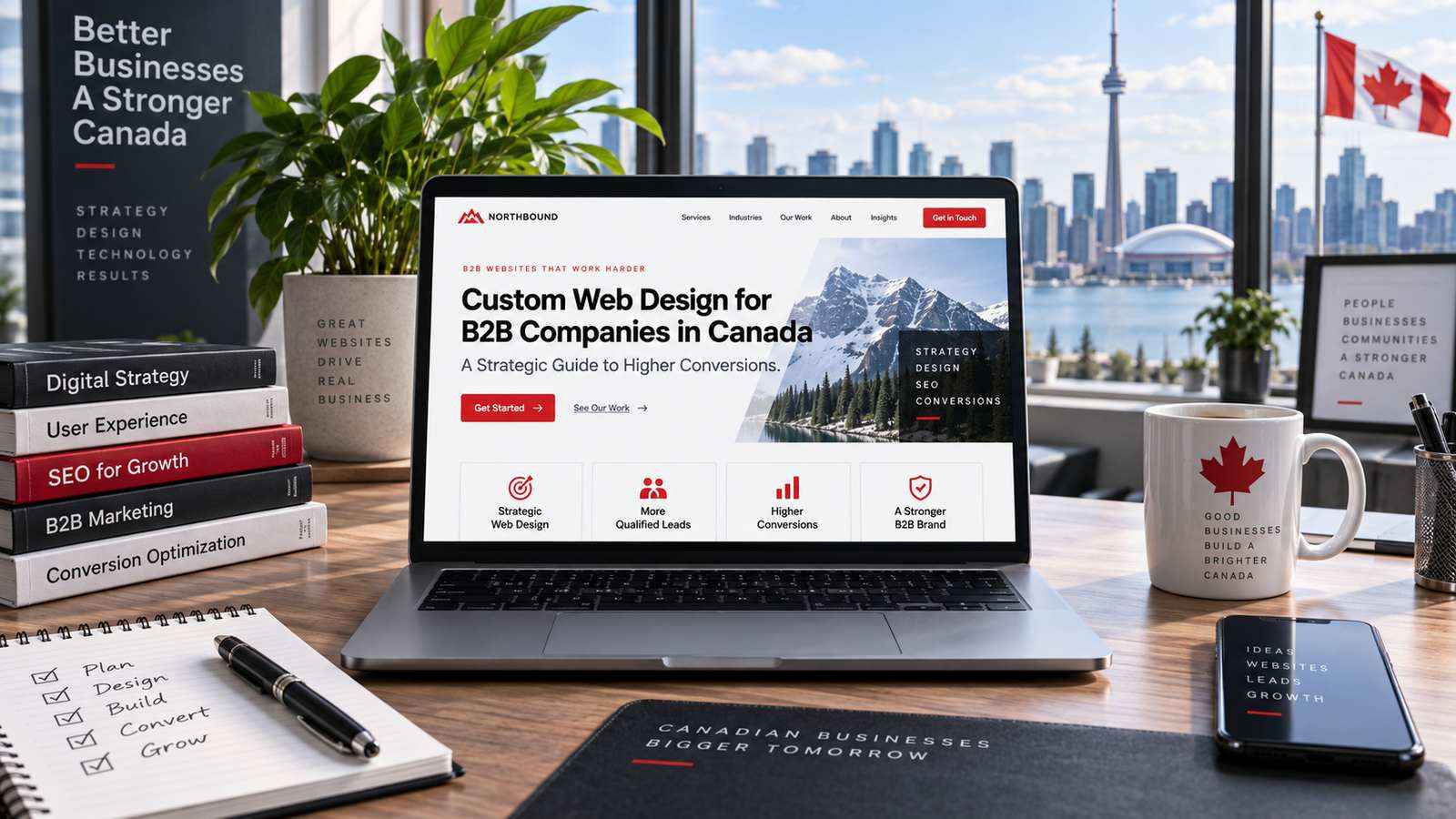
Custom Web Design for B2B Companies in Canada: A Strategic Guide to Higher Conversions

Why Canadian B2B Companies Need Custom Web Design
Canadian B2B firms operate in a uniquely layered marketplace. Unlike consumer e-commerce, where a generic layout might suffice, business buyers expect a digital presence that reflects technical competence, regulatory awareness, and cultural nuance. The challenge intensifies when you consider Canada’s official bilingualism, the proximity of the U.S. market, and industry-specific procurement standards. A website built from a template may look professional at first glance, but it rarely accommodates the depth of trust-building required for high-value contracts. Custom web design for B2B companies in Canada is not a luxury—it is a strategic necessity for converting informed, risk-averse buyers.
The Limitations of Template-Based Websites for B2B
Templates are engineered for speed and cost-efficiency, not for complex sales cycles. For a Canadian B2B company, this mismatch creates several concrete problems:
- Bilingual rigidity: Most templates are designed for single-language content. French and English versions often break layout symmetry, causing text overflow or awkward spacing. Custom design allows for parallel content structures that respect both languages equally.
- Shallow trust signals: Templates rely on generic icons and stock imagery. Canadian B2B buyers—whether in manufacturing, logistics, or clean tech—need to see proprietary certifications (e.g., CSA Group, CWB welding standards), provincial compliance notices, and case studies with local references. Custom layouts can prioritize these elements without clutter.
- Cross-border friction: Many Canadian firms export to the U.S. or import from it. A template’s default currency, measurement units, or legal disclaimers often reflect American assumptions. Custom design can segment content by audience (e.g., Canadian visitors vs. U.S. buyers) while maintaining a cohesive brand voice.
- Poor scalability: As your product line expands or you enter new provincial markets, a template forces you to squeeze new content into fixed modules. Custom builds allow for modular expansion that matches your actual service architecture.
Understanding the Canadian B2B Buyer’s Journey
The Canadian B2B buyer is not a single persona. A procurement manager in Ontario may prioritize Ontario’s Workplace Safety and Insurance Board (WSIB) compliance, while a Quebec-based buyer expects French-language technical documentation before any sales call. The journey typically involves three distinct phases:
- Problem identification: The buyer searches for solutions using industry-specific terms, often in both official languages. A custom design allows for keyword-optimized landing pages that mirror these search patterns.
- Vendor evaluation: Canadian buyers frequently compare vendors across borders. They look for evidence of local service support, bilingual account management, and familiarity with Canadian supply chain regulations (e.g., customs duties, GST/HST handling). Custom web design can feature interactive maps, downloadable compliance sheets, and side-by-side comparison tables that templates cannot support elegantly.
- Risk mitigation: Final decisions involve legal and financial review. The website must provide clear, persistent access to privacy policies (PIPEDA compliance), terms of service, and secure portals for document exchange. Custom design ensures these elements are integrated into the user flow rather than buried in a footer.
How Custom Design Aligns with Business Goals and Brand Identity
Your website is not a brochure; it is a conversion engine. For a Canadian B2B firm, business goals often include increasing qualified leads from specific provinces, shortening sales cycles, or establishing thought leadership in a niche like sustainable resource extraction. Custom web design directly supports these objectives through:
| Business Goal | Custom Design Feature | Why It Works |
|---|---|---|
| Generate leads from Quebec | Dedicated French microsite with localized case studies | Builds immediate cultural credibility and avoids translation errors |
| Build authority in industrial safety | Dynamic resource library with filterable white papers and videos | Demonstrates depth without overwhelming the homepage |
| Support a multi-region sales team | Personalized content blocks based on visitor geolocation | Shows regional offices and provincial certifications first |
Brand identity for Canadian B2B companies often hinges on reliability, transparency, and a commitment to local communities. Custom design allows you to express these values through typography, imagery, and interaction patterns that a template cannot replicate. For example, a custom-built timeline of your company’s Canadian history or a live feed of your participation in local industry associations adds authenticity. Moreover, custom code ensures faster load times, better accessibility (key for public-sector contracts), and seamless integration with CRM systems like HubSpot or Salesforce—all of which directly impact conversion rates. When your design mirrors your operational reality, buyers perceive your firm as a partner, not just a vendor.
Key Differences Between B2B and B2C Web Design
B2B web design in Canada cannot borrow the playbook of consumer e-commerce. A B2C site thrives on emotional triggers, impulse-driven “Add to Cart” buttons, and streamlined visual storytelling. In contrast, a B2B buyer is not a single person making a quick decision—they are part of a procurement committee that evaluates risk, ROI, and long-term compatibility. Custom web design for B2B companies in Canada must therefore shift from persuasion to evidence-based guidance, structuring every page to serve a months-long research process rather than a five-minute session.
Designing for Multiple Stakeholders and Longer Sales Cycles
Your website must accommodate at least three distinct personas: the end-user who cares about daily usability, the technical evaluator who digs into specifications, and the financial decision-maker who compares total cost of ownership. A generic template fails because it forces all three into the same linear path. Custom design allows you to create separate entry points—for example, a “For Engineers” section with data sheets and a “For Executives” section with ROI calculators—while still maintaining a consistent navigation structure.
Longer sales cycles also mean your site must function as a persistent reference tool. Consider implementing a “Resource Library” with downloadable PDFs that require a simple form. Each page should include a sticky sidebar showing the user’s position in the cycle (e.g., “Stage 2: Evaluation”), but only if that information is dynamically tracked. At the very least, custom design lets you add a “Save to My Briefcase” feature, allowing stakeholders to collect pages and share them internally. This turns your site from a passive brochure into a collaborative workspace.
Prioritizing Lead Capture Over Impulse Purchases
B2C sites push for immediate checkout. B2B sites must push for qualified contact—a lead that can be nurtured over weeks. Every high-value page (product specs, pricing tiers, case studies) should have a contextual call-to-action that is not a “Buy Now” button but a “Talk to an Expert” or “Download the Technical Brief” link. Custom design enables you to place these CTAs without disrupting deep reading, using expandable panels or end-of-section prompts instead of intrusive pop-ups.
You also need progressive profiling. Instead of a long form on first visit, ask only for an email to access one asset. On the next visit, after a cookie or tracking parameter identifies the user, request their company size. This incremental data collection respects the user’s time and yields higher conversion rates. A custom backend can integrate with your CRM to assign lead scores based on pages visited—something no off-the-shelf theme can do effectively.
Building Authority with Technical Content and Case Studies
B2B buyers in Canada are notoriously skeptical of marketing fluff. They want proof that your product works in their industry, climate, and regulatory environment. Custom design allows you to present technical content in a scannable, hierarchical manner:
- Product data sheets with collapsible sections for full specifications, not just bullet points.
- Interactive comparison tables that let users filter by attributes like power output or compliance certifications.
- Case study templates that include a “Challenge/Solution/Result” structure, with links to the actual client’s website (with permission).
For each case study, include a sidebar with downloadable metrics—not just “increased efficiency” but “reduced downtime by 23% over six months.” Use a table to show before-and-after performance:
| Metric | Before | After Custom Solution |
|---|---|---|
| Order processing time | 4.2 days | 1.1 days |
| Client support tickets | 37/month | 12/month |
| On-time delivery rate | 88% | 97% |
Finally, technical content must be versioned and searchable. Custom design lets you build a faceted search that filters by industry, application, or product line—something a blog-style theme cannot handle. When a stakeholder revisits your site two weeks later, they should be able to find the same PDF through a saved bookmark or a “Recent Downloads” section. This persistence builds the trust that ultimately shortens the sales cycle, turning your custom website into a silent, always-available sales engineer.
Essential Features of a High-Converting B2B Website
For Canadian B2B companies, a website is not a digital brochure—it is a sales engine. Generic templates fail to address the long sales cycles, multiple stakeholders, and technical due diligence that define B2B purchasing. Custom Web Design for B2B Companies in Canada ensures every pixel supports a single objective: moving a qualified visitor toward a measurable business action. Below are the structural pillars that separate high-performing sites from passive online presences.
Clear Calls-to-Action and Conversion Pathways
B2B buyers rarely purchase on first contact. They research, compare, and evaluate. Your website must therefore offer distinct, purposeful calls-to-action (CTAs) at each stage of their journey. A single “Contact Us” button is insufficient. Instead, deploy a tiered CTA strategy:
- Top-of-funnel CTAs: “Download the 2025 Canadian Supply Chain Report” or “Watch a 3-Minute Platform Demo” capture interest without commitment.
- Mid-funnel CTAs: “Book a Technical Consultation with an Engineer” or “Request a Custom ROI Calculator” signal deeper intent.
- Bottom-funnel CTAs: “Start a Pilot Project” or “Speak to Sales About Enterprise Licensing” must appear on product pages, case studies, and pricing sections.
Custom design allows you to map these CTAs to specific content. For example, a logistics firm serving Ontario manufacturers might place a “Compare Freight Rates” tool directly beside a white paper on cross-border compliance. Each CTA must be visually distinct, repeated with moderation, and paired with minimal form fields—only company name, work email, and industry. Avoid generic “Submit” buttons; use action verbs that promise value.
Trust Signals: Certifications, Testimonials, and Case Studies
Canadian B2B buyers, particularly in regulated sectors like energy, healthcare, and finance, require proof of competence before sharing contact details. Trust signals must be embedded natively, not relegated to a footer. Critical elements include:
- Industry certifications (ISO 9001, SOC 2, CMMI, or provincial-specific licenses like Quebec’s RBQ for construction)
- Verifiable client logos with permission, ideally segmented by sector
- Video testimonials from named executives (not anonymous “clients”)
- Detailed case studies with measurable outcomes: “Reduced procurement cycle by 22% for a Calgary oilfield services firm”
- Third-party review badges (G2, Clutch, or Google Ratings) with live update dates
A custom design can weave these signals into the user flow. For instance, a certification badge can appear next to a security-related product feature, while a case study PDF preview loads on the same page as a service description. Avoid carousels that auto-rotate; static, strategically placed testimonials outperform rotating sliders because users can read them at their own pace.
Mobile Responsiveness and Performance Optimization
Canadian B2B decision-makers often review websites on tablets during travel or on smartphones between meetings. A non-responsive site is an immediate disqualifier. However, responsive design alone is not enough—performance is equally critical. Use this comparison to guide your technical priorities:
| Feature | Standard Template Approach | Custom Design Approach for B2B |
|---|---|---|
| Mobile layout | Collapses columns, hides secondary content | Reorders content to prioritize CTAs and trust badges; keeps full case study navigation |
| Image handling | Compresses all images uniformly | Uses next-gen formats (WebP) with context-aware compression (e.g., technical diagrams remain sharp) |
| Load time target | Under 3 seconds on fiber | Under 2 seconds on 4G LTE for key landing pages; tests on mid-range Android devices |
| Resource loading | Loads all scripts globally | Defers non-critical JavaScript until after user interaction; preloads hero and CTA assets |
Performance optimization also extends to server response times. For Canadian companies serving domestic clients, hosting content on Canadian servers (e.g., in Toronto or Montreal) reduces latency. Custom design allows you to implement lazy loading for below-the-fold case study images, while keeping above-the-fold text visible instantly. Use browser caching to shorten repeat visit times—a returning client who has already downloaded a spec sheet should experience near-instantaneous navigation.
Finally, integrate custom design with accessibility standards (WCAG 2.1 AA) to ensure that keyboard navigation and screen readers function flawlessly—this is both a legal consideration under Canadian provincial accessibility laws (like the AODA in Ontario) and a practical conversion factor, since accessible sites often rank better and serve a wider audience. The result is a seamless, fast, and trustworthy experience that guides every visitor toward a qualified conversation.
How Custom Design Enhances User Experience (UX) for B2B Buyers
B2B purchasing decisions in Canada are rarely impulsive. They involve multiple stakeholders, lengthy evaluation cycles, and a need for precise technical or pricing information. A generic template often fails because it forces buyers to dig for critical details, creating friction. Custom web design for B2B companies in Canada addresses this by building every layout decision around how procurement teams, engineers, and C-suite executives actually scan and process content. The result is a seamless path from first visit to a qualified lead or demo request.
Structuring Complex Information for Easy Scanning
B2B websites are dense with product specs, case studies, compliance documents, and industry data. Without deliberate hierarchy, this becomes a wall of text that drives bounce rates upward. Custom design allows you to chunk information into digestible modules, using visual weight to signal importance. Key principles include:
- Progressive disclosure: Show summary-level data first, then expandable sections for deep technical details.
- Visual anchors: Use icons, callout boxes, and numbered steps to break up paragraphs.
- Consistent labeling: Reuse the same terminology across pages (e.g., “Industries Served” never becomes “Sectors”) to reduce cognitive load.
For example, a custom layout might place a product’s top three differentiators in bold at the top, followed by a comparison table that collapses on mobile. This lets a busy logistics manager scan in 15 seconds while still allowing an engineer to expand full API documentation. The structure itself guides the buyer’s eye, making complex offerings feel orderly and credible.
Creating Intuitive Navigation That Guides Users to Key Pages
B2B sites often suffer from “everything in the menu” syndrome. Custom design solves this by prioritizing conversion-focused pathways over generic browsing. Instead of a flat list of services, you can implement:
- Role-based menus: Segments like “For Procurement” or “For IT Directors” that lead to tailored content.
- Breadcrumb trails with purpose: Show the buyer exactly where they are in a solution journey (e.g., Home > Solutions > Supply Chain > Real-Time Tracking).
- Sticky utility bar: Keep “Request a Quote” or “Talk to an Expert” visible after scrolling past 600 pixels.
A custom navigation model might use a mega-menu that groups products by industry challenge rather than product name. This reduces the number of clicks from three to one for high-value pages like white papers or ROI calculators. More importantly, it minimizes dead ends—pages that offer no next step. Every nav element is tested against a task list (e.g., “Find compliance certifications,” “Download a spec sheet”), ensuring users never feel lost.
Personalization and Dynamic Content for Returning Visitors
B2B buyers often return multiple times before making contact. A static homepage wastes these repeat visits. Custom design enables dynamic content blocks that change based on session behavior or known firmographics. Practical implementations include:
- Industry-aware landing sections: If a visitor arrives from a LinkedIn post about manufacturing, the homepage highlights your manufacturing case studies.
- Recently viewed items: Show “Last viewed: Integration Guide” with a link back to that resource, reducing search friction.
- Progressive profiling forms: On a second visit, ask fewer questions and pre-fill fields from the first interaction.
For returning visitors from the same company IP, you might swap generic hero text for a province-specific compliance note (e.g., Ontario’s accessibility requirements). This personalization is not about gimmicks—it demonstrates that you understand their context, which builds trust. In practice, a simple JavaScript snippet can track a session variable and alter a call-to-action label:
// Example: Change CTA text for returning session visitors
if (sessionStorage.getItem('b2b_returning') === 'true') {
  document.querySelector('.cta-primary').textContent = 'Download Updated Specs';
} else {
  sessionStorage.setItem('b2b_returning', 'true');
}
By reducing redundant searching and showing relevant content immediately, custom design lowers bounce rates and increases average time on page. Buyers feel understood rather than overwhelmed, which directly supports higher conversion rates for Canadian B2B firms.
SEO Benefits of Custom Web Design for Canadian B2B Companies
For Canadian B2B firms, a custom website is not merely a digital brochure—it is a conversion engine. Unlike template-based designs, custom builds give you full control over every technical element that search engines evaluate. This translates directly into higher rankings, more qualified traffic, and ultimately, more sales leads from Canadian buyers who are actively searching for your services.
Technical SEO Foundations: Clean Code and Site Speed
Search engines reward websites that are easy to crawl and fast to load. A custom web design allows your development team to write semantic, lightweight HTML5 and CSS that eliminates redundant code, unused JavaScript, and bulky plugins commonly found in pre-built themes. This clean code ensures that Googlebot can index your content efficiently without getting lost in irrelevant markup.
Site speed is a confirmed ranking factor and a critical user experience metric. Canadian B2B decision-makers expect pages to load in under two seconds, especially when researching complex solutions on mobile devices. Custom builds let you implement advanced performance techniques that are difficult to achieve with off-the-shelf templates:
- Image optimization: Serve next-gen formats like WebP with automatic compression and lazy loading for below-the-fold visuals.
- Server-side caching: Configure edge caching via a CDN with points in Toronto, Vancouver, and Montreal to reduce latency for regional users.
- Minified resources: Strip unnecessary characters from CSS, HTML, and JavaScript files to reduce page weight by up to 40%.
- Database query optimization: Write efficient SQL queries that prevent bottlenecks when your catalogue or case-study library grows.
Additionally, custom designs allow you to implement structured data (schema markup) precisely. For B2B, this means marking up your product specifications, customer reviews, and FAQ sections. Rich snippets can display star ratings or answer boxes directly in Canadian search results, increasing your click-through rate without additional ad spend.
Structuring URLs and Content for Target Keywords
A custom architecture gives you the freedom to design a logical URL hierarchy that mirrors your sales funnel. Instead of generic strings like /page?id=123, you can create clean, descriptive paths that include your primary keywords. For example:
/industrial-automation/control-systems/for a manufacturer in Ontario/logistics-software/fleet-tracking/for a SaaS provider in Alberta/professional-services/compliance-audits/for a consulting firm in Quebec
This structure communicates relevance to search engines and helps users understand where they are in your site. More importantly, a custom CMS allows you to control XML sitemaps, canonical tags, and pagination rules without plugin conflicts. You can also build dedicated landing pages for each service line or geographic market, each with a unique meta title, H1, and body copy targeting specific long-tail keywords like “custom web design for B2B companies in Canada” or “industrial supplier website optimization in Calgary.”
Content siloing becomes straightforward: you can group related blog posts, whitepapers, and case studies under topic clusters that pass authority to your core service pages. This internal linking strategy is far more effective when you control the template hierarchy, rather than forcing content into a rigid blog layout.
Local SEO Strategies for Regional Canadian Markets
Canadian B2B purchasing often happens regionally—a mining company in Sudbury needs different logistics than a tech firm in Kitchener-Waterloo. Custom web design enables you to build geo-targeted content that resonates with local searchers and satisfies Google’s local pack algorithms.
Start by creating dedicated pages for each city or province you serve. These pages should include:
- Embedded Google Maps with your physical office or showroom location
- Local phone numbers with area codes (e.g., 416 for Toronto, 604 for Vancouver)
- Testimonials from clients in that specific region
- Mentions of local industry events, associations, or supply chain partners
Schema markup can be extended with LocalBusiness or ProfessionalService structured data, including your business hours, service radius, and accepted payment methods. This helps search engines associate your site with a specific geographic area, improving your visibility for queries like “industrial equipment supplier near Edmonton” or “B2B marketing agency in Halifax.”
Furthermore, a custom site allows you to implement hreflang tags correctly if you serve both English and French markets. For example, you can target en-CA for Ontario and fr-CA for Quebec without duplicating content penalties. You can also generate localized sitemaps that submit each regional page to Google Search Console separately, giving you granular performance data.
Finally, custom designs make it easier to earn high-quality backlinks from local Canadian business directories, chambers of commerce, and industry publications. When those links point to region-specific pages with unique content, they carry more authority than if they all pointed to a generic homepage. This layered approach—technical cleanliness, keyword-focused architecture, and regional relevance—creates a compounding SEO effect that template sites cannot replicate.
Integrating Marketing Automation and CRM with Custom Design
For B2B companies in Canada, a custom website is not merely a digital brochure—it is the central nervous system of your revenue operations. Off-the-shelf templates force your sales and marketing teams to adapt to rigid structures, often creating data silos where lead intelligence disappears. A custom design, however, is built with your specific CRM (like HubSpot, Salesforce, or Pipedrive) and marketing automation platform (such as Marketo or ActiveCampaign) as foundational architecture. This allows every click, form submission, and content download to flow directly into a unified system, triggering actions that move prospects through the funnel without manual intervention.
Connecting Your Website to CRM for Lead Tracking
Standard contact forms only capture basic details. Custom development enables deep tracking through hidden fields, UTM parameter capture, and behavioral event tracking. When a visitor from a Canadian enterprise downloads a whitepaper on compliance regulations, your website can automatically record:
- Source attribution: Which LinkedIn ad, Google search, or referral partner drove the visit
- Engagement depth: Pages viewed, time on key resources, and repeated visits
- Firmographic data: IP-based company identification (e.g., Shopify, RBC, or Bombardier) before they even fill out a form
For a practical implementation, consider server-side tracking to avoid ad-blocker interference. A simple webhook example using JavaScript to push a lead to your CRM endpoint would look like this:
fetch('https://yourcrm.com/api/leads', {
  method: 'POST',
  headers: { 'Content-Type': 'application/json' },
  body: JSON.stringify({
    email: userEmail,
    company: detectedCompany,
    score: calculateLeadScore(sessionData),
    source: getUTMParameter('campaign')
  })
});
This ensures that every lead carries context—not just a name and email—enabling your Canadian sales team to prioritize follow-ups based on real buying signals.
Automating Lead Nurturing with Personalized Content
Once the CRM knows a prospect’s industry (e.g., manufacturing in Ontario vs. tech in BC) and their stage of awareness, custom design allows dynamic content swapping. Instead of sending generic email blasts, your website can trigger personalized sequences:
- Trigger-based emails: A visitor who views your pricing page three times but doesn’t convert receives a case study from a similar Canadian company within 24 hours.
- Smart content blocks: Returning visitors see tailored testimonials from their sector, not a generic homepage.
- Progressive profiling: Forms hide already-known fields and ask for the next most valuable piece of information (e.g., budget range or project timeline).
This automation respects the longer B2B sales cycle—often 6 to 12 months in Canada—by nurturing leads with relevant, non-pushy content until they are sales-ready. A custom design ensures that your email templates and landing pages share the same visual language, reinforcing trust and consistency across every touchpoint.
Using Analytics to Refine Marketing Strategies
Custom integration turns raw analytics into actionable intelligence. By connecting your CRM data with your website’s analytics (Google Analytics 4, Matomo, or a custom dashboard), you can answer questions that off-the-shelf setups cannot:
| Metric | What Custom Integration Reveals | Strategic Action |
|---|---|---|
| Lead-to-close rate by source | Which channels produce high-quality Canadian leads, not just traffic | Shift ad spend to top-performing regions or industries |
| Content engagement vs. sales cycle stage | Which resources accelerate deals and which cause drop-off | Create more of what works; retire ineffective content |
| Time-to-follow-up | Correlation between response speed and win probability | Set automated alerts for high-scoring leads within minutes |
For example, if analytics show that Quebec-based manufacturing leads that download a ROI calculator close 40% faster, you can build a dedicated landing page for that segment and automate a follow-up sequence with a French-language version. Without a custom connection between your website, CRM, and analytics tool, this level of granularity remains impossible—leaving your Canadian competitors to capture the demand you cannot see.
The Custom Web Design Process: From Discovery to Launch
A custom web design project for a B2B company in Canada is not a linear sprint but a structured, collaborative journey. Unlike template-based builds, a bespoke process ensures every decision—from navigation structure to call-to-action placement—is rooted in your specific business goals, your buyers’ research habits, and your competitive landscape. While timelines vary based on scope, most projects follow a disciplined lifecycle that balances strategy, creativity, and technical rigor. Here is what you can expect at each critical stage, and why your active participation is non-negotiable for a high-converting result.
Discovery Phase: Defining Goals, Audience, and Brand
The discovery phase is the foundation. It is not about aesthetics yet; it is about aligning stakeholders on the “why” behind the redesign. This typically involves a series of workshops and interviews with your sales, marketing, and leadership teams. Your project lead will audit your existing analytics, CRM data, and customer feedback to answer three core questions:
- What specific conversion actions matter? (e.g., demo requests, quote downloads, or direct phone calls)
- Who are the distinct buyer personas? (e.g., the technical evaluator vs. the economic buyer) and what are their pain points?
- What brand assets and messaging differentiators exist that must be amplified, not diluted?
The output of this phase is a comprehensive strategy document that includes a sitemap, content inventory, and a prioritized feature list. Crucially, this is where you define your value proposition in plain language. Without this stage, you risk building a beautiful site that fails to speak to Canadian B2B procurement cycles, compliance needs, or regional industry nuances.
UX Strategy and Wireframing for B2B User Flows
Once goals are locked, the UX strategist maps out how a visitor moves from landing page to lead. For B2B, user flows are rarely linear; they often involve multiple visits, research deep-dives, and comparison with competitors. Wireframing is the low-fidelity blueprint where we test these flows before any visual design begins. Key activities in this phase include:
- User flow mapping: Defining paths for different personas (e.g., a procurement officer looking for a spec sheet vs. a C-suite executive seeking case studies).
- Low-fidelity wireframes: Structuring content hierarchy, form fields, and navigation without colors or fonts.
- Interaction design: Planning for sticky CTAs, chatbot triggers, or gated content placement.
- Accessibility and compliance review: Ensuring WCAG 2.1 AA standards and Canadian privacy considerations (e.g., PIPEDA) are baked into the architecture.
Your role here is to challenge assumptions. Review wireframes with your sales team—they know the exact objections your website must preempt. This iterative feedback loop prevents costly revisions later.
Development, QA, and Launch Best Practices
With approved wireframes and a defined visual style (typography, color palette, and component library), the project transitions to development. This stage is where custom functionality, such as a resource library with advanced filtering or a quote calculator, is built. To ensure a smooth launch, follow these best practices:
- Staging environment testing: Never test on a live server. Use a staging site to check cross-browser compatibility, mobile responsiveness, and page speed (target under 2.5 seconds on mobile).
- Content entry early: Do not wait for development to finish to write copy. Enter all final text and meta descriptions into a CMS before QA begins.
- User acceptance testing (UAT): Assign a non-technical stakeholder from your team to click through every form, dropdown, and PDF download. They will spot usability issues developers miss.
- Redirect mapping: Create a 301 redirect map from every old URL to the new one. This preserves SEO equity and prevents broken links for bookmarked pages.
Launch day is not the finish line. Plan for a post-launch support window of at least two weeks to monitor analytics, fix any edge-case bugs, and review conversion heatmaps. A collaborative process—where stakeholders remain engaged from discovery to go-live—invariably produces a website that not only looks distinctive but performs as a measurable sales asset for your Canadian B2B operation.
Budgeting and ROI for Custom B2B Web Design in Canada
Investing in a custom website is a capital decision, not an expense. For Canadian B2B firms, where sales cycles are long and trust is paramount, the website must function as your best salesperson. However, the cost can vary widely from Vancouver to Halifax. Below is a realistic framework to help you budget effectively and measure the return on that investment.
Understanding the Cost Breakdown of Custom Design
A custom build is not a single line item. Your budget should account for four distinct phases, each with its own Canadian market rates. Expect to pay a premium for senior talent and agencies in major hubs like Toronto or Calgary.
- Discovery & UX Strategy (10–15% of budget): Includes stakeholder interviews, user journey mapping, and content architecture. This phase prevents costly redesigns later.
- Visual Design & Prototyping (20–25%): Custom layouts, interactive prototypes, and brand-specific UI kits. For B2B, this must prioritize clarity over flash.
- Development & CMS Integration (45–55%): Front-end coding, back-end integration with your CRM (e.g., HubSpot, Salesforce), and secure hosting setup. Custom modules for quoting or client portals add hours here.
- Content Creation & Migration (10–15%): Professional copywriting, technical whitepaper formatting, and video production. This is often underestimated.
Ongoing maintenance is separate. Budget 15–20% of the original build cost annually for security updates, plugin patches, and minor feature tweaks. In Canada, a mid-range custom B2B site typically starts at $40,000 CAD and can exceed $150,000 for complex integrations.
Measuring ROI: Key Metrics for B2B Websites
Unlike e-commerce, you cannot measure ROI by cart abandonment alone. For B2B, focus on these three proxies for revenue:
- Conversion Rate (Lead Form Submissions): Track the percentage of visitors who fill out a “Request a Quote” or “Book a Demo” form. A custom site should lift this from a 1–2% baseline to 3–5% by removing friction and aligning content with buyer intent.
- Lead Quality (SQL Rate): Use UTM parameters and CRM integration to score leads. Are you attracting procurement managers or students? A higher percentage of Sales Qualified Leads (SQLs) means your design is filtering out tire-kickers.
- Customer Lifetime Value (CLV): Compare the CLV of leads acquired pre- and post-redesign. If your new site enables a self-service resource library that nurtures accounts, your average contract value should rise.
Long-Term Value vs. Short-Term Savings of Template Sites
Template sites (e.g., $5,000–$15,000 themes) seem attractive. However, they force your sales narrative into a generic mold. Consider the operational trade-offs:
| Factor | Custom Design (Canada) | Premium Template (Canada) |
|---|---|---|
| Initial cost (CAD) | $50,000–$120,000 | $8,000–$20,000 |
| Time to launch | 12–20 weeks | 4–8 weeks |
| SEO flexibility | Full schema & technical control | Limited by theme’s code structure |
| CRM/ERP integration | Built to your exact API needs | Requires paid plugins or custom hacks |
| Scalability for new features | Modular, no debt | Often requires full rebuild at year 3 |
| Annual maintenance | $7,500–$15,000 | $2,000–$5,000 (but higher risk) |
| Typical lead conversion lift | +50% to +100% | +10% to +20% |
The math is clear when you factor in your sales cycle. If a single enterprise contract is worth $100,000 in annual recurring revenue, converting just one extra lead per quarter pays for the entire custom build. A template may save you $40,000 upfront, but it will cost you in lost differentiation, slower load times (Google Core Web Vitals), and the inability to personalize content for key verticals like oil & gas or healthcare. For a Canadian B2B firm looking to dominate a niche, the custom route is not a luxury—it is the most predictable path to predictable revenue.
Choosing the Right Custom Web Design Partner in Canada
Selecting a web design partner for your B2B company in Canada is not a vendor procurement exercise; it is a strategic decision that directly impacts lead generation, pipeline velocity, and long-term revenue. The right partner understands that your website is a sales asset, not a digital brochure. They must combine technical craftsmanship with a deep grasp of the Canadian business landscape—including bilingual considerations, regional industry clusters, and compliance norms like PIPEDA and CASL. Below is a focused framework to evaluate agencies and freelancers, with practical criteria designed to separate strategic partners from order-takers.
Evaluating Portfolios for B2B Expertise
A portfolio reveals more than aesthetic taste; it exposes the depth of strategic thinking applied to complex buyer journeys. When reviewing candidate portfolios, do not simply skim homepage screenshots. Instead, examine case studies that demonstrate measurable outcomes, such as increased demo requests or reduced bounce rates on pricing pages. Look for evidence of:
- B2B-specific UX patterns: Does the work show clear paths for multiple buyer personas, technical documentation hubs, or ROI calculators? Consumer e-commerce layouts do not translate to high-consideration B2B purchases.
- Content architecture for long sales cycles: Strong B2B sites feature resource libraries, gated content flows, and integration with marketing automation (e.g., HubSpot, Marketo). A portfolio should show how design supports lead nurturing.
- Canadian market nuances: Look for French-language versions that are not literal translations but culturally adapted messaging. Also, check if designs reference Canadian industry regulations (e.g., CSA standards, provincial procurement rules) or regional case studies (e.g., Alberta energy, Ontario manufacturing).
- Technical depth: Ask to see performance budgets, accessibility audits (WCAG 2.1 AA), and how they handle multilingual URL structures or hosting within Canada for data residency.
If a portfolio contains only static mockups without traffic or conversion data, treat it as an incomplete signal. Request a walkthrough of one project’s logic: How did they map user intent to page hierarchy? What A/B tests informed the final layout? The answers reveal whether design decisions are data-driven or purely subjective.
Questions to Ask Before Hiring a Design Partner
Before signing a contract, conduct a structured discovery call. Use these questions to probe beyond surface-level capability:
- “How do you handle stakeholder interviews across different Canadian provinces or language groups?” A partner with local experience will have a process for synthesizing input from sales, engineering, and executive teams while respecting regional market differences.
- “What is your approach to designing for lead generation versus brand awareness?” The answer should include specific tactics: prominent form placements, chat widgets, or gated asset design—not vague statements about “modern looks.”
- “Can you provide a reference from a B2B client in a similar industry or sales cycle length?” Ask the reference how the partner handled post-launch iterations and whether they delivered conversion rate improvements.
- “How do you integrate with our existing CRM and marketing stack?” Technical fluency here is non-negotiable. A partner who cannot articulate API endpoints or webhook triggers will create handoff friction.
- “What is your process for compliance with Canadian privacy laws?” Specifically, ask about form consent mechanisms under CASL and data storage practices for PIPEDA. A weak answer is a dealbreaker.
Document their responses verbatim. Later, compare them against your internal priorities—if they cannot explain how design supports your sales cycle length (e.g., 60-90 days), they likely lack B2B maturity.
Red Flags: Lack of Strategy, Poor Communication, or Cookie-Cutter Approaches
Several warning signs should immediately disqualify a candidate, regardless of portfolio polish:
- Strategy-free pitches: If the proposal focuses on color schemes, fonts, or “trendy animations” without mentioning conversion goals, user research, or content strategy, walk away. B2B web design requires a documented hypothesis about what drives a prospect to request a quote.
- Poor communication patterns: During the sales process, note response times and clarity. If they take three days to answer a technical question or provide vague estimates (“approximately 6-8 weeks”), expect the same chaos during project delivery. Insist on a named project manager and a written communication cadence.
- Cookie-cutter templates disguised as custom work: Ask directly: “Will you build from a blank canvas or adapt a pre-built theme?” While using component libraries is efficient, a true custom partner will create bespoke layouts for your buyer personas. Red flags include offering identical homepage structures to their past clients or refusing to show you the underlying codebase for review.
- Lack of post-launch support: A partner who disappears after launch leaves you vulnerable. Insist on a documented maintenance plan, including security updates, plugin patches, and performance monitoring—especially if you operate in a regulated sector like finance or healthcare.
As a practical test, request a short technical audit of your current site. A competent partner will quickly identify issues like unoptimized hero images slowing load times or missing schema markup for product pages. For example, they might suggest adding structured data to your service pages to enhance search visibility:
<script type="application/ld+json">
{
  "@context": "https://schema.org",
  "@type": "Service",
  "name": "Industrial Automation Consulting",
  "provider": {
    "@type": "Organization",
    "name": "Your Company",
    "areaServed": "CA"
  },
  "hasOfferCatalog": {
    "@type": "OfferCatalog",
    "name": "Consulting Services",
    "itemListElement": [
      {
        "@type": "Offer",
        "itemOffered": {
          "@type": "Service",
          "name": "PLC Programming"
        }
      }
    ]
  }
}
</script>
If a candidate cannot articulate why such technical elements matter for B2B lead quality, they are likely a visual designer, not a strategic partner. Choose someone who treats your website as a revenue engine, not an art project.
Future-Proofing Your B2B Website with Custom Design
In the fast-evolving Canadian B2B landscape, a website that merely looks good today can become a liability tomorrow. Custom web design offers a distinct advantage over rigid template-based solutions: it is built with your long-term business strategy in mind. Rather than forcing your operations into predefined constraints, a bespoke approach creates a digital foundation that adapts as your company grows, your product lines expand, and your customers’ expectations shift. The goal is not just to launch a site, but to maintain a platform that continuously supports higher conversions for years to come.
Scalable Architecture for Growing Product Lines or Services
Canadian B2B companies often diversify their offerings—adding new service tiers, entering adjacent markets, or launching bilingual content for English and French audiences. A custom content architecture allows you to plan for this expansion from day one. Unlike off-the-shelf themes that require hacks or plugins to accommodate new structures, custom design uses modular components that can be reused, reordered, or extended without disrupting the user experience.
- Modular page builders: Create flexible layouts for new case studies, whitepapers, or product categories without redesigning the entire site.
- Advanced taxonomy: Structure your content to support complex filtering by industry, region, or solution type—essential for multi-sector Canadian firms.
- API-ready foundations: Build endpoints that allow future integrations with ERPs, CRMs, or inventory systems as your operational needs evolve.
- Multi-language readiness: Design with character expansion and translation workflow in mind, avoiding costly retrofits for French-Canadian markets.
This scalability ensures that adding a new service line doesn’t require a full redesign. Instead, you simply plug new modules into your existing framework, preserving your SEO equity and user familiarity while reducing time-to-market.
Integrating AI Chatbots and Personalization Tools
Custom design is the only reliable pathway to seamlessly integrate emerging technologies like AI-driven chatbots and deep personalization. Template sites often treat these tools as afterthoughts, bolted on via third-party widgets that clash with your brand and slow down your page speed. A custom build, however, places data architecture at the core, enabling your site to learn from visitor behavior and respond in real time.
| Capability | Template Approach | Custom Design Approach |
|---|---|---|
| AI chatbot training | Limited to generic FAQ responses | Trained on your product specs, pricing, and Canadian compliance terms |
| Content personalization | Basic location or device detection | Dynamic recommendations based on firmographic data, past downloads, and session intent |
| Lead scoring | Static forms, no behavioural tracking | Real-time scoring that routes hot leads to sales automatically |
| Integration depth | Requires workarounds | Native APIs for your existing marketing stack |
For example, a custom chatbot can be programmed to understand industry-specific jargon like “OEM parts” or “supply chain logistics,” then pass qualified conversations directly to your CRM. Meanwhile, personalization rules can show different content to a first-time visitor from Alberta versus a returning procurement manager from Ontario—all without sacrificing load time or accessibility.
Regular Maintenance and Continuous Improvement Strategies
Future-proofing is not a one-time event; it is an ongoing discipline. A custom-built website requires a structured maintenance plan that goes beyond security patches. This includes quarterly performance audits, conversion rate reviews, and iterative updates based on user analytics. Without this commitment, even the best architecture will stagnate.
- Monthly technical checks: Monitor uptime, broken links, and core web vitals to maintain search rankings.
- Quarterly content refreshes: Update product information, team pages, and industry resources to reflect your latest capabilities.
- Annual UX review: Conduct heatmap analysis and user testing to identify friction points in your lead generation funnel.
- Proactive security updates: Custom code requires vigilant monitoring for vulnerabilities, especially if you handle sensitive B2B data.
By pairing a flexible custom architecture with a dedicated improvement roadmap, your Canadian B2B website becomes a compounding asset—one that not only converts more visitors today but also adapts effortlessly to the technologies and market conditions of tomorrow. Investing in this approach means you are never locked into yesterday’s limitations, and your digital presence remains a strategic driver of revenue growth.
Frequently Asked Questions
Why is custom web design better than using templates for B2B companies in Canada?
Custom web design allows B2B companies to tailor user journeys to specific buyer personas, integrate complex functionalities like quote systems or client portals, and ensure brand consistency across all touchpoints. Templates often come with unnecessary code, slowing down your site and harming SEO. For Canadian B2B firms, custom design can also address bilingual needs (English/French) and regional compliance. A custom approach ultimately improves user experience, which directly correlates with higher conversion rates and better search engine rankings.
How does custom web design impact conversion rates for B2B businesses?
Custom web design focuses on creating clear calls-to-action, streamlined navigation, and trust signals such as case studies and certifications. By removing distractions and aligning design with your sales funnel, custom sites guide visitors toward desired actions like requesting a quote or downloading a whitepaper. Research shows that a well-designed user interface could raise conversion rates by up to 200%. For B2B, where sales cycles are longer, an optimized design helps nurture leads effectively, leading to higher conversion rates over time.
What are the key elements of a high-converting B2B website design?
Key elements include: (1) clear value proposition above the fold, (2) prominent and repeated calls-to-action, (3) social proof like testimonials and logos, (4) easy access to case studies and white papers, (5) intuitive navigation with descriptive labels, (6) fast loading times and mobile responsiveness, (7) lead-capture forms with minimal fields, and (8) live chat or chatbot support. For Canadian B2B, consider including bilingual options and trust badges from recognized industry associations. Each element should work together to reduce friction and guide visitors toward conversion.
How does custom web design support SEO for B2B companies?
Custom web design allows for clean, semantic HTML, optimized page structure, and fast load times—all factors Google considers for ranking. You can also implement schema markup for products, services, and FAQs, which helps search engines understand your content. Custom design enables you to create unique, relevant content for each page, targeting long-tail keywords that B2B buyers use. Additionally, you can optimize for local SEO if you target specific Canadian regions. A well-designed site also improves user engagement metrics like bounce rate and dwell time, indirectly boosting SEO.
What is the typical cost and timeline for custom B2B web design in Canada?
Costs vary widely based on complexity, features, and agency location. A basic custom B2B site might range from $10,000 to $30,000 CAD, while more complex builds with integrations can exceed $100,000. Timeline typically spans 3 to 6 months from discovery to launch, depending on content readiness and client feedback. Remember, custom design is an investment; a higher upfront cost can lead to better conversion rates and ROI. Always request a detailed proposal to understand what’s included.
How can custom web design address bilingual needs for Canadian B2B audiences?
Canada has two official languages, and many B2B buyers expect to interact in their preferred language. Custom web design allows you to implement a robust multilingual strategy, including URL structure (e.g., /fr/), hreflang tags for search engines, and a language switcher that’s intuitive. You can also design layouts that accommodate longer French text without breaking design. This level of personalization builds trust and widens your reach, potentially increasing conversions among French-speaking decision-makers in Quebec and other regions.
What are common mistakes to avoid in B2B web design?
Common mistakes include: (1) focusing on aesthetics over usability, (2) using jargon-heavy copy without clear explanations, (3) hiding contact information or making it hard to reach a human, (4) having too many form fields that deter leads, (5) neglecting mobile optimization, (6) ignoring page speed, and (7) not integrating analytics to track conversions. For Canadian B2B, also avoid overlooking regional compliance (e.g., PIPEDA) and accessibility standards (AODA). A user-centered design avoids these pitfalls and ensures your site works as a sales tool.
How does custom web design integrate with CRM and marketing automation?
Custom web design allows for seamless integration with your CRM (e.g., Salesforce, HubSpot) and marketing automation tools. You can design custom forms that push leads directly into your CRM, track user behavior to score leads, and create personalized experiences based on visitor data. This integration ensures that no lead is lost and that your sales team has the context they need. For B2B, this is critical because it enables efficient follow-up and nurturing, which directly impacts conversion rates and ROI.
Sources and further reading
- Statistics on Website Conversion Rates
- Web Design and Conversion Optimization – Stanford Guidelines
- B2B Marketing Insights – Content Marketing Institute
- Google Search Central: SEO Starter Guide
- Nielsen Norman Group: Web Usability
- Canadian Internet Registration Authority (CIRA) – Internet Use in Canada
- Statistics Canada: E-commerce and Digital Economy
- Office of the Privacy Commissioner of Canada – PIPEDA
- W3C Web Accessibility Initiative (WAI)
- HubSpot – B2B Marketing and Web Design Research
Need help with this topic?
Send us your details and we will contact you.



Comment (1)
Pingback: WordPress Web Design Cost in Canada: 2025 Guide