

Introduction: Why Custom Web Design Matters for Toronto Businesses
Your website is often the first handshake a potential customer has with your brand. In a dense, fast-moving market like Toronto, that handshake must feel confident, relevant, and distinctly yours. A generic, template-based site might get you online quickly, but it rarely gets you remembered. Custom web design is not about aesthetics alone—it is a strategic investment that aligns your digital presence with your operational goals, your local audience, and the specific realities of competing in one of North America’s most vibrant business ecosystems.
The Competitive Toronto Digital Landscape
Toronto is home to over 200,000 businesses, from financial services in the Financial District to retail in Queen West, tech startups in Liberty Village, and professional practices in Yorkville. Your customers are not just comparing you to the business next door; they are comparing you to global brands, slick direct-to-consumer startups, and established players with multi-million-dollar marketing budgets. In this environment, a website that looks like a modified template from a stock library signals a lack of care. Worse, it fails to address local search behaviour: Torontonians search for “plumber near Yonge and Eglinton,” “best vegan bakery in Leslieville,” or “lawyer for small business in Scarborough.” A custom build allows you to structure content, schema, and navigation around these hyper-local queries, improving visibility where it matters most—your immediate service area.
Custom vs. Template: Key Differences and Benefits
The gap between custom and template design is not just visual; it is operational. Consider the following comparison:
| Aspect | Template-Based Design | Custom Web Design |
|---|---|---|
| Unique branding | Limited to pre-set layouts and fonts | Fully tailored to your logo, voice, and colour psychology |
| Page speed | Often bloated with unused plugins and code | Optimized for performance, with only necessary elements |
| Scalability | Difficult to adapt as your offerings grow | Built with future features and integrations in mind |
| SEO control | Restricted by theme’s coding structure | Clean, semantic HTML and custom metadata for local search |
| Maintenance cost | Lower upfront, higher long-term due to patches | Higher upfront, but predictable and modular upkeep |
Beyond technical specs, custom design offers three practical benefits for Toronto businesses:
- Authentic user journeys: Map your unique services—such as condo staging, immigration consulting, or restaurant reservations—to custom calls-to-action and forms, rather than forcing them into a generic “contact us” box.
- Accessibility compliance: Toronto has a large and diverse population, including seniors and newcomers. Custom coding allows you to meet WCAG 2.1 standards from the ground up, not as an afterthought.
- Integration readiness: Whether you need a booking engine for a clinic or a real-time inventory feed for a boutique, custom development ensures seamless API connections without hacks.
How Custom Design Aligns with Business Goals
A custom website is not a decorative expense; it is a conversion tool. For a Toronto law firm, that might mean a secure client portal and clear practice-area pages that reduce phone calls for basic questions. For a restaurant group, it could mean a multilingual menu system and a location finder for your three downtown venues. For a construction company, it might be a project portfolio with before-and-after sliders that load instantly on mobile—since over 60% of local searches happen on phones. The strategic advantage is that every element—from the hero headline to the footer navigation—is decided based on your sales cycle, customer pain points, and competitive positioning. You are not inheriting someone else’s assumptions about your market; you are building a digital storefront that answers the exact questions your Toronto clients ask, in the tone they expect, with the speed they demand.
Ultimately, custom web design is a deliberate choice to treat your online presence as a long-term asset rather than a temporary placeholder. In a city where reputation moves quickly, that choice often separates the businesses that are merely visible from those that are truly remembered.
Defining Custom Web Design: Scope and Core Components
In Toronto’s competitive digital landscape, “custom web design” is often used loosely, but it means far more than a unique colour palette or a bespoke homepage layout. A truly custom build is architected from the ground up to serve your specific business logic, user base, and operational workflows—not adapted from a pre-existing template. This approach affects every layer of the project, from the visual language to the underlying codebase and third-party system connections. Understanding the true scope of a custom project helps you set realistic expectations for timeline, budget, and the level of collaboration required with your design and development partners.
Bespoke Visual Design and Branding
Bespoke visual design goes beyond selecting a font and a hero image. It involves creating a unique interface that translates your brand’s personality into a functional digital environment. This process starts with a deep audit of your existing brand assets—logos, colour systems, typography, and tone of voice—and then extends those elements into new territories: iconography, micro-interactions, spacing rules, and component states (hover, active, error). Unlike a theme-based site, where design choices are constrained by the template’s predefined options, a custom design allows you to craft a visual hierarchy that prioritises your most valuable content and guides users intuitively. For Toronto businesses, this often means reflecting local sensibilities—whether that’s a clean, corporate aesthetic for a financial services firm or a more vibrant, editorial style for a creative agency—without being locked into a generic “one-size-fits-all” look.
Custom Functionality and Integrations
Functionality is where custom web design moves from aesthetics into operational efficiency. Off-the-shelf plugins can handle basic needs like contact forms or simple blogs, but complex business requirements demand tailored solutions. Common examples for Toronto-based companies include:
- Booking systems that sync with your staff’s calendars and send automated reminders via SMS or email.
- Custom dashboards that display real-time inventory, client data, or project statuses in a format your team actually uses.
- Payment gateways integrated with Canadian processors (e.g., Stripe, Moneris) and configured for multi-currency or tax-specific calculations.
- CRM and ERP connections that push web form submissions directly into HubSpot, Salesforce, or Microsoft Dynamics without manual data entry.
These integrations require backend development work—writing API calls, handling authentication, and mapping data fields. For example, a simple API integration to fetch a product price might look like this in a PHP environment:
// Fetch product data from a custom endpoint
$response = wp_remote_get('https://api.yourstore.com/products/123');
if (is_wp_error($response)) {
    error_log('API call failed: ' . $response->get_error_message());
} else {
    $product = json_decode(wp_get_response_body($response), true);
    echo 'Price: $' . number_format($product['price'], 2);
}
This level of customisation ensures your website does not just look good—it actively reduces manual work and minimises errors in your daily operations.
The Role of UX Strategy in Custom Builds
UX strategy is the invisible framework that determines whether your custom site converts visitors or loses them. In a custom project, UX is not an afterthought; it is a research-driven discipline that starts with user personas, journey mapping, and usability testing. For example, a Toronto law firm might discover through user interviews that potential clients prefer a simplified “Ask a Question” form over a phone call—so the UX strategy would prioritise that form’s placement and reduce its fields to just three. Similarly, an e-commerce brand might use A/B testing to determine whether a sticky “Add to Cart” button increases mobile conversions. A custom build allows you to implement these findings precisely, without being constrained by a template’s fixed layout. The result is a site that feels intuitive to your specific audience, reducing bounce rates and increasing time-on-page, which directly impacts your search engine performance and bottom line. Importantly, UX strategy also encompasses content hierarchy and accessibility (WCAG compliance), ensuring that your custom design is not only beautiful but also usable for every visitor, including those with disabilities—a legal and ethical consideration that is increasingly relevant in Ontario.
Strategic Planning: The Foundation of a Successful Custom Website
In Toronto’s competitive digital landscape, a custom website is only as effective as the strategy that precedes it. Jumping directly into visual design or development without a defined plan often results in a site that looks polished but fails to convert visitors, rank well, or serve business objectives. Strategic planning is the phase where you align your business goals with user needs, market realities, and measurable outcomes. This upfront investment—typically 2–4 weeks of discovery and analysis—dramatically reduces costly revisions later and ensures your custom build delivers a clear return on investment.
Audience Research and Persona Development
Understanding who your website serves is the first non-negotiable step. Toronto is a diverse, multi-ethnic market with distinct neighbourhood-level behaviours, so generic assumptions about your audience will underperform. Audience research involves gathering both quantitative data (analytics, demographic reports) and qualitative insights (surveys, user interviews). From this data, you develop 2–4 detailed buyer personas that include:
- Demographics: Age, income, occupation, family status, and location (e.g., downtown condo dweller vs. suburban homeowner).
- Pain points: Specific frustrations your product or service solves, such as “I need same-day service near Yonge and Eglinton.”
- Digital behaviour: Preferred devices, browsing times, and channels (e.g., Instagram-heavy vs. Google Search–driven).
- Decision triggers: What prompts them to buy—reviews, price transparency, or local credibility.
Personas are not static documents. They guide content tone, information architecture, call-to-action placement, and even visual hierarchy. For example, a Toronto law firm targeting first-time homebuyers will need a simpler, more reassuring interface than one targeting corporate legal teams. Without persona clarity, you risk designing for yourself rather than for the people who actually pay your bills.
Competitor Analysis and Market Positioning
Toronto’s business ecosystem is dense—from Bay Street financial services to Queen West creative agencies—so standing out requires a clear-eyed view of your rivals. Competitor analysis goes beyond glancing at their homepage. You should audit their website structure, content depth, keyword targeting, page speed, and user experience. A practical framework involves selecting 3–5 direct competitors and evaluating them on specific criteria:
| Evaluation Criteria | What to Assess | Why It Matters |
|---|---|---|
| Content & messaging | Tone, value proposition clarity, blog depth | Reveals gaps you can exploit with stronger positioning |
| Technical performance | Mobile responsiveness, load time, Core Web Vitals | Identifies opportunities to outperform on user experience |
| SEO & keyword focus | Title tags, headings, local SEO (e.g., “best plumber in Etobicoke”) | Shows which search terms are underserved or highly competitive |
| Conversion paths | Forms, chat widgets, booking flows, CTAs | Highlights friction points you can avoid or improve |
| Visual identity | Layout patterns, colour schemes, typography | Helps you differentiate without alienating your target audience |
This analysis informs your market positioning—the specific niche or promise you own. For instance, if every competitor offers generic “24/7 support,” you might position yourself as the only provider with a dedicated Toronto-based team and transparent flat-rate pricing. Your custom design then reinforces that positioning through imagery, copy, and interactive elements, rather than merely matching industry templates.
Setting Measurable Goals and KPIs
Strategic planning concludes with defining what success looks like. Vague objectives like “increase traffic” are insufficient. Instead, establish SMART goals—specific, measurable, achievable, relevant, and time-bound—tied to your business model. Common KPIs for a custom website include:
- Conversion rate: Percentage of visitors completing a desired action (form submission, purchase, phone call).
- Bounce rate: Share of users leaving after one page; high rates signal poor relevance or slow loading.
- Average session duration: Time spent on site, indicating content engagement.
- Lead quality score: For B2B sites, the proportion of qualified inquiries from your primary personas.
- Page speed: Core Web Vitals thresholds (LCP under 2.5 seconds, CLS under 0.1) directly impact SEO and user retention.
Set baseline metrics before redesign so you can measure post-launch improvements. For example, if your current contact form converts at 1.5%, a realistic goal might be 3% within six months. These KPIs are then embedded into your analytics setup, heatmapping tools, and A/B testing plan. Crucially, they also guide design decisions—a page designed to drive phone calls will prioritise a persistent click-to-call button, while a lead-generation page focuses on form length and trust signals. By locking goals upfront, every design choice becomes deliberate rather than aesthetic preference.
Ultimately, strategic planning transforms custom web design from a cost centre into a competitive asset. Toronto businesses that invest in research, competitive intelligence, and measurable objectives consistently outperform those that treat the website as a digital brochure. The result is a site that not only looks distinctive but also earns its keep through higher conversions, stronger search visibility, and a clearer brand identity in a crowded market.
The Custom Design Process: Step-by-Step from Discovery to Launch
A custom web design project in Toronto follows a structured journey, but the exact path depends on your goals, timeline, and the agency you choose. Understanding the phases below will help you prepare, allocate resources, and avoid surprises. Expect to be an active participant—not a passive observer—throughout the process.
Discovery and Requirements Gathering
This first phase is the most critical, yet it is often rushed. Your design partner will conduct stakeholder interviews, audit your existing website (if any), and analyze your competitors. The goal is to define the project’s scope, target audience, and success metrics. You will be asked to provide brand guidelines, content assets, and access to analytics tools.
During this stage, expect to answer questions like:
- Who are your primary user personas, and what tasks must they complete?
- Which pages or features are non-negotiable for launch?
- What is your budget range for design, development, and ongoing maintenance?
- Who approves content and design decisions on your side?
The output is a project brief or a requirements document. This document acts as your contract’s technical appendix. Review it line by line—ambiguity here leads to change orders later. A common pitfall is skipping technical requirements (e.g., CRM integrations, multilingual support) because they feel “back-end.” Flag them now.
Wireframing, Prototyping, and Visual Design
Once requirements are locked, the design team moves into low-fidelity wireframes—simple black-and-white layouts that map content hierarchy and user flow. These are not meant to be pretty; they are meant to be logical. You will review wireframes for navigation structure and placement of key conversion elements (e.g., contact forms, phone numbers, calls-to-action).
After wireframes are approved, the team builds a clickable prototype (often in Figma or Adobe XD). This prototype simulates the user experience without real code. You should test it with actual users or at least with colleagues who fit your persona. Changes at this stage cost 10x less than after development begins.
Visual design follows, adding typography, colour palettes, imagery, and motion. You will receive a style guide that documents your brand’s digital rules. For a Toronto business, ensure the design accounts for local nuances—for example, bilingual (English/French) copy lengths if you serve federal clients, or accessibility standards per the Accessibility for Ontarians with Disabilities Act (AODA).
Development, Testing, and Launch
With approved designs, developers convert static screens into a functional website. They will set up a staging environment (a private URL) where you can see progress. Expect iterative sprints—typically weekly demos where you give feedback on live functionality, not design tweaks. This is where technical decisions become visible: page speed, mobile responsiveness, and content management system (CMS) usability.
Testing is rigorous but often underestimated. A professional team will run cross-browser checks, performance audits, and security scans. For a custom build, you should also request a basic code quality review. Here is a practical example of what a developer might run to check for common issues:
# Check for broken internal links on a staging site
wget --spider --force-html --recursive --level=1 https://staging.yoursite.com 2>&1 | grep -i "404"
This command crawls your staging URL and flags any 404 errors—a simple but effective pre-launch check. Do not skip user acceptance testing (UAT): you and your team should click through every form, menu, and checkout flow on real devices.
Launch day involves DNS migration, SSL certificate installation, and a final content sweep. After launch, plan for a 30-day hyper-care period where the agency monitors uptime, fixes bugs, and trains your staff. A custom design is not a one-time deliverable—it is the start of an ongoing relationship.
Cost Breakdown: How Custom Web Design Pricing Works in Toronto
Investing in a custom website in Toronto is not a one-size-fits-all expense. Unlike template-based sites with flat fees, custom design pricing reflects the specific strategy, architecture, and development effort required for your business. To avoid surprises, it helps to understand the three main cost drivers, realistic market ranges, and the recurring expenses that follow launch.
Factors Influencing Cost (Complexity, Features, Team)
Your final quote is determined by how much bespoke work is involved. The following factors carry the most weight:
- Scope and complexity: A five-page marketing site with a contact form costs far less than a 30-page e-commerce platform with product filters, user accounts, and a booking system. Each custom page layout and interactive element requires additional design and coding hours.
- Feature set: Custom integrations (CRM, payment gateways, third-party APIs), membership portals, multilingual support, or advanced search functionality all add significant development time. Off-the-shelf plugins are cheaper, but true custom features increase the budget.
- Team composition and seniority: Toronto agencies typically assign a project manager, UX designer, visual designer, and front-end/back-end developers. Senior-level specialists command higher hourly rates (often $120–$200 CAD/hour), while freelancers may offer lower rates but with less built-in project management and quality assurance.
- Content and visual assets: If you need professional copywriting, custom photography, videography, or custom iconography, those production costs are separate from the design and development quote.
- Timeline and revisions: Rush projects with tight deadlines often incur premium charges. Similarly, unlimited revision rounds can inflate costs, so confirm the number of included feedback cycles before signing.
Typical Price Ranges for Toronto Custom Websites
While every project is unique, the Toronto market generally falls into these ranges for custom work (excluding taxes and ongoing fees):
| Project Type | Typical Range (CAD) | What’s Included |
|---|---|---|
| Small business brochure site (5–10 pages) | $5,000 – $12,000 | Custom homepage and inner page templates, responsive layout, basic CMS, contact form, on-page SEO setup. |
| Corporate or lead-generation site (10–20 pages) | $12,000 – $25,000 | Advanced custom layouts, blog/news sections, multi-step forms, integrations (e.g., Mailchimp, Salesforce), more thorough user testing. |
| E-commerce or web application (20+ pages) | $25,000 – $60,000+ | Product database design, custom cart and checkout, payment gateways, user dashboards, custom admin panels, security hardening. |
These figures assume a reputable Toronto agency or senior freelancer. Lower quotes often indicate template-based work or hidden costs for plugins and third-party services.
Ongoing Costs: Maintenance, Hosting, and Updates
Your initial design fee is just the start. Budget for recurring expenses to keep your site secure, fast, and functional:
- Hosting and domain: Managed WordPress or custom cloud hosting in Canada typically costs $25–$150/month, depending on traffic and performance needs. Domain renewal is roughly $20–$40/year.
- Maintenance retainers: Most Toronto agencies offer monthly plans ($75–$300/month) covering core updates, security patches, daily backups, uptime monitoring, and minor bug fixes. Without this, you risk vulnerabilities and downtime.
- Content updates: If you don’t manage updates in-house, hourly rates for minor text changes, new pages, or image swaps run $50–$100/hour. Some firms sell prepaid hour blocks.
- Plugin and software licenses: Premium plugins, SSL certificates, and third-party tools (e.g., form builders, analytics) can add $200–$1,000/year.
When comparing quotes, ask what ongoing support is included for the first 30–90 days after launch. A slightly higher upfront cost that includes post-launch fixes and training often saves you money in the long run.
What to Expect: Timelines, Deliverables, and Team Roles
A custom web design in Toronto is not a one-week sprint. Unlike template-based builds, a bespoke project follows a structured lifecycle, typically spanning 10 to 16 weeks from discovery to launch. The variance depends on scope, content readiness, and the number of revision rounds. Below is a realistic breakdown so you can plan resources, budget, and internal communication without surprise delays.
Average Project Timelines and Milestones
Most custom builds divide into four phases, each with a clear approval gate. A typical timeline for a mid-sized business site (10–20 pages) looks like this:
- Weeks 1–2: Discovery & Strategy — Stakeholder interviews, competitor audit, sitemap, and content inventory. You approve the wireframe structure.
- Weeks 3–5: Visual Design — Two homepage concepts are presented, followed by one refined direction applied to key inner pages. You sign off on the style guide.
- Weeks 6–10: Development & Content Integration — Front-end build, CMS setup, responsive testing, and SEO basics. Content is entered by your team or the agency.
- Weeks 11–14: QA, Revisions & Launch — Cross-browser checks, performance optimization, user acceptance testing (UAT), and final deployment. Post-launch support runs for 30 days.
If you need e-commerce, a custom booking system, or third-party API integrations, add 3–5 weeks to the development phase. Factor in a 2-week buffer for content delays—this is the most common cause of slippage.
Key Deliverables at Each Phase
You should never pay for “vague progress.” Each milestone produces tangible assets that you own. Here is what to expect:
| Phase | Deliverables |
|---|---|
| Discovery | UX strategy document, sitemap, user flow diagrams, wireframes (low-fidelity) |
| Design | High-fidelity mockups, interactive prototype (Figma), style token sheet (colors, fonts, spacing) |
| Development | Staging site URL, version-controlled code repository, CMS training video, content migration checklist |
| Launch | Production URL, SSL certificate setup, 404 redirect map, analytics dashboard, post-launch support ticket |
For a practical example, during the development phase, you might receive a command to pull the local build for review. If your developer uses a Git-based workflow, a typical handoff instruction would be:
git clone https://staging.yourproject.com/repo.git
cd yourproject
npm install
npm run dev
This allows you to preview the site locally before it goes live. If that command looks foreign, your project manager should provide a one-click staging link instead—do not accept a dev-only environment without a user-friendly preview.
Roles: Designers, Developers, Project Managers, and Strategists
A custom project is a team sport. Each role has distinct responsibilities, and you should know who to contact for what:
- Strategist — Owns the research phase, defines user personas, and sets measurable goals (e.g., conversion paths). They are less involved after design starts but should review final QA against the original strategy.
- UX/UI Designer — Creates wireframes, visual mockups, and interactive prototypes. They handle usability, accessibility contrast, and responsive behaviour. You will work closely with them during weeks 3–5.
- Developer (Front-end & Back-end) — Translates designs into HTML/CSS/JavaScript, integrates the CMS, and handles database architecture. They rarely speak to you directly—feedback flows through the PM to avoid scope creep.
- Project Manager (PM) — Your primary point of contact. They manage the timeline, coordinate revisions, run weekly status calls, and flag risks. If you have a request, send it to the PM, not the designer or developer.
In smaller Toronto agencies, one person may wear two hats (e.g., a designer who also writes front-end code). Confirm this before signing—a combined role can save money but may slow down revision cycles if that individual falls ill or takes vacation.
Finally, expect a single point of accountability: your PM should provide a written revision log after each approval gate. If you do not receive one, ask for it. This prevents “I thought we changed that” disputes at launch.
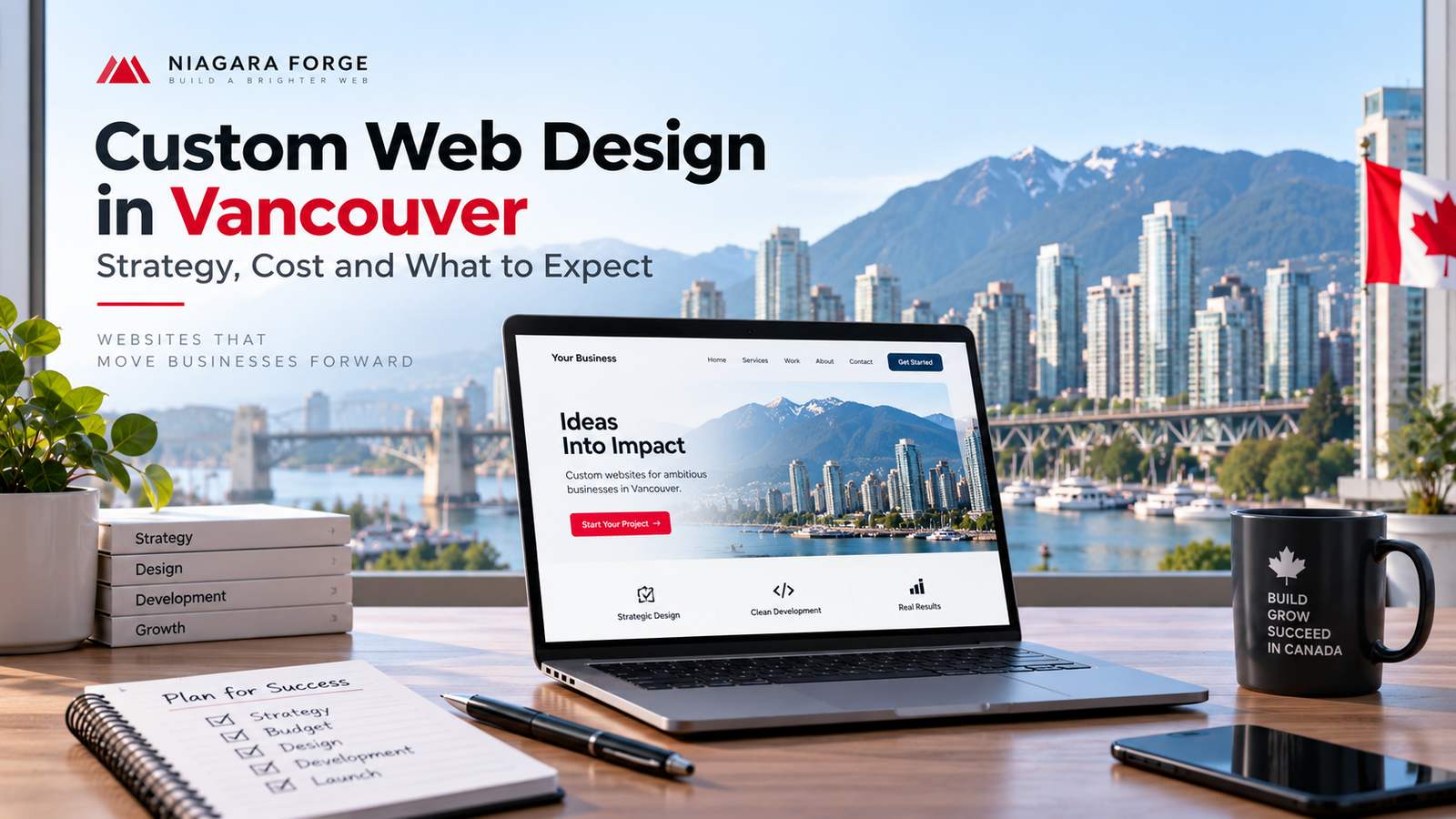
Custom Web Design in Toronto: Strategy, Cost and What to Expect
In Toronto’s competitive digital landscape, a custom website is not merely a digital brochure—it is a conversion engine. The most effective custom designs are built on a foundation where content strategy and search engine optimization (SEO) are not afterthoughts but integral components of the design blueprint. This integration ensures that every pixel serves a purpose, both for the human user and for search engine crawlers. When your design agency aligns visual storytelling with technical and editorial best practices, the result is a site that ranks well, engages deeply, and drives measurable business outcomes.
Content-First Design and Information Architecture
Before a single wireframe is drawn, your content must be audited, structured, and prioritized. A content-first approach means that the design layout is dictated by the message hierarchy, not the other way around. In practice, this involves mapping user journeys: What questions does a Toronto homeowner, a startup founder, or a healthcare professional have before converting? The information architecture (IA) then organizes this content into logical, scannable clusters.
- Keyword-driven page hierarchy: Primary service pages target high-intent keywords, while supporting blog posts or resource hubs capture long-tail queries.
- Clear navigation paths: No more than three clicks to any critical conversion point (e.g., quote request, contact form).
- Content inventory: Every existing page is evaluated for relevance, duplication, and gap opportunities before being migrated or rewritten.
This stage directly impacts cost—comprehensive IA workshops and content mapping are more labour-intensive than template-based builds, but they prevent costly redesigns within 18 months.
On-Page SEO Fundamentals for Custom Sites
Custom design allows you to code for clarity, not compromise. On-page SEO begins with semantic HTML5 elements (header, nav, main, footer) that help search engines understand the role of each block. However, the true differentiator lies in how your design team handles content variables:
- Unique title tags and meta descriptions: Each custom template includes dynamic fields, so a service page for “custom web design in Toronto” is never duplicated across neighbourhood sub-pages.
- Strategic header hierarchy (H1-H4): The design system enforces a single H1 per page, with H2s and H3s used for supporting topics—this prevents accidental keyword cannibalization.
- Image optimization: Custom design includes automated alt-text fields, lazy loading, and correct file naming (e.g., custom-web-design-toronto.jpg) rather than generic IMG_2045.jpg.
- Internal linking architecture: Modular content blocks (e.g., “Related Services” or “Recent Case Studies”) are designed as part of the template, ensuring every page naturally links to 3-5 other relevant pages.
Because the design is bespoke, you can also prioritize content above the fold—placing your primary value proposition and call-to-action within the first 600 pixels, which improves both user engagement and click-through rates from search results.
Technical SEO: Speed, Mobile, and Schema
Toronto users expect sub-2-second load times, and Google’s Core Web Vitals are non-negotiable. Custom design gives you full control over the technical stack, unlike page builders that inject excessive JavaScript. Key technical integrations during the build phase include:
- Speed optimization: Code is minified, images are served in WebP format, and critical CSS is inlined. Your agency should test on 4G and 5G networks—not just fibre—to simulate real Toronto commuter usage.
- Mobile-first responsiveness: Custom breakpoints are designed for actual devices (iPhone SE, Android tablets), not generic viewport widths. Touch targets are at least 48×48 pixels, and forms are thumb-friendly.
- Schema markup: Structured data is added at the template level. For a Toronto business, this means LocalBusiness schema, reviews, and service-area markup so that Google can display rich snippets with your phone number, address, and ratings.
- Canonical and redirect management: During the design migration, every old URL is 301-mapped to its new counterpart, preserving link equity and preventing 404 errors that hurt rankings.
In practice, this technical layer adds approximately 10-15% to the initial design cost, but it reduces ongoing maintenance and ad spend by improving organic visibility. A custom site that loads quickly, passes Core Web Vitals, and clearly signals its content hierarchy to search engines will outperform a generic template from day one—making the integration of SEO and design not just a best practice, but a strategic investment with measurable ROI.
User Experience (UX) and Conversion Optimization in Custom Design
In Toronto’s competitive digital landscape, a visually striking website is not enough. Custom web design shifts the focus from generic templates to a strategic framework where every pixel serves a purpose: guiding visitors toward a desired action. Unlike pre-built themes, which often force your content into rigid layouts, custom design begins with user behavior data, business objectives, and local market nuances. The result is an interface that reduces friction, builds trust, and systematically increases conversion rates—turning traffic into measurable revenue.
Designing for User Intent and Journey Mapping
Intent-driven design starts before a single wireframe is drawn. You must identify the primary reasons Toronto users visit your site—whether comparing service providers, checking product availability, or seeking immediate contact. Journey mapping then plots the emotional and practical steps a user takes from first click to final conversion. For custom builds, this means:
- Segmented entry points: Homepage, service pages, and blog content each address different intents, so navigation and internal linking adapt accordingly.
- Contextual content hierarchy: A user researching “custom web design Toronto” needs portfolio proof and case studies before a pricing page, whereas a returning client needs a direct login or support link.
- Localized trust signals: Include Toronto-specific testimonials, neighbourhood references, or industry association badges at decision points in the journey.
Custom design allows you to prioritize these elements based on actual scroll depth and click heatmaps, not guesswork. For example, a legal firm might discover that users who read a “How We Bill” section convert 40% better—so that section moves above the fold in the custom layout.
Conversion Rate Optimization (CRO) Strategies
CRO in custom design is not about adding pop-ups; it is about engineering a seamless path to action. Key strategies implemented at the code and layout level include:
- Single primary call-to-action (CTA) per viewport: Reduce choice paralysis. A custom layout can hide secondary links on mobile and emphasize one high-contrast button.
- Sticky, context-aware CTAs: For long service pages, a floating “Book a Free Consultation” button appears only after the user scrolls past the first two sections, avoiding early interruption.
- Form optimization: Custom fields remove unnecessary inputs (e.g., phone number optional for first contact) and use inline validation with specific error messages, cutting form abandonment by up to 20% in many B2B cases.
- Trust-building microcopy: Reassuring text near CTAs—”No retainers required,” “Response within 2 business hours”—is placed dynamically based on the user’s referral source.
These tactics rely on custom back-end logic that A/B testing tools can modify without redesigning the whole page. For instance, a Toronto e-commerce store might test two different checkout button placements; custom design makes this a simple CSS variable change, not a developer overhaul.
Testing and Iteration for Continuous Improvement
A custom website is never “finished.” Post-launch, you enter a cycle of hypothesis-driven testing. Unlike template sites where structural changes are risky, custom code allows for rapid experimentation. The process typically involves:
- Quantitative analysis: Heatmaps, session recordings, and funnel drop-off reports identify where users hesitate.
- Qualitative feedback: On-site polls (“Did you find what you needed?”) or user interviews with Toronto-based customers reveal emotional blockers.
- Prioritized experiments: Focus on high-impact, low-effort changes first—headline rewriting, CTA color contrast, or image compression—rather than full-page redesigns.
- Statistical validation: Run each test until it reaches 95% confidence, then document learnings for the next iteration.
Below is a practical comparison of how custom design differs from template-based approaches in key conversion-related areas:
| Factor | Custom Web Design | Template-Based Design |
|---|---|---|
| User journey flexibility | Fully mapped to your specific sales funnel and audience segments | Limited to pre-set page structures and navigation patterns |
| CTA placement control | Pixel-level positioning with dynamic visibility rules | Constrained by theme’s grid and widget areas |
| A/B testing speed | Rapid changes via modular code components | Often requires plugin conflicts or theme child overrides |
| Trust element integration | Native embedding of reviews, certifications, and local cues | Must rely on third-party widgets that may slow load time |
| Iteration cost (per test) | Lower after initial build, due to clean code architecture | Higher due to workarounds and compatibility patches |
Ultimately, custom design’s real advantage is its capacity to learn. Every click, hover, and form submission feeds into a refinement loop that aligns the site with Toronto users’ evolving expectations. The initial investment in strategy and development pays off through reduced bounce rates, higher engagement, and a clear return on ad spend—because the website itself becomes a conversion engine, not just a digital brochure.
Choosing the Right Custom Web Design Partner in Toronto
Selecting a partner for custom web design in Toronto is a decision that shapes your digital presence for years. The city hosts hundreds of agencies and independent freelancers, each with distinct workflows and strengths. A structured evaluation process—based on evidence, not pitch decks—will separate capable teams from those that overpromise and underdeliver. Below is a practical framework for vetting candidates, with a focus on transparency, technical depth, and long-term reliability.
Portfolio and Case Study Evaluation
Do not judge a portfolio by visual appeal alone. Instead, ask for three case studies that match your project’s complexity (e.g., e-commerce, membership portals, or multi-location service sites). For each case, verify the following:
- Business context: Did the design solve a stated problem (e.g., reduced bounce rate, higher conversion), or is the write-up purely aesthetic?
- Your role vs. theirs: Clarify whether the partner handled strategy, copywriting, and development, or only the visual layer. A custom design is worthless if the underlying code is a template with new colours.
- Technical stack: Look for evidence of custom post types, bespoke plugins, or headless integrations. For example, a proper custom build might include a filterable resource library with a custom REST API endpoint—not just a standard blog.
- Performance metrics: Ask for load-time benchmarks before and after launch, plus Core Web Vitals scores. A polished mockup that fails Lighthouse’s 4-second mobile threshold is not a successful project.
A simple test: request a live URL and open the page inspector. If the CSS class names are generic (e.g., col-md-6 from a page builder), the “custom” work is likely skin-deep. A genuinely bespoke build will show project-specific naming conventions and structured data markup.
Questions to Ask Before Hiring
Your discovery call should be a two-way interrogation. Beyond budget, ask these five questions verbatim:
- “Who writes the final copy, and how many revision rounds are included?” Many Toronto agencies outsource content, leading to tone mismatches.
- “Do you provide a staging environment before launch?” If the answer is no, walk away—testing on a live site is amateur.
- “What is your change-request process after the first month?” Understand hourly rates for post-launch tweaks, not just the initial package.
- “How do you handle third-party integrations (e.g., CRM, payment gateways) that fail mid-project?” Look for a written SLA on debugging time.
- “Can you show me a project where you recommended a simpler solution than requested?” A partner who pushes back on unnecessary features saves you money and future headaches.
Red Flags and Best Practices for Collaboration
Toronto’s competitive market means some firms prioritize sales volume over delivery quality. Watch for these warning signs:
| Red Flag | Why It Matters |
|---|---|
| No named project manager in the proposal | Unclear accountability leads to missed deadlines and scope creep. |
| Refusal to share a development timeline with milestones | Custom work requires phased approvals; vague timelines hide bottlenecks. |
| Portfolio images only, no live links | Dead or retired sites hide technical debt and poor maintenance. |
| “Unlimited revisions” as a selling point | This often means the initial design is deliberately rushed to trigger endless loops. |
For smooth collaboration, establish a single point of contact on both sides, and require weekly written updates with screenshots. Use a shared project board (e.g., Trello or Notion) to log every decision. Finally, insist on a post-launch support window—typically 30 days—where bug fixes are free, but content changes are billed separately. This clarity prevents “scope surprise” invoices later. A reputable partner will welcome these terms because they signal a serious client who values process as much as pixels.
Conclusion: Making an Informed Decision for Your Toronto Business
Choosing between a custom website and a template is not a matter of aesthetics alone—it is a strategic business decision grounded in your market position, growth timeline, and operational needs. Throughout this guide, we have examined how Toronto’s competitive digital landscape rewards differentiation, how transparent cost structures prevent surprise expenses, and how a well-defined discovery phase sets the foundation for measurable results. The key takeaway is simple: a custom build is an investment in your brand’s ability to convert, rank, and adapt—not a one-time expense to be minimized.
Balancing Cost, Quality, and Strategic Value
The cheapest option rarely delivers the highest return, and the most expensive does not guarantee success. Instead, evaluate custom web design through a three-part lens:
- Cost – Expect a realistic range of $8,000 to $30,000+ for a bespoke Toronto business site, depending on functionality, content structure, and integrations. Hidden costs often arise from revisions, plugin licensing, and post-launch training, so insist on a fixed-scope contract.
- Quality – Quality means more than visual polish. It includes accessibility compliance (AODA), fast load times on Canadian hosting, and mobile-first layouts that reflect local user behavior. Ask for a portfolio with case studies from similar service areas or industries.
- Strategic value – A custom site should map to your sales funnel, local SEO targets (e.g., “plumber near Yonge and Eglinton”), and internal workflows, such as booking systems or inventory management. If a template can handle those with minimal compromise, you may not need custom—but if your differentiator relies on unique user journeys, custom wins.
Use a simple comparison table during vendor interviews: list your must-have features, then score each proposal on cost, timeline, and post-launch support. This prevents emotional decisions based on flashy mockups alone.
Next Steps: Starting Your Custom Design Project
Once you decide to proceed, follow a disciplined onboarding sequence to avoid scope creep:
- Audit your current site – Document pain points: slow pages, poor mobile conversions, or manual content updates.
- Define your conversion goals – Is the primary action a phone call, form submission, or e-commerce checkout? This dictates design hierarchy.
- Shortlist three Toronto agencies or freelancers – Request a technical discovery session, not just a price quote. Ask who will handle copywriting, photography, and SEO setup.
- Agree on a phased delivery plan – A typical timeline is 6–12 weeks: discovery (1–2 weeks), wireframes (1 week), visual design (2–3 weeks), development (3–5 weeks), and testing/launch (1 week).
- Plan for content migration – Allocate internal time or budget for rewriting, not just copying, existing text.
Before signing, confirm ownership of all design files, code, and third-party accounts. Also clarify who handles ongoing maintenance—many Toronto firms offer monthly care plans for security updates and backups.
Long-Term Benefits of a Custom Website
The advantages of custom design compound over time. Unlike a template that becomes dated with each theme update, a custom codebase can be refined incrementally. You gain full control over analytics tracking, schema markup for local search, and integration with tools like HubSpot or QuickBooks without hacky workarounds. Moreover, a custom site is easier to scale—whether you add a second location, launch a blog, or introduce multilingual content for Toronto’s diverse audience. From a brand perspective, a bespoke design communicates credibility to clients who research you before making a purchase. Over three to five years, the difference in conversion rate often outweighs the initial cost gap by a factor of two or three.
Finally, approach your project with realistic patience. Custom work requires back-and-forth feedback, and the best results emerge when you trust your designer’s expertise while staying clear about your business rules. By balancing cost against strategic value, following a structured kickoff, and keeping your long-term roadmap in view, you will move forward with confidence—and launch a website that serves your Toronto business for years, not just for launch day.
Frequently Asked Questions
What is the average cost of custom web design in Toronto?
In Toronto, custom web design costs typically range from $5,000 to $30,000+ for a business website. A basic marketing site with 5-10 pages may cost $5,000–$10,000, while a more complex e-commerce or custom web application can exceed $30,000. The final price depends on features, integrations, content creation, and the agency’s expertise. Always request detailed quotes and compare what’s included—design, development, testing, and post-launch support.
How long does a custom web design project take in Toronto?
A typical custom web design project in Toronto takes 6 to 12 weeks from kickoff to launch. The timeline includes discovery, strategy, wireframing, visual design, development, content integration, and QA testing. Complex sites with custom functionality or heavy content migration can take longer. Your agency should provide a detailed project plan with milestones so you know what to expect at each stage.
What is the difference between custom web design and template-based design?
Custom web design is built from scratch to match your brand, goals, and user needs, offering unique layouts, tailored functionality, and better scalability. Template-based design uses pre-built themes, which are faster and cheaper but can look generic and limit customization. Custom design is ideal if you need specific features, strong SEO, or a distinctive brand experience. It also provides cleaner code and better performance when done properly.
What should I prepare before starting a custom web design project?
Before starting, prepare your business goals, target audience insights, brand assets (logo, colors, fonts), content or copy, and examples of websites you like. Also define your must-have features, such as contact forms, e-commerce, or booking systems. Having clear sitemap and page structure will speed up the process. If you lack content, budget for professional copywriting or content creation to avoid delays.
How can I ensure my custom website is SEO-friendly from the start?
To ensure SEO-friendliness, work with a designer who follows SEO best practices: semantic HTML, fast load times, mobile responsiveness, proper heading hierarchy, image optimization, and clean URL structures. Also plan for keyword research and on-page SEO for each page. After launch, set up Google Search Console and submit your sitemap. Regular content updates and technical audits will help maintain rankings.
What ongoing costs are associated with a custom website after launch?
After launch, expect ongoing costs for domain renewal (approx $15-$30/year), hosting ($20-$100/month for quality), SSL certificate (often free with hosting), and maintenance ($50-$200/month). If you need content updates, SEO, or security monitoring, costs increase. Many Toronto agencies offer maintenance plans starting around $100/month. Budget for these to keep your site secure, fast, and up-to-date.
How do I choose the right custom web design agency in Toronto?
Look for agencies with a strong portfolio, positive client reviews, and experience in your industry. Check their process—do they include strategy, UX, and testing? Ask about post-launch support and who owns the design and code. Get references and verify their claims. Also consider communication: a good agency listens, asks questions, and provides transparent pricing. Don’t just pick the cheapest; value and expertise matter.
What is the typical process for a custom web design project?
The process usually involves: 1) Discovery and research to understand your business and audience. 2) Strategy and sitemap planning. 3) Wireframing to outline functionality. 4) Visual design to create a unique look. 5) Development and content integration. 6) Testing across devices and browsers. 7) Launch and post-launch support. Each phase includes client feedback and revisions to ensure the final product meets expectations.
Sources and further reading
- Web Content Accessibility Guidelines (WCAG) 2.1
- Google Search Central: SEO Starter Guide
- Toronto Region Board of Trade – Digital Economy
- Statistics Canada: Canadian Internet Use Survey
- W3Schools: HTML & CSS (Web Standards)
- Mozilla Developer Network: Web Performance
- Google Developers: Mobile-First Indexing
- Khan Academy: HTML/CSS (Educational Resource)
- Ontario Government: Accessibility for Ontarians with Disabilities Act (AODA)
- WebAIM: Web Accessibility in Mind
Need help with this topic?
Send us your details and we will contact you.