
Business Strategy
165 Minute
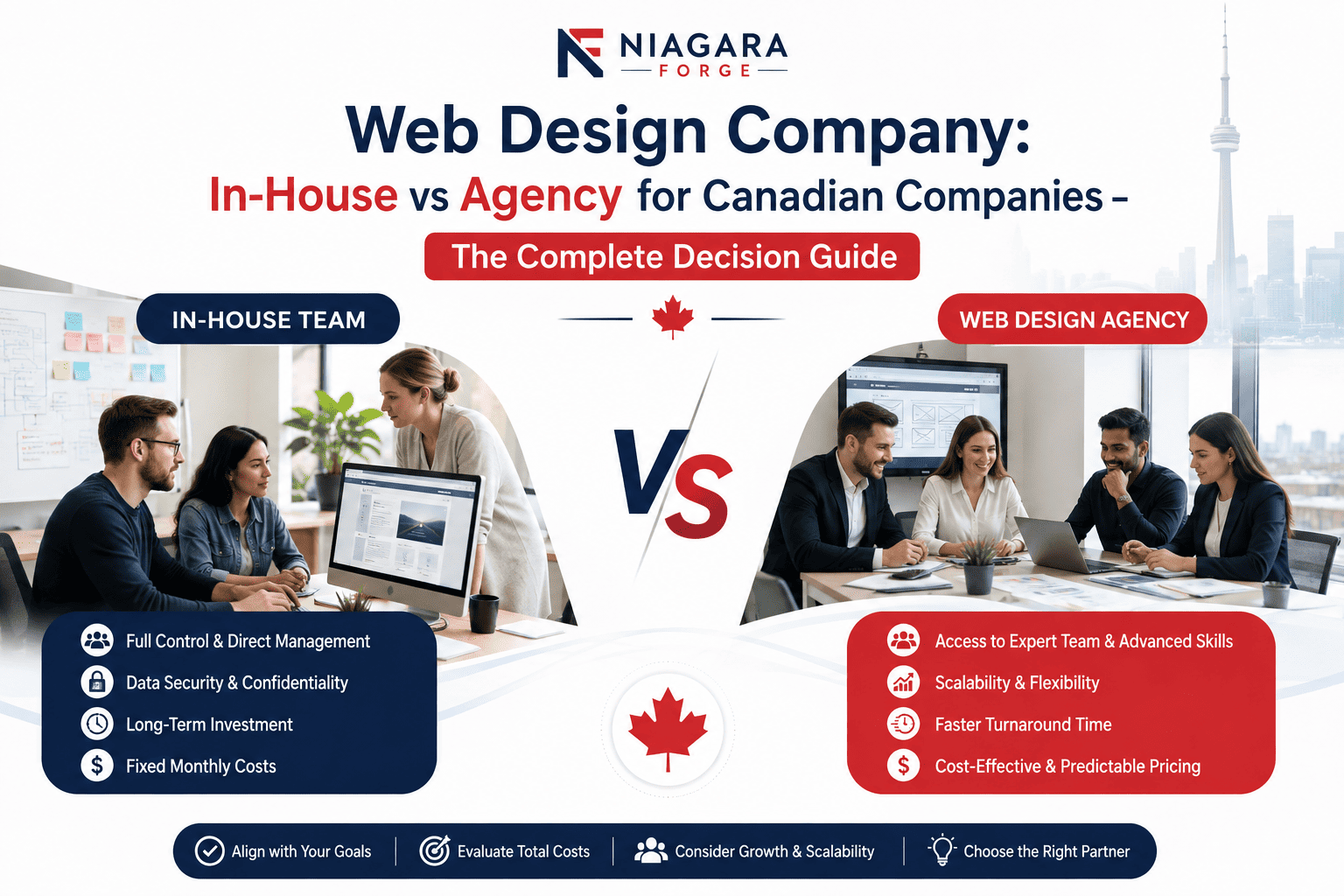
Web Design Company: In-House vs Agency for Canadian Companies – The Complete Decision Guide

1. Introduction: The Canadian Digital Landscape and Your Web Design Decision
Canada’s digital economy is not a smaller version of the United States or the United Kingdom. It is a distinct environment shaped by official bilingualism, vast geographic spread, and a rapidly maturing tech sector. From Vancouver’s Pacific gateway to Atlantic Canada’s emerging innovation hubs, your website must serve customers in English and French—and increasingly, in other languages as immigration drives demographic change. Provincial regulations, regional payment preferences, and cultural nuances around trust and privacy (with PIPEDA compliance being non-negotiable) all land on your website’s shoulders. This is the backdrop against which you must decide: build an in-house web team or hire a web design agency. That choice is not merely operational; it is strategic, determining how quickly you can adapt to market shifts, how much you spend over three to five years, and whether your digital presence feels authentically Canadian to every visitor.
Why Canadian Companies Face a Unique Web Design Dilemma
Unlike companies in more homogeneous markets, Canadian businesses must solve for complexity that is both linguistic and regional. A single website must handle French-language navigation, content, and legal pages without feeling like a translation afterthought. It must also accommodate time-zone differences for customer support, regional shipping calculators, and province-specific tax or compliance information. An in-house team offers deep, ongoing control over these details—but only if you can recruit bilingual designers and developers, which is costly and scarce outside major cities. An agency, meanwhile, brings a breadth of experience across Canadian industries and can implement bilingual architecture from day one. But agencies vary wildly in their familiarity with, say, Quebec’s consumer protection laws or Alberta’s energy-sector tone. The dilemma is real: neither option is inherently superior, and the wrong fit can alienate half your potential market.
The True Cost of Getting This Decision Wrong
Choosing poorly is not a minor setback—it is a compounding liability. If you hire an in-house team without adequate senior leadership, you may end up with a website that launches late, lacks accessibility compliance (a legal requirement under provincial standards in Ontario and Manitoba), and drains your budget through endless revisions. Conversely, partnering with an agency that treats your project as a generic template can produce a site that feels imported, missing the local trust signals Canadian consumers actively seek—such as clear French-language support, Canadian hosting for data residency, and references to local case studies. The financial impact is measurable:
- Direct costs: Salaries, benefits, and tools for an in-house team typically exceed agency project fees within 18 months, especially if you need senior full-stack and UX talent.
- Opportunity costs: A delayed or poorly localized launch means lost revenue from francophone customers and reduced search visibility on google.ca for regional keywords.
- Hidden costs: Redesigning a failed site within two years costs two to three times the original build, not to mention the reputational damage from a broken mobile experience.
Every month you delay a decision, your competitors—many of whom have already optimized for bilingual SEO and regional user journeys—pull further ahead.
What This Guide Covers and How to Use It
This guide is a structured comparison for Canadian decision-makers—CEOs, marketing directors, and operations leads—who need clarity, not jargon. We will walk through the core criteria: total cost of ownership, speed to market, quality control, bilingual and regional expertise, scalability, and long-term maintenance. Each section will present a balanced view, with checklists and decision matrices tailored to Canadian contexts. To get the most out of this guide, read it with your specific business constraints in mind. Are you a startup in Toronto needing a launch within six weeks? A manufacturer in Saskatchewan with a legacy site and no internal IT? A non-profit serving both official languages? Your answers will shift the weight of each factor. Use the final decision framework to score your options against your own priorities, and do not skip the section on hybrid models—many Canadian companies find that a small in-house team paired with a specialized agency is the pragmatic sweet spot. By the end, you will not have a universal answer, but a defensible, costed rationale for your unique situation.
2. Defining the Options: What ‘In-House’ and ‘Agency’ Really Mean
Before comparing costs, timelines, or quality, it is essential to establish a precise vocabulary. In the Canadian digital landscape, “in-house” and “agency” are often used loosely, leading to mismatched expectations. An in-house web team is a group of employees on your company’s payroll, working exclusively on your projects from your office (or remote, under your direct management). An agency, by contrast, is an external business you contract, which brings its own workflows, tools, and profit margins to your engagement. Between these two poles lies a spectrum of hybrid arrangements that many mid-sized Canadian firms adopt to balance control with flexibility.
In-House Web Design Teams: Structure and Roles
A fully in-house web team typically mirrors a small studio’s hierarchy but operates within your corporate culture. Standard roles include:
- Web Designer (UI/UX): Handles visual design, wireframing, and user research. In Canada, bilingual designers (English/French) are valuable for federal or Quebec-focused sites.
- Front-End Developer: Translates designs into HTML, CSS, and JavaScript. Often also responsible for accessibility compliance (WCAG 2.1 AA), which is legally relevant for public-sector contracts.
- Back-End Developer: Manages servers, databases, and CMS integrations (e.g., WordPress, Drupal, or custom Laravel solutions).
- Project Manager/Producer: Coordinates sprints, stakeholder approvals, and launch logistics. This role is frequently underestimated but critical for avoiding scope creep.
- QA Specialist (optional): Tests cross-browser compatibility and performance, especially for high-traffic e-commerce sites.
This structure works best when your company has continuous, high-volume web needs—such as a national retail chain updating product pages weekly. However, hiring a full team in Toronto or Vancouver costs $600,000–$1,200,000 annually in salaries, benefits, and tooling (e.g., Figma, Adobe Creative Cloud, DevOps subscriptions). You also own the risk of turnover and skill gaps; a single departure can stall a launch.
Web Design Agencies: Types, Sizes, and Specializations
Agencies in Canada range from solo freelancers in Halifax to multi-department firms in Montreal with 50+ staff. Understanding their categories helps you match your project scope:
| Agency Type | Typical Team Size | Best For |
|---|---|---|
| Boutique studio | 2–10 people | Custom design, brand-focused builds, small-to-mid business sites |
| Full-service digital agency | 15–100+ people | Integrated marketing, SEO, content, and large-scale development |
| Specialized dev shop | 5–30 engineers | Complex web apps, headless CMS, API integrations |
Full-service agencies often provide a dedicated account manager, which simplifies communication for busy executives. However, their overhead means you pay for layers—strategy, creative direction, and reporting—that may be unnecessary for a simple brochure site. Boutique studios offer senior talent at lower rates, but they may lack redundancy if a key designer falls ill during your deadline. Always ask for case studies involving Canadian-specific needs, such as bilingual routing (fr-ca vs. en-ca URL structures) or compliance with PIPEDA for user data.
Hybrid Approaches: When In-House Meets Agency
Most Canadian companies do not choose a pure model. Instead, they adopt a hybrid to leverage strengths while mitigating weaknesses. Common configurations include:
- In-house lead, agency execution: Your CTO or marketing director defines strategy, while an agency handles design and development. This gives you control over vision without hiring a full team.
- Agency lead, in-house support: An agency manages the project, but your in-house developer handles CMS maintenance post-launch. This reduces ongoing agency retainers.
- Fractional specialists: You hire an in-house generalist (e.g., a WordPress developer) and contract a specialized UX researcher or accessibility auditor for specific phases.
For example, a Vancouver SaaS company might keep a two-person in-house team for daily content updates and bug fixes, then hire a Toronto agency for a quarterly redesign sprint. This hybrid is practical because it avoids the agency’s monthly minimums while ensuring you have senior expertise when needed. The trade-off is coordination overhead: you must manage two sets of workflows, version control (e.g., Git repositories), and communication channels. Define clear handoff points—such as design sign-off before development begins—to prevent friction.
Ultimately, the right definition is not about labels but about who holds accountability for your website’s success. Whether you choose in-house, agency, or hybrid, document roles in a RACI matrix (Responsible, Accountable, Consulted, Informed) to avoid ambiguity. This single step prevents most common project failures, regardless of the model you select.
3. Cost Analysis: Budgeting for In-House vs Agency in Canada
For Canadian companies, the financial decision between building an in-house web team and hiring an agency extends far beyond a simple salary comparison. The true cost difference hinges on geography, seniority, and the hidden expenses that often escape initial budget forecasts. Below, we break down the real numbers—in Canadian dollars—for both models, with ranges that reflect the market in Toronto, Vancouver, and Montreal.
Hidden Costs of In-House Teams: Salaries, Benefits, and Overhead
Hiring a single senior web developer in Canada costs between $85,000 and $130,000 CAD annually in base salary, depending on city and experience. A full in-house team—typically including a developer, a designer, and a project manager—adds up quickly:
- Salaries: Junior roles start at $50,000–$65,000; mid-level at $70,000–$95,000; senior at $100,000–$140,000. In Toronto and Vancouver, expect the top of these ranges; Montreal often sits 10–15% lower.
- Benefits and payroll burden: Add 15–20% on top of salaries for EI, CPP, health insurance, and retirement matching.
- Tools and software: Design suites (Figma, Adobe), development licenses, testing tools, and project management software cost $3,000–$8,000 per person annually.
- Training and certifications: Annual professional development budgets of $2,000–$5,000 per employee are typical to keep skills current.
- Overhead: Office space, equipment (laptops, monitors), and IT support add $8,000–$15,000 per employee per year, even in hybrid setups.
Critically, in-house teams carry idle time risk: when no project is active, you still pay full wages. Recruitment costs (10–20% of first-year salary) and onboarding downtime (2–4 months at partial productivity) are frequently overlooked.
Agency Pricing Models: Fixed Quotes, Retainers, and Hourly Rates
Agencies in Canada offer three primary pricing structures, each with distinct cash-flow implications:
- Fixed quotes (project-based): A typical marketing website costs $15,000–$50,000; a custom e-commerce build ranges $50,000–$150,000+. Fixed quotes are predictable but often exclude post-launch changes.
- Retainers (monthly): Ongoing support, maintenance, and small updates run $2,000–$10,000 per month, depending on scope. This covers hosting management, security patches, and content changes.
- Hourly rates: Canadian agency rates vary by city: $100–$150/hr for senior developers in Toronto and Vancouver, $80–$120/hr in Montreal. Strategy and UX consulting often cost 20–30% more.
Hidden agency costs include rush fees (25–50% premium), out-of-scope change requests (billed at hourly rates), and third-party plugin licenses that pass through to you. Always clarify what the fixed quote includes—revisions, testing, and launch support are common exclusions.
Total Cost of Ownership Over 3–5 Years: A Comparative Look
To compare fairly, model a 3-year horizon for a mid-sized Canadian company (e.g., 50–200 employees) needing a custom website plus ongoing updates. The table below assumes a senior-level in-house team of three versus a full-service agency retainer.
| Cost Category | In-House Team (3 people) | Agency (project + retainer) |
|---|---|---|
| Year 1 – Setup & build | $350,000–$500,000 (salaries, benefits, tools, onboarding) | $40,000–$120,000 (fixed quote, one-time) |
| Year 1 – Ongoing maintenance | Included in salaries | $24,000–$60,000 (retainer at $2k–$5k/mo) |
| Year 2 – Operations | $300,000–$420,000 (full team, no project) | $24,000–$60,000 (retainer only) |
| Year 3 – Operations | $300,000–$420,000 (plus raises of 3–5%) | $24,000–$60,000 (plus inflation adjust) |
| 3-Year Total | $950,000–$1,340,000 | $112,000–$300,000 |
For most Canadian companies, the agency model delivers 60–80% lower total cost over three years, while providing access to a broader skill set (SEO, UX, performance) without fixed payroll. However, if your company requires daily, high-volume content changes or deep integration with proprietary systems, the in-house team’s availability may justify its premium—but only if you can keep the team fully utilized. For others, the agency retainer offers predictable, scalable spending that aligns with actual business needs.
4. Skills and Expertise: Accessing Specialized Talent
When comparing an in-house web design team to an agency, the most significant divergence appears in the depth and breadth of skills available. An in-house team, embedded in your company’s daily operations, develops an intimate understanding of your business goals, brand voice, and customer pain points. This deep context enables faster decision-making and more aligned design iterations. However, the same proximity often creates a silo: an in-house team may lack exposure to the broader market trends, emerging technologies, and niche disciplines that a specialized agency encounters across multiple clients. Agencies, by contrast, bring a portfolio of cross-industry solutions, from e-commerce conversion optimization to complex SaaS onboarding flows. Their consultants have seen what works—and what fails—in sectors far removed from yours, which can inject fresh perspective into stale design patterns. The trade-off is onboarding time; an agency must learn your business model, your Canadian market nuances, and your internal workflows before delivering at full speed.
Core Skills Every Web Design Team Needs (and How Each Option Covers Them)
Regardless of delivery model, a complete web design team must cover a baseline set of competencies. The table below maps these core skills against typical in-house and agency coverage:
| Core Skill Area | In-House Team (Typical) | Agency Team (Typical) |
|---|---|---|
| Visual design & brand system | Strong, but may become insular over time | Broad, with exposure to multiple brand languages |
| Front-end development (HTML/CSS/JS) | Often 1–2 generalists | Specialized roles (e.g., React, performance) |
| Back-end integration (CMS, CRM) | May rely on IT department | Dedicated full-stack developers |
| Content strategy & copywriting | Marketing team overlap | Dedicated UX writers and content strategists |
| Testing & QA | Often ad-hoc, part-time | Systematic QA across browsers and devices |
For Canadian companies, the core skill set must also include an understanding of the Accessibility for Ontarians with Disabilities Act (AODA) and the broader WCAG 2.1 AA standards. In-house teams may treat accessibility as a checklist item, while agencies often have dedicated accessibility auditors who run automated and manual tests, including screen reader compatibility and keyboard navigation flows.
Niche Expertise: UX, CRO, Accessibility, and French/English Localization
Where the gap widens is in niche, high-impact expertise. Consider these four areas critical for Canadian businesses:
- UX research: In-house teams may conduct occasional user interviews, but agencies run moderated usability tests, card sorting, and journey mapping with statistically valid sample sizes. This is especially crucial for bilingual sites where navigation patterns differ between anglophone and francophone users.
- Conversion rate optimization (CRO): Agencies bring A/B testing frameworks, heatmap analysis, and behavioral analytics from dozens of projects. An in-house team might have one generalist who has read about CRO but lacks the empirical reps to know which button color or microcopy actually moves metrics in Canadian markets.
- Accessibility compliance: Beyond WCAG, Canadian provinces have distinct requirements. For example, Quebec’s Standard sur l’accessibilité des sites Web (SGQRI 008-01) imposes stricter contrast and language-tagging rules than federal guidelines. An agency with pan-Canadian clients will have templates and test scripts for these variations.
- French/English localization: Translation is only the start. French Canadian web copy requires different character lengths, formality levels (tutoiement vs. vouvoiement), and date/number formatting. Agencies that serve Quebec and federal clients maintain glossaries and linguistic validation processes. In-house teams without a francophone copywriter often ship awkward, literal translations that erode trust.
For a practical example, consider a simple localization issue in a web form. A French Canadian postal code field must accept both the English format K1A 0B1 and the French label “Code postal” with a space before the colon. An agency would implement a regex pattern that permits the space and uppercase letters, and then test it with real Quebec addresses:
// Accepts Canadian postal codes with or without space, case-insensitive
const postalCodePattern = /^[A-Za-z]d[A-Za-z][ -]?d[A-Za-z]d$/;
if (!postalCodePattern.test(input.value)) {
  showError("Veuillez entrer un code postal valide (ex. H2X 1Y4).");
}
An in-house team might overlook the space requirement, causing failed form submissions for 20% of Quebec users.
Keeping Skills Current: Training and Certifications in Canada
Web design is a moving target. In-house teams in Canada often struggle to allocate time for professional development, especially in smaller organizations. They may rely on free online tutorials or occasional conference attendance, which leads to skill drift. Agencies, however, treat certifications as a business differentiator. A reputable agency will invest in Google Analytics 4 certification, Nielsen Norman Group UX certifications, and IAAP (International Association of Accessibility Professionals) credentials for their staff. They also participate in Canadian industry groups like the Design Educators and Practitioners Association of Canada or the Accessibility Association of British Columbia. For in-house teams, the practical solution is a structured training budget—at least 5% of payroll—and annual attendance at events like Web à Québec or UXPA Canada. But the reality is that most in-house teams cannot match the agency’s sheer volume of certification hours, simply because agencies spread these costs across multiple clients. When choosing between the two, ask for a skills matrix and recent training logs. If the in-house team cannot name their last formal course, that is a red flag. If the agency cannot name the specific accessibility standard for your province, that is an equally serious one.
5. Control and Collaboration: How Each Model Shapes Your Workflow
When choosing between an in-house web design team and an agency for your Canadian company, the daily rhythm of control and collaboration will define your experience more than any contract or portfolio. Each model distributes decision-making authority and communication channels differently, which directly impacts speed, quality, and team morale. Understanding these dynamics before you commit prevents friction later.
Direct Oversight vs. Account Management: Who’s in the Driver’s Seat?
In-house teams place you firmly in the driver’s seat. Your project manager, designers, and developers sit within your organizational chart, reporting to your leadership. You can walk to a desk, request a change, and see it implemented within hours. This proximity gives you granular control over every pixel and workflow decision, but it comes with a hidden cost: your team may become too compliant, avoiding pushback on poor ideas to preserve workplace harmony. They also risk silo thinking, where internal assumptions go unchallenged because everyone shares the same corporate culture.
Agencies, by contrast, place an account manager between you and the production team. That manager becomes your single point of contact, translating your business goals into creative briefs. You surrender day-to-day oversight in exchange for structured governance. The agency’s creative director, not your internal staff, makes tactical calls on typography, user flow, and code architecture. This distance is a feature, not a bug: agencies can deliver hard truths about your website’s usability or brand positioning without fearing internal politics. However, you must trust their judgment, because you will not see raw drafts or sprint logs unless you explicitly request them.
For Canadian companies with limited internal capacity, the agency model often provides better strategic control at the macro level—you set the destination, they navigate the route. For firms with deep technical leadership, in-house offers micro-control but demands constant managerial attention to avoid drift.
Communication Cadence: Standups, Sprints, and Status Reports
In-house teams thrive on informal, high-frequency rituals. Daily 15-minute standups keep designers and developers aligned, while weekly sprint reviews allow stakeholders to course-correct early. Because everyone shares a physical office (or a Slack channel), feedback loops are nearly instantaneous. You can flag a navigation issue at 10 a.m. and see a prototype revision by lunch. This cadence works best when your team has mature agile practices; without them, meetings multiply and productivity stalls.
Agencies operate on a more formal rhythm. Expect a kickoff workshop, biweekly status reports, and monthly steering committee calls. Each deliverable—wireframes, visual mockups, development builds—arrives on a set schedule, often with a written rationale. This structure reduces surprise but slows iteration. A typical agency sprint lasts two weeks, and change requests are batched into the next sprint rather than handled ad hoc. For Canadian companies managing multiple vendors or regulatory compliance, this predictability is valuable. Yet, if your market moves quickly (e.g., e-commerce or seasonal promotions), the agency cadence may feel glacial.
Key difference in practice:
- In-house: Daily standups, ad hoc huddles, immediate demos.
- Agency: Weekly status emails, biweekly demos, monthly executive reviews.
Collaboration Tools and Workflows: Slack, Jira, Figma, and More
Both models rely on the same digital toolkit, but their usage patterns diverge. In-house teams often use Slack for continuous, low-friction chatter—designers post Figma links, developers share code snippets, and PMs update Jira tickets in real time. This creates a living archive of decisions, but it can also fragment knowledge across threads. To succeed, in-house teams need disciplined documentation: a single source of truth (e.g., Confluence or Notion) for design tokens, user stories, and acceptance criteria.
Agencies typically centralize communication through project management platforms like Jira or Asana, with Slack reserved for urgent queries only. Figma serves as the collaborative design hub, where clients can comment directly on frames and leave time-stamped feedback. The agency’s project manager enforces a workflow: every comment must be triaged, every change logged against a version history. This rigor prevents scope creep but requires clients to learn the agency’s tooling conventions.
For either model to flourish, adopt these rituals:
- Weekly design review (Figma or Miro) with annotated feedback.
- Sprint grooming (Jira) to prioritize backlog items jointly.
- Shared glossary for Canadian-specific terms (e.g., bilingual requirements, provincial regulations).
- Recorded demo sessions for asynchronous review across time zones.
Ultimately, the best workflow is the one your team actually follows. In-house teams must fight the urge to over-collaborate; agencies must fight the urge to under-communicate. Choose the model that matches your company’s tolerance for structure versus spontaneity, and invest in the tools that bridge that gap.
6. Speed and Agility: Meeting Deadlines in a Fast-Paced Market
For Canadian companies, speed is rarely about raw velocity—it is about predictable delivery under unique pressures. Whether you are coordinating a Quebec-wide bilingual launch or a last-minute Canada Day promotion, the structural differences between an in-house team and an agency directly dictate how fast you can move, and more importantly, how fast you can change direction without breaking the budget or the schedule.
In-House Agility: Quick Pivots and Internal Alignment
An in-house web team has a fundamental advantage: zero contractual friction. When your marketing lead spots a competitor’s aggressive Black Friday campaign on a Tuesday, the in-house designer can adjust the homepage hero by Thursday afternoon. There is no scope-of-work amendment, no change-order email chain, and no need to explain your brand’s internal politics to an external account manager.
This agility shines in two specific Canadian scenarios:
- Bilingual content corrections: When the Office québécois de la langue française flags a terminology issue on a product page, an in-house team can fix the French copy and re-deploy within hours—no agency backlog for translation review.
- Regional campaign splits: A sudden provincial health regulation (e.g., a retail capacity change in Ontario) requires immediate website updates. An in-house team can push a geo-targeted banner without waiting for an agency’s project manager to slot the request into next week’s sprint.
However, this speed has a ceiling. In-house teams are finite. If your two developers are already buried in a CRM integration, an urgent “quick fix” becomes a queue-jumping exercise that delays other critical work. The bottleneck is not skill—it is parallel capacity. You can pivot fast, but only on one thing at a time.
Agency Scalability: Handling Peaks and Complex Launches
Agencies excel at what in-house teams cannot do: throwing multiple specialists at a deadline simultaneously. Consider a national retailer preparing for the holiday season—a period where Canadian e-commerce traffic spikes by 40–60% from late November to late December. An agency can deploy three front-end developers, a dedicated QA tester, and a content editor onto a single launch, compressing a six-week timeline into three. This is not speed through shortcuts; it is speed through resource multiplication.
For complex launches, agencies also bring pre-built playbooks. A Toronto-based agency that has executed 30 bilingual Shopify migrations will have reusable code snippets, translation memory files, and staging environments ready. They do not need to invent the process from scratch, which reduces the risk of last-minute integration failures.
The trade-off is scheduling dependency. Your project competes with other clients’ deadlines. If your agency’s senior developer is finishing a rush job for another retailer, your urgent bug fix may wait 48 hours. This is not negligence—it is the reality of shared resources. To mitigate this, Canadian companies should negotiate dedicated sprint slots in the contract, especially for peak periods like back-to-school or the December holiday rush.
Managing Revisions and Change Requests in Both Models
Revisions are where the two models diverge most sharply in practice. In-house, a revision is an internal conversation: “Can you adjust the checkout flow?”—and the developer does it, often same-day, with no formal tracking. The downside is accountability. Without a change log, scope creep happens silently. A “small tweak” to the navigation can consume two days without anyone noticing until the next release is delayed.
Agencies, conversely, formalize revisions. Most contracts include two or three revision rounds per deliverable, with additional changes billed hourly. This prevents scope creep but can frustrate teams that need iterative feedback loops. For example, a Vancouver SaaS company testing a new pricing page may want to A/B test five variations in a week. An agency’s standard revision cap would make that prohibitively expensive.
Practical middle ground for Canadian firms:
| Scenario | In-House Best For | Agency Best For |
|---|---|---|
| Urgent regulatory update (e.g., cannabis packaging rules) | Yes—same-day fix | No—likely 3–5 day turnaround |
| Multi-page bilingual microsite launch (FR/EN) | Risky—may lack copywriters | Yes—dedicated translation & QA |
| Ongoing weekly content updates | Yes—low marginal cost | Expensive if hourly |
| One-time major redesign (e.g., platform migration) | No—capacity strain | Yes—parallel workstreams |
For technical teams, a practical tip: use a shared Git repository with protected branches for both models. If you are in-house, enforce a code review policy to avoid “quick fixes” breaking production. If you are with an agency, require them to commit to your repo and tag every release with a timestamp—this gives you an auditable trail for change requests, preventing billing disputes. A simple command to verify deployment status on a Canadian-hosted server (e.g., AWS ca-central-1):
git log --oneline -5 --since="2025-01-01" --deployUltimately, choose in-house for reactive agility and agency for proactive scale. The best Canadian companies often use a hybrid: an in-house core for daily maintenance, and a retainer-based agency for peak-season surges and complex launches—negotiating revision caps that allow for three rounds per deliverable, with pre-paid overflow hours for unexpected regulatory changes.
7. Long-Term Maintenance and Support: Who Keeps Your Site Alive?
Launch day is a milestone, not a finish line. A website is a living system that demands continuous care: security patches, software updates, fresh content, performance tuning, and occasional new features. How you structure this ongoing support—through an in-house team or an agency retainer—will determine your site’s uptime, security posture, and total cost of ownership over the next three to five years. For Canadian companies, this decision carries extra weight due to PIPEDA compliance and the need for data residency clarity. Below, we break down the operational realities of each model.
Ongoing Maintenance: Security, Backups, and Updates
Every content management system, plugin, and custom script requires regular updates to patch vulnerabilities. An in-house developer can apply these updates during business hours, but they often juggle this with feature requests and internal IT tasks. If your in-house person is on vacation or leaves the company, updates may lapse for weeks—a critical risk given that most breaches exploit known, unpatched flaws. Backups are similarly dependent on one person’s discipline; a single misconfigured cron job can silently fail.
An agency retainer typically formalizes this process with a defined schedule: weekly security scans, monthly core updates, and automated off-site backups with verified restoration tests. Agencies also monitor uptime 24/7, not just during office hours. For Canadian firms, a key advantage of an agency is their familiarity with PIPEDA requirements—they can ensure that backups are stored in Canadian data centers or approved jurisdictions, and that any third-party tools (analytics, form processors) comply with Canadian privacy standards. In-house teams may overlook these nuances unless they have dedicated legal or compliance support.
Content Management: Who Updates Your Site and How Fast?
Content changes fall into two categories: routine edits (blog posts, team pages, pricing updates) and urgent fixes (a broken checkout button, a legal notice, a product recall). With an in-house team, routine edits are often fast—provided the person has the training and the CMS is user-friendly. However, urgent fixes depend entirely on that person’s availability. If they are in a meeting, on a sick day, or handling a critical server issue, your request waits. In-house content managers also tend to accumulate “shadow IT” tasks, which can delay even simple updates.
Agencies offer a different trade-off. Routine edits are typically handled through a ticketing system with a defined turnaround—often 24 to 48 hours for non-urgent requests. Urgent fixes, however, are covered by a service-level agreement (SLA) that specifies response times (e.g., 1 hour for critical issues) and resolution targets (e.g., 4 hours). For Canadian companies operating across time zones, an agency can provide staggered coverage, ensuring that a request made at 6 PM EST is not stuck until the next morning. The downside is that an agency doesn’t know your brand voice as intimately as a dedicated employee, so you may need to provide clear style guides and review cycles.
Support SLAs and Response Times: What to Expect
Reliability is the core difference. An in-house team offers presence, not guarantees. You can walk to their desk, but they have no contractual obligation to prioritize your request over their other duties. Turnover is a real risk—if your only developer leaves, you face a hiring gap of weeks or months, during which your site receives zero maintenance.
An agency retainer, by contrast, is built around contractual accountability. A typical SLA includes:
- Response time: How quickly a human acknowledges your ticket (e.g., 1 hour for critical, 8 hours for normal).
- Resolution time: How long until the issue is fixed (e.g., 4 hours for critical, 3 business days for minor bugs).
- Coverage hours: Business hours, extended hours, or 24/7 monitoring.
- Escalation path: A named account manager who ensures your issue isn’t lost in a queue.
Agencies also mitigate turnover by having multiple people familiar with your codebase, whereas an in-house team often becomes a single point of failure. For PIPEDA compliance, an agency can document their data handling procedures in a written agreement, which strengthens your own accountability framework. The trade-off is cost—retainers typically run from a few hundred to several thousand dollars per month, depending on scope. For many Canadian companies, the peace of mind and predictable response times justify the expense, especially if your site generates revenue or handles sensitive customer data.
Ultimately, the choice hinges on your risk tolerance. If you have a large internal IT department with redundant skills, in-house support can work well. If you operate a lean team and cannot afford a security lapse, an agency retainer provides the structured, enforceable support that keeps your site alive—and your compliance intact.
8. Culture and Team Dynamics: Fitting with Your Company Values
Culture is the invisible architecture of every organization. When choosing between an in-house web design team and an agency, the decision extends far beyond portfolios and pricing—it is a question of how people, values, and working styles will align under daily pressure. Canadian companies, with their emphasis on collaboration, transparency, and regional identity (from Vancouver’s creative hubs to Toronto’s corporate corridors), must weigh how each model embeds into their existing cultural fabric. The right choice amplifies your values; the wrong one creates friction that no project timeline can survive.
Embedding Brand Identity: In-House Immersion vs. Agency Objectivity
An in-house team lives inside your brand daily. They attend your all-hands meetings, absorb your internal language, and instinctively know why your customer service script reads a certain way. This immersion produces designs that feel native—not applied, but grown from within. For example, a Quebec-based cooperative that prizes consensus will find an in-house designer who naturally incorporates feedback loops into every mockup, because they experience those loops themselves.
Agencies, by contrast, offer the value of strategic distance. They are not burdened by institutional habits or “we’ve always done it this way” thinking. A fresh agency team can see what insiders miss: a cluttered homepage that reflects internal silos, or a colour palette that no longer matches your evolved mission. However, this objectivity requires deliberate onboarding. Without structured brand workshops and style-guide audits, an agency may produce work that is clever but off-key—a risk Canadian firms must mitigate by demanding brand immersion sessions as a contractual step, not an optional extra.
Team Morale and Retention: The In-House Advantage?
In-house web designers enjoy something agencies struggle to replicate: stable belonging. They are part of your payroll, your benefits, and your Friday socials. This continuity builds deep product knowledge and loyalty, directly reducing turnover costs—a significant factor in Canada’s competitive tech talent market. A designer who has shipped three iterations of your e-commerce flow understands the codebase and the customer pain points better than any newcomer.
Agencies offer a different morale equation. Their teams thrive on variety and creative stimulation, but they are not invested in your company’s long-term internal dynamics. If your culture values deep, long-term relationships over project-based intensity, an agency’s rotating account managers may feel transactional. Conversely, if your culture celebrates fresh challenges and rapid iteration, an agency’s energy can invigorate your internal team, pushing them to raise their own standards. The in-house advantage is real, but only if you can offer competitive salaries, clear career paths, and meaningful creative ownership—otherwise, your “advantage” becomes a retention risk.
Evaluating Cultural Fit: Interview Questions for Agencies and Candidates
Assessing cultural fit requires structured, values-based questioning. For in-house candidates, go beyond technical tests. Ask behavioral questions that reveal how they handle ambiguity, feedback, and cross-departmental conflict. For agencies, treat the pitch process as a two-way cultural interview—do they ask about your decision-making style, or only about your budget?
Use these questions to guide your evaluation:
- For in-house candidates: “Describe a time you disagreed with a stakeholder’s design direction. How did you navigate the relationship while maintaining your creative standards?”
- For in-house candidates: “What does ‘brand immersion’ mean to you, and how would you embed yourself in our company’s regional and linguistic nuances?”
- For agencies: “How do you handle a client whose internal culture is slower to approve than your typical agile process?”
- For agencies: “Can you share a project where your objectivity created tension with the client’s internal team, and how did you resolve it?”
Also, request a “culture deck” from agencies—a document outlining their own values, remote work policies, and team composition. Compare it against your own employee handbook. If their stated values clash with yours (e.g., they prize speed over consultation), that is a red flag.
| Cultural Dimension | In-House Team | Agency Partner |
|---|---|---|
| Brand immersion level | Deep, continuous, organic | Shallow initially; requires structured workshops |
| Feedback speed | Fast, informal, iterative | Formal, scheduled, contract-bound |
| Creative diversity | Limited to internal expertise | High—exposed to multiple industries |
| Retention risk | Low if compensated well | High—team members may rotate off your account |
| Conflict resolution | Internal, often relationship-based | Escalates to account managers or contracts |
Ultimately, Canadian companies must decide whether they want culture to be a byproduct of proximity or a deliberate, managed choice. Neither model is superior—only better suited to your specific values. Invest the time to interview both with the same rigor you would apply to a new executive hire, and you will build a web design partnership that feels less like a vendor relationship and more like an extension of your own team.
9. Risk and Reliability: What Happens When Things Go Wrong?
Every web project carries risk, but the source of that risk differs sharply between an in-house team and an agency. In-house, you face the fragility of a single point of failure. With an agency, you face the volatility of a vendor’s business health. Neither model is inherently safer; both require deliberate risk management. The key is to identify where your exposure is highest and build safeguards before a crisis occurs, not after.
Key Person Risk: When Your Designer Leaves or Your Agency Loses a Lead
In-house, the most common failure is key person dependency. If your only developer or designer resigns, your website becomes a black box. They hold undocumented logic, login credentials, and the mental map of why certain decisions were made. The agency equivalent is a senior lead leaving mid-project, taking client context and technical nuance with them. Both situations cause delays, quality drops, and costly re-learning.
Mitigation strategies:
- In-house: Mandate documentation from day one. Require code comments, a living README, and a shared dashboard for all credentials. Cross-train a second team member on every critical system.
- Agency: Insist on a named backup contact in your contract. Ask for a project handoff plan if the lead changes. Schedule regular knowledge-transfer check-ins with the agency’s account manager, not just the developer.
- Both: Conduct a “bus test” quarterly. If your designer or agency lead vanished tomorrow, could a competent outsider rebuild the site from your documentation alone? If not, fill the gaps.
Intellectual Property and Contractual Safeguards
Ownership is a silent risk that surfaces only when you try to switch vendors or hire a new developer. Without explicit terms, an agency may retain rights to the code, design files, or even the content structure. In Canada, the Copyright Act defaults to the creator owning the work unless a written assignment exists. This means a contract that simply says “we build your site” may not transfer IP to you.
Critical contractual clauses to request:
- Explicit IP assignment: A clause stating all deliverables, including source code, design assets, and documentation, are assigned to your company upon full payment.
- Escrow for source code: For agencies, require a third-party escrow agreement that releases source files if the agency goes bankrupt or breaches the contract.
- Privacy compliance: Under PIPEDA (and provincial laws like Quebec’s Law 25), your agency is often a “service provider” handling personal information. Your contract must specify data processing limits, breach notification duties, and deletion obligations after project termination.
- Work-for-hire language: For in-house employees, this is automatic in most Canadian provinces, but for freelancers or contractors, you need a written agreement that overrides their default copyright.
Business Continuity Planning for Web Operations
Reliability is not just about who builds the site—it’s about who keeps it running when the unexpected occurs. An agency can vanish overnight due to insolvency. An in-house team can be decimated by layoffs or a key employee’s long-term illness. Your continuity plan must treat the website as a critical business asset, not a project.
Practical steps:
- Maintain full administrative access: Never let a third party hold sole control of your domain registrar, hosting account, or CMS admin. Use your own corporate email for these accounts.
- Automated backups: Store nightly backups offsite, in a separate cloud provider from your primary host. Test restoration quarterly.
- Documentation of stack: Record every plugin, library, and server configuration in a version-controlled file. This allows a new team to rebuild your environment quickly.
- Exit strategy in every contract: Include a 90-day transition period where the agency must cooperate with a new vendor, provide all credentials, and offer a paid support handover.
For Canadian companies, also consider jurisdictional risk. If your agency is based in another province, your contract should specify which province’s laws govern disputes. This avoids the costly question of where to file a claim. Similarly, ensure your hosting provider stores data in Canada if your privacy obligations require it.
One practical example for continuity: if you use a Git-based workflow, you can enforce a rule that all code must be pushed to your own repository, not just the agency’s private server. A simple command like git remote add backup https://yourcompany-git.example.com/website.git && git push backup --all ensures you hold a full, versioned copy of the codebase, independent of any vendor’s infrastructure.
Ultimately, the agency vs. in-house decision should not be based on who is more likely to fail, but on who you can hold accountable when they do. Contracts, documentation, and tested recovery procedures are your only real insurance.
10. Making the Final Call: A Decision Framework for Canadian Companies
After weighing costs, control, and Canadian market nuances, the choice between an in-house team and a web design agency rarely resolves to a single “correct” answer. Instead, the best decision emerges from a structured assessment of your company’s current reality and future trajectory. The framework below helps you move beyond gut feeling, forcing a candid evaluation of what you truly need—and what you can sustain. For many Canadian firms, the optimal path is not either/or but a deliberate blend of both models.
Scorecard: Rating In-House vs Agency Across Key Criteria
Use this scorecard to assign points (1–5, with 5 being strongest) for each criterion relevant to your situation. Tally the results, but treat the totals as a starting point for discussion, not a verdict.
| Criterion | In-House Team | Agency (Canadian or Local) |
|---|---|---|
| Upfront cost | High (salaries, tools, onboarding) | Moderate to high (project-based) |
| Ongoing cost predictability | Fixed monthly payroll, but hidden costs (training, benefits) | Variable retainer or per-project; easier to scale down |
| Speed for urgent fixes | Immediate, if capacity exists | Depends on contract SLA; often 24–48 hours |
| Depth of specialized expertise | Limited to hires’ skills; gaps require external training | Broad—agencies employ UX, SEO, security, and branding specialists |
| Understanding of Canadian market (bilingual, regional compliance) | Possible, but depends on team’s background | Strong if agency is Canadian or has proven local experience |
| Scalability for large redesigns or campaigns | Poor—hiring spikes are slow and expensive | Excellent—agencies can staff up quickly |
| Institutional knowledge retention | High, but lost if key employees leave | Lower; documentation is critical to bridge gaps |
| Creative diversity and innovation | Risks groupthink; may become stale | Higher—exposure to multiple industries and challenges |
Interpretation: If your score strongly favors in-house, you likely have stable, ongoing needs with a focus on quick iteration. If agency wins, you are probably facing a major project, tight deadline, or need for niche skills. A close score suggests a hybrid model.
Checklist: 10 Questions to Ask Before You Decide
Before committing, gather your leadership, marketing, and finance teams and answer these questions honestly. Write down your responses—vague answers are a red flag.
- What is our realistic annual budget for web design, including hidden costs (software, training, agency management time)?
- How often do we actually need to change or update the website? Daily, weekly, or only quarterly?
- Do we have internal capacity to manage, mentor, and retain technical staff in a competitive Canadian job market?
- What specific technical skills (e.g., e-commerce, multilingual, accessibility) are non-negotiable for our next project?
- Can we articulate our project scope clearly, or do we need strategic guidance from discovery to launch?
- How quickly must we respond to security vulnerabilities or regulatory changes (e.g., PIPEDA, Quebec’s Bill 64)?
- What is our tolerance for vendor dependency—are we comfortable with an agency holding our code and hosting?
- Do we have a detailed brand guide that an agency can follow, or does the design need to evolve with our culture?
- What are our growth plans in the next 12–24 months? Will our web needs scale linearly or spike?
- Have we interviewed at least one internal candidate and one agency to assess cultural fit and communication style?
Hybrid Success Stories: When Combining Both Makes Sense
The most pragmatic Canadian companies often discover that a hybrid approach delivers the best of both worlds. This is not a compromise—it is a strategic allocation of work based on strengths.
Consider a mid-sized Vancouver-based SaaS company. They maintain a two-person in-house team for daily content updates, A/B testing, and rapid bug fixes. However, for their annual rebrand or a major product launch, they hire a specialized agency for a fixed-term project. The in-house team manages the agency, ensures brand consistency, and takes over the code after launch. This avoids the cost of full-time senior designers they would rarely use, while keeping the agency’s fresh perspective and deep expertise.
Another example: a Montreal law firm with a strong need for French-first UX and strict privacy compliance. They keep an in-house webmaster for routine edits and client intake forms, but they partner with a local agency that specializes in legal sector design and PIPEDA compliance for the annual audit and security overhaul. The agency’s knowledge of Quebec’s unique language laws prevents costly mistakes, while the in-house staff handles the day-to-day relationship with clients.
The key to successful hybrids is clear boundaries. Define which tasks are “business as usual” (in-house) and which are “project spikes” (agency). Set communication protocols, ownership of code, and a transition plan at the end of each engagement. When done well, the hybrid model offers the agility of an agency and the institutional memory of an in-house team—without the financial burden of either extreme.
Frequently Asked Questions
What are the main differences between an in-house web design team and an agency?
In-house teams are dedicated employees who work exclusively on your brand, offering deep context and immediate availability. Agencies bring a diverse portfolio of skills, specialized tools, and cross-industry insights, often at a predictable cost. In-house provides greater control and alignment with company culture, while agencies offer scalability and access to a broader talent pool. The choice depends on your project scope, budget, and long-term digital needs.
How do costs compare between hiring an in-house team and using an agency in Canada?
In-house costs include salaries, benefits, training, software, and overhead—typically $80,000–$120,000 per senior designer annually in Canada. Agencies charge project-based or monthly retainers, which can be more predictable. For one-off projects, agencies are often cheaper; for ongoing, high-volume work, in-house may be cost-effective. However, agencies eliminate recruitment and management costs. Always compare total cost of ownership, not just headline rates.
What are the advantages of using a Canadian web design agency?
Canadian agencies understand local market nuances, cultural references, and bilingual requirements (English/French). They often have established relationships with Canadian vendors and are familiar with provincial regulations (e.g., PIPEDA). Agencies bring a fresh perspective and a team of specialists—designers, developers, SEOs—without the overhead of full-time hires. They also scale up or down quickly, making them ideal for campaigns or redesigns.
When should a Canadian company choose an in-house web design team?
Choose in-house when your digital presence is core to your business model, requiring constant iteration and deep integration with internal stakeholders. If you need rapid daily changes, tight brand control, or have sensitive data that must stay in-house, an internal team is beneficial. Also, if you have a large enough budget to support a full-time team and can afford recruitment, training, and retention, in-house offers long-term strategic advantage.
How does the hiring process differ for in-house designers versus agencies in Canada?
Hiring in-house involves a lengthy recruitment process: posting, screening, interviews, and onboarding, which can take 2–3 months. You must compete with other employers for top talent. Agencies are pre-vetted; you evaluate their portfolio and fit, then sign a contract. Agencies have already done the hiring, so you get immediate access to a team. This speed is crucial if you have tight deadlines or need niche skills temporarily.
What are the hidden costs of in-house web design teams?
Beyond salaries, in-house teams require software licenses, hardware, training, and professional development. You also bear the cost of sick days, vacations, and benefits. Project management and quality assurance are your responsibility. Turnover can lead to lost knowledge and rehiring costs. Additionally, you may need to hire specialists like UX researchers or SEOs, which multiplies overhead. These hidden costs can make in-house more expensive than anticipated.
How do agencies handle project management and communication compared to in-house teams?
Agencies typically assign a dedicated project manager who acts as a single point of contact, using tools like Slack and Jira. They follow structured processes with defined milestones and regular reporting. In-house teams often have more informal communication, with daily stand-ups and direct access to designers. However, agencies may have more rigorous documentation and accountability, as their contract requires. The key is to establish clear communication protocols regardless of the model.
What should Canadian companies consider regarding bilingual web design requirements?
If you serve both English and French markets, your web design must support bilingual content, including layout adjustments for longer French text, proper language tags, and culturally appropriate imagery. Agencies with Canadian experience are often better prepared for these nuances, offering French translation and localization services. In-house teams may need to hire bilingual staff or work with external translators, adding complexity. Ensure your chosen model can handle accessibility and legal compliance for both languages.
Sources and further reading
- Statistics Canada: Digital economy and society
- Government of Canada: PIPEDA (Privacy Act)
- W3C Web Accessibility Initiative (WAI)
- Interaction Design Foundation
- Nielsen Norman Group
- Canadian Internet Registration Authority (CIRA)
- Smashing Magazine: Web Design
- A List Apart
- UXPA (User Experience Professionals Association)
- Government of Canada: Innovation, Science and Economic Development
Need help with this topic?
Send us your details and we will contact you.




Comment (1)
Pingback: Small Business Web Design Checklist for Canadian Businesses