

Introduction: The Canadian Digital Landscape
For Canadian businesses, the decision to invest in custom web design is rarely straightforward. Unlike template-based solutions that promise quick deployment, custom design requires a deliberate evaluation of your company’s goals, market position, and operational capacity. In Canada, this decision carries additional weight due to the country’s distinct digital environment—a landscape shaped by linguistic duality, vast geographic dispersion, and a fiercely competitive e-commerce sector. A website is not merely a digital brochure; it is your most persistent salesperson, your first impression for international buyers, and your primary channel for converting regional interest into revenue. Treating custom design as an expense rather than a strategic asset often leads to missed opportunities, particularly when your competitors are already leveraging tailored user experiences to capture market share.
This article outlines the precise conditions under which a Canadian business should move beyond templates and invest in custom web design. We will examine the unique pressures of the Canadian market, clarify the functional differences between custom and template-based approaches, and provide a practical framework for determining the right timing for your investment. By the end, you will have a clear decision checklist—not abstract advice—to guide your next steps.
Understanding the Canadian Market’s Unique Digital Demands
Canada’s digital market is not a smaller version of the United States. It is a complex, bilingual, and regionally fragmented environment that demands careful attention. Consider the following structural realities:
- Bilingual compliance: The Official Languages Act and consumer expectations in Quebec require that websites serving French-speaking Canadians offer full French-language functionality—not just translated text, but culturally adapted messaging, correct date/number formats, and localized payment options. Template themes often handle this poorly, producing awkward translations or broken navigation when switching languages.
- Regional preferences: A customer in Vancouver expects different shipping options, local product availability, and even visual aesthetics than a customer in Halifax. Custom design allows you to serve province-specific content, such as GST/HST calculations, regional promotions, and local store locators, without forcing a one-size-fits-all experience.
- Cross-border competition: Canadian businesses routinely compete with American and international e-commerce giants that invest heavily in user experience. A generic template signals a lack of investment, which can undermine trust—especially for higher-priced B2B purchases or specialized retail goods.
- Mobile and connectivity variance: While urban centres have high-speed internet, rural and remote communities (including Northern territories) often rely on slower connections. Custom design allows you to optimize for bandwidth constraints, such as lightweight images and simplified checkout flows, which template frameworks rarely prioritize.
These factors create a fundamental tension: a template can get you online quickly, but it cannot adapt to the nuanced needs of a multi-region, bilingual market. Custom design, on the other hand, is built from the ground up to accommodate these variables. However, that flexibility is only valuable if your business actually needs it—which brings us to the core distinction between custom and template-based design.
The Difference Between Custom and Template-Based Design
To make an informed investment decision, you must first understand what you are paying for. The differences extend far beyond visual appearance:
| Aspect | Template-Based Design | Custom Web Design |
|---|---|---|
| Development time | Days to weeks, using pre-built themes | Months, involving research, prototyping, and iteration |
| Flexibility | Limited to theme’s features and layout options | Unlimited—code, structure, and functionality tailored to your processes |
| Scalability | Difficult to extend without hacky workarounds | Built to grow with your product catalogue, traffic, and integrations |
| Performance | Often bloated with unused code and third-party scripts | Optimized for speed, accessibility, and conversion paths |
| SEO and local search | Generic schema, limited control over site architecture | Custom schema markup, structured data for local business, and tailored URL hierarchies |
| Brand differentiation | Your site may resemble thousands of others | Unique design that reinforces your brand’s value proposition |
| Long-term maintenance | Dependent on theme updates; risk of breaking customizations | Owned codebase with predictable maintenance costs |
This table highlights a critical insight: templates are not inherently bad. For a small local business with a simple service offering and no ambitions for rapid growth, a well-chosen template can be perfectly adequate. The problem arises when a business outgrows the template’s constraints—when adding a new product line breaks the layout, when the checkout process fails to convert mobile users, or when you cannot implement bilingual routing without a developer’s constant intervention. Custom design eliminates these bottlenecks by giving you a system that aligns with your operational reality, not the theme developer’s assumptions.
However, this advantage comes with a caveat: custom design demands a clearer definition of your requirements. You cannot simply “try” custom design and see what happens. You must invest in discovery, user research, and content strategy, which requires time and budget. Therefore, the decision hinges on timing—knowing when your business has reached the point where the costs of a template outweigh its benefits.
Why Timing Matters for Your Website Investment
Timing is the most underappreciated factor in web design decisions. Many Canadian businesses wait until a crisis—such as a platform shutdown, a major security breach, or a catastrophic drop in conversions—before considering a redesign. By then, they have lost revenue, customer trust, and market position. Conversely, investing too early in custom design, when your business model is still unproven, can waste resources on features you never use. The goal is to identify the inflection point where a template becomes a liability. Watch for these signals:
- Your conversion rate has plateaued or declined despite steady traffic. This often indicates that your site’s usability, load speed, or trust signals are not meeting visitor expectations—something templates rarely address without major overhauls.
- You are expanding into new provinces or launching a French-language version. This is the most common trigger for Canadian businesses. A template might handle a single language, but bilingual routing, localized pricing, and regional compliance require custom logic.
- Your competitors are outranking you in search results for local keywords. Custom design allows for superior technical SEO, such as faster Core Web Vitals scores and structured data that templates often neglect.
- Your operational processes have changed. For example, if you have moved from manual order processing to a custom ERP system, your website must integrate seamlessly. Templates rarely offer clean APIs for bespoke backend systems.
- You are planning a major brand refresh or rebranding. A generic template can undermine a rebrand by forcing your new identity into an old framework.
Timing also involves your budget cycle. Custom design is not a one-time purchase; it is an ongoing investment in maintenance, updates, and iterative improvements. If your cash flow is unstable, a template may be the prudent short-term choice, provided you document the limitations you are accepting. Conversely, if you have secured growth funding or are preparing for a seasonal surge (e.g., Black Friday, holiday shopping), investing several months before that peak allows you to launch with confidence, rather than frantically patching a template during high-traffic periods.
Finally, consider the opportunity cost of waiting. Every month you operate with a suboptimal website, you are losing potential conversions, paying for workarounds, and ceding ground to competitors who have already invested in custom experiences. The right time to invest is not when you feel ready, but when the strategic signals align: your business model is stable, your growth trajectory is clear, and your current website is demonstrably holding you back. By evaluating these factors against the unique demands of the Canadian market, you can make a decision that is both financially sound and competitively necessary.
Signs Your Current Website Is Holding You Back
For Canadian businesses, the website is no longer a digital brochure—it is your hardest-working salesperson, your first impression, and often the deciding factor between a converted customer and a lost one. Yet many business owners operate on autopilot, assuming that as long as the site loads, it is doing its job. The reality is more sobering: a website that underperforms does not merely sit idle; it actively repels revenue, damages credibility, and hands market share to competitors who have invested in their digital presence. Recognizing the warning signs early is not just about aesthetics—it is about survival in a market where consumers have endless options and zero patience for friction.
The challenge for Canadian businesses is unique. With a geographically dispersed population, a mix of urban and rural customers, and two official languages, your website must perform flawlessly across devices, regions, and contexts. When it fails, the consequences are not abstract. A slow page load in Vancouver costs you a sale just as surely as a broken checkout in Halifax. Below are the most common red flags that indicate your current website is actively working against you—and why each one demands immediate attention.
Performance Metrics: Bounce Rate, Time on Site, and Conversions
The first place to look for trouble is your analytics dashboard. If you are not checking these numbers monthly, you are flying blind. Three metrics matter most: bounce rate, average time on site, and conversion rate. Together, they tell a story about user intent and satisfaction.
Bounce rate measures the percentage of visitors who land on your page and leave without clicking anything else. A bounce rate above 60% is a strong signal that something is wrong—either the content does not match the search query, the page takes too long to load, or the design fails to guide the visitor toward action. For Canadian businesses, high bounce rates are particularly damaging because paid traffic (Google Ads, social campaigns) costs real dollars in a competitive market. Every bounced visitor is money spent with zero return.
Time on site is the flip side. If visitors stay for under 30 seconds, they are not engaging with your content. This often stems from poor information architecture: confusing navigation, walls of text, or missing calls-to-action. A healthy time on site for a service-based business is 2–3 minutes; for e-commerce, 3–5 minutes is realistic. If your numbers fall short, your website is failing to capture interest, let alone convert it.
Conversion rate is the ultimate arbiter. Whether your goal is a contact form submission, a phone call, or a product purchase, a conversion rate below 1% for e-commerce or 2% for lead generation indicates systemic issues. These are not minor tweaks—they point to fundamental mismatches between what your business offers and how your website presents it.
To diagnose these issues, start with a simple audit. Use Google Analytics or a heat-mapping tool like Hotjar to see where users drop off. If you notice a pattern—for example, 80% of exits occur on the pricing page—you have found your problem. Here is a practical example of how to check your bounce rate using Google Analytics 4:
// In GA4, navigate to Reports > Engagement > Pages and Screens
// Filter by "Session bounce rate" and sort descending
// Look for pages with bounce rate > 70% and high exit counts
// Cross-reference with landing page source to identify weak entry points
Once you identify the underperforming pages, ask yourself: is the content relevant? Is the design cluttered? Is the call-to-action visible without scrolling? If the answer is no, custom web design can address these root causes rather than applying band-aid fixes.
Mobile Usability: The Non-Negotiable for Canadian Consumers
Consider this scenario: a potential customer in Toronto searches for your service on their smartphone during a commute. They tap your link, but the site takes eight seconds to load, the text is microscopic, and the “Buy Now” button is half-covered by a pop-up. They leave and call your competitor. This is not hypothetical—it is the daily reality for businesses with outdated, non-responsive websites.
Mobile usage in Canada has surpassed desktop for the majority of web traffic, and the gap widens every year. According to recent industry data, over 60% of Canadian online shoppers use a mobile device to browse and purchase. Google’s mobile-first indexing means your site’s mobile version is what gets ranked and evaluated. If your mobile experience is poor, you are invisible in search results, regardless of your desktop design.
The red flags are unmistakable: text that requires pinch-to-zoom, buttons that are too small to tap, horizontal scrolling, and forms that are impossible to fill out on a touchscreen. Each of these issues signals that your website was designed for a desktop era that no longer exists. The impact on revenue is direct—mobile users are often further along in the buying journey, and a frustrating experience pushes them to abandon the purchase entirely.
Beyond functionality, mobile usability affects credibility. A site that looks broken on a phone implies a business that does not pay attention to details. Canadian consumers, known for their loyalty and word-of-mouth behavior, will not risk their money on a brand that cannot be bothered to serve them properly. Custom web design solves this by building mobile-first, where every element is optimized for touch, speed, and clarity from the ground up—not retrofitted as an afterthought.
Visual Trust: How Outdated Design Erodes Brand Confidence
First impressions are formed in 50 milliseconds. In that time, a visitor decides whether your business is trustworthy, professional, and worth their attention. If your website looks like it was built in 2010—with clip-art icons, gradient buttons, stock photos of people shaking hands, and a generic template layout—you are signaling that your business is stuck in the past.
Visual trust is not about being trendy for its own sake. It is about matching the expectations of your audience. A law firm in Calgary needs a design that conveys authority and discretion; a craft brewery in Victoria needs something that feels artisanal and approachable. When your design is generic or dated, it fails to communicate your specific value proposition. Worse, it triggers a subconscious bias: if the website is neglected, the product or service is probably neglected too.
Consider the elements that erode confidence:
- Inconsistent typography and color schemes that clash with your brand guidelines.
- Broken links and missing images that suggest a lack of maintenance.
- Cluttered layouts with no clear visual hierarchy, making it hard for users to know where to look.
- Pop-ups and auto-playing videos that interrupt the user experience and feel desperate.
- Outdated trust signals, such as “Best viewed in Internet Explorer” or expired certification badges.
These issues do not just look bad—they cost money. A study of consumer behavior found that 75% of users judge a company’s credibility based on website design alone. For Canadian businesses, where personal reputation and community trust are paramount, an outdated design can be fatal. Customers will not call you if they do not believe you are competent enough to deliver.
Custom web design addresses this by creating a visual identity that aligns with your brand’s personality, using modern layouts, professional photography, and purposeful whitespace. It also ensures consistency across all pages, from the homepage to the checkout, building a cohesive narrative that reinforces trust at every touchpoint. When your website looks like it was built by experts, visitors assume your business is run by experts—and they act accordingly.
The bottom line is that your website is not a static asset; it is a living tool that must evolve with consumer expectations and technological standards. If you recognize any of these signs—high bounce rates, poor mobile performance, or a design that embarrasses you—the time to invest in custom web design is now. Waiting only deepens the damage, allowing competitors to capture the traffic and revenue that should be yours.
When Your Business Model Evolves or Expands
Growth is rarely linear for Canadian businesses. A company that launches with a single service in one city often finds itself managing multiple product lines, serving clients in new provinces, or transitioning from a brick-and-mortar operation to a hybrid online model. Each of these transitions introduces friction points that a template website—however polished—cannot resolve. The moment your operational reality outpaces your digital storefront, you have entered the territory where custom web design stops being a luxury and becomes a strategic necessity.
Template-based sites are built for generic scenarios. They assume a static catalogue, a single currency, and a one-size-fits-all user journey. When your business model shifts, you begin layering workarounds: third-party plugins that conflict with each other, manual data entry between systems, or abandoned carts because the checkout flow doesn’t match how your customers actually buy. These symptoms are not cosmetic. They directly affect conversion rates, operational efficiency, and customer trust. Custom web design, by contrast, is architected around your specific workflows, your unique value proposition, and the precise paths your users take to purchase or book.
To decide whether you need a custom build, ask yourself three diagnostic questions. First, are you forcing a workaround to make your current site perform a task it wasn’t designed for? Second, does your team spend more time updating content or wrestling with plugins than serving customers? Third, are you losing sales or bookings because the user experience doesn’t match your new offerings? If the answer to any of these is yes, your business model has evolved beyond your website’s capacity—and custom design is the appropriate response.
Adding E-Commerce or Advanced Booking Systems
Perhaps the most common trigger for a custom build is the transition from a brochure site to a transactional platform. A Canadian restaurant that previously only displayed its menu now wants online reservations. A consulting firm that once collected contact forms now needs to sell digital courses. A tradesperson who relied on phone calls now requires a scheduling system with deposit payments. Each of these scenarios demands a level of functionality that generic e-commerce plugins handle poorly.
Custom web design for e-commerce or booking systems addresses three specific pain points that off-the-shelf solutions ignore:
- Complex pricing and availability rules: Canadian businesses often operate with regional pricing, GST/HST variations, or seasonal rates. A custom system can encode these rules natively, rather than relying on a plugin that requires constant manual overrides.
- Multi-step user journeys: Booking a service is not the same as buying a t-shirt. It may involve selecting a date, choosing a provider, adding a deposit, and receiving a confirmation email with specific instructions. Custom design allows you to map these steps precisely, reducing drop-off at each stage.
- Inventory or capacity management in real time: If you sell physical products with variants (size, colour, material) or offer time-based services, a custom backend can sync inventory across channels—your website, your physical store, and any third-party marketplaces—without double-selling.
Consider the example of a Canadian spa chain that expanded from a single location to three provinces. Their template site allowed customers to book a massage, but only at the original location, and only for a fixed 60-minute slot. When they added 90-minute treatments, couples’ packages, and gift cards, the template’s rigid structure forced them to create duplicate service pages and manually reconcile bookings across spreadsheets. A custom booking system, built around their actual operational logic, would have allowed dynamic pricing, location-specific availability, and automated email reminders—all without administrative overhead.
Advanced booking systems also require integration with payment gateways that support Canadian banking requirements, including Interac Online and provincial tax calculations. Template plugins often default to US-based processors, which can charge foreign transaction fees and complicate reconciliation. A custom build ensures your checkout flow aligns with Canadian payment infrastructure, reducing friction for both you and your customers.
Expanding to New Provinces or Bilingual Audiences
Canada’s geographic and linguistic diversity presents a unique challenge for businesses that scale beyond their home province. A website built for Ontario customers may not serve Quebec’s francophone market, nor British Columbia’s Pacific time zone, nor Atlantic Canada’s distinct consumer preferences. Each new province introduces not only different tax rates and shipping rules but also cultural expectations around language, tone, and customer service.
Custom web design becomes essential when you operate in multiple provinces because it allows you to build a true localization strategy, not just a translation. A template site might offer a French toggle, but it often fails to adjust date formats, currency symbols, or legal disclaimers. Worse, it may present the same content in both languages without accounting for regional terminology—for example, “téléphone” versus “cellulaire” in Quebec, or “soda” versus “pop” in different regions. A custom design enables you to create separate content hierarchies for each market, with distinct product names, promotional offers, and compliance information.
Bilingual audience expansion also affects user experience at a structural level. French-language text is typically 20–30% longer than its English equivalent. A template layout with fixed-width buttons or rigid grid columns will break, causing text overflow or truncated headlines. Custom design allows for flexible typography and responsive spacing that accommodates linguistic variation without compromising visual hierarchy.
Beyond language, provincial expansion means navigating different regulatory environments. If you sell alcohol, cannabis, or regulated health products, each province has its own age verification, shipping, and labelling requirements. A custom website can include conditional logic that shows or hides products based on the user’s IP address or postal code, ensuring you never display an item that cannot legally be shipped to that location. This level of compliance is nearly impossible to achieve with a generic template that treats all Canadian visitors as a single audience.
Custom design also enables you to adjust your user journey for regional buying habits. For example, customers in Alberta might prefer express checkout with minimal fields, while customers in Quebec may expect a more detailed product description before committing to a purchase. By building separate user flows for each region, you increase conversion rates without forcing a compromise that alienates either group.
Integrating New Tools: CRM, ERP, or Custom APIs
The third major trigger for custom web design is the need to connect your website to the rest of your business infrastructure. As a Canadian business grows, it typically adopts a customer relationship management (CRM) system like HubSpot or Salesforce, an enterprise resource planning (ERP) tool like NetSuite or Microsoft Dynamics, or proprietary APIs for inventory, accounting, or shipping. A template website operates in isolation—it cannot natively communicate with these systems. The result is a fragmented workflow where sales data from your website must be manually entered into your CRM, or inventory levels must be checked by phone before fulfilling an online order.
Custom web design solves this by building direct integrations between your website and your back-end systems. This is not merely a convenience; it is a competitive advantage. Consider the following comparison:
| Integration Scenario | Template Website (Plugin-Based) | Custom Web Design |
|---|---|---|
| CRM sync (e.g., new leads from forms) | Requires third-party plugin; data may be delayed or lost; limited field mapping | Real-time API connection; custom field mapping; automated lead scoring |
| ERP inventory updates | Manual export/import spreadsheets; risk of overselling; no real-time visibility | Live inventory sync across all sales channels; automatic reorder alerts; accurate stock counts |
| Custom API (e.g., shipping rates, tax calculators) | Often unsupported; requires workaround or separate pages | Native integration; dynamic pricing based on postal code, weight, or carrier |
| User data security (PIPEDA compliance) | Plugin vulnerabilities; limited control over data storage | Custom-built security protocols; data stored in Canadian servers if required |
| Workflow automation (e.g., order to invoice) | Manual steps; errors from duplicate entry | Automated triggers; single source of truth across systems |
For a Canadian business, this integration is not just about efficiency—it is about compliance with the Personal Information Protection and Electronic Documents Act (PIPEDA). When customer data flows between your website and a third-party CRM, you must ensure that data is stored and processed in accordance with Canadian privacy laws. A custom design allows you to control where data resides, how it is encrypted, and which third-party processors are involved. Template plugins often route data through servers in the United States, which may expose you to legal risk if a customer files a privacy complaint.
Custom APIs are particularly valuable for businesses with unique operational needs. A Canadian farm equipment dealer, for instance, might need to pull real-time pricing from a manufacturer’s API to display on its website. A logistics company might require a live quote calculator that integrates with Canada Post or Purolator rates. A professional association might need to verify membership status against a provincial registry before allowing access to member-only content. None of these can be achieved with a generic contact form or a static product list. Only a custom build can connect your website to the specific data sources that drive your business decisions.
Moreover, custom integrations reduce the risk of data inconsistency. When your website, CRM, and ERP all draw from the same data source via a custom API, you eliminate the errors that arise from manual entry. A customer who updates their address in your CRM sees that change reflected immediately on their order history. An inventory count that drops below a threshold automatically triggers a purchase order. These automations free your team to focus on strategic tasks rather than data reconciliation—a critical advantage when your business is scaling across provinces and product lines.
Ultimately, the decision to invest in custom web design is a decision to align your digital presence with your operational reality. When your business model evolves—whether through new sales channels, new geographic markets, or new back-end systems—your website must evolve with it. A template will always lag behind, forcing you to adapt your business to the limitations of your software. Custom design flips that relationship: your software adapts to the way you actually do business. For Canadian companies navigating a complex, bilingual, multi-provincial market, that alignment is not just beneficial—it is essential for sustainable growth.
When Should a Canadian Business Invest in Custom Web Design?
For many Canadian businesses, a website begins as a necessary digital storefront—a place to list services, share contact information, and perhaps process a few transactions. But as your company grows, so do the expectations of your visitors. A generic template or an outdated build that once sufficed can quietly become a liability. The clearest signal that it is time to invest in custom web design is when your user experience (UX) starts to hand customers directly to your competitors. In Canada’s competitive landscape—where e-commerce penetration continues to rise and consumers have endless alternatives just a tab away—a frustrating interface is not a minor annoyance. It is a conversion killer. When you notice that visitors are leaving your site without engaging, that cart abandonment rates are climbing, or that your support team is fielding “I can’t find” questions, your UX has shifted from a functional asset to a strategic disadvantage. Custom web design rebuilds the experience around your users’ actual behaviours, removing the friction that template-based designs often ignore.
Navigation and Information Architecture That Confuses Users
The most common symptom of a failing UX is navigation that makes users feel lost. Template themes often force your content into pre-set menus, dropdowns, and page structures that do not reflect how your customers think. For example, a Canadian retailer selling both wholesale and retail might find that a generic theme lumps both audiences into a single “Shop” page, forcing the wholesale buyer to wade through consumer products before finding bulk pricing. Similarly, a service-based business in Calgary might have its “Service Areas” buried under a “About Us” dropdown, while a potential client in Vancouver struggles to confirm that you operate in their province.
Custom web design solves this by building information architecture (IA) from scratch. You begin with user research—analysing search queries, click patterns, and customer feedback—to map out the exact paths your visitors take. The result is a navigation system that mirrors mental models. For instance, a custom IA might place a prominent “For Business” link in the primary menu, with a submenu that separates “Pricing,” “Case Studies,” and “Request a Quote.” It might also use breadcrumbs, sticky headers, and predictive search to reduce the number of clicks required to reach any destination. Consider the difference in a practical scenario:
| Task | Template-Based Navigation | Custom Navigation |
|---|---|---|
| Find shipping policy for a small business order | Scroll to footer → Click “FAQ” → Scroll through 12 accordion items → Open a PDF | Click “Shipping” in the main menu → View a one-page summary with rates by province |
| Locate a bilingual (French/English) contact form | Hover over “Contact” → Choose “English” or “Français” → Fill out a generic form | Language toggle in the header → Same form, but with province-specific phone numbers and hours |
When users can find what they need in three clicks or fewer, they stay longer and trust your brand more. Conversely, every extra click or confusing label is a reason to bounce back to a competitor whose site respects their time. Custom design also allows you to implement progressive disclosure—showing only essential options initially, with advanced details available on demand—which keeps the interface clean without hiding critical information.
Checkout Friction and Cart Abandonment in Canadian E-Commerce
For Canadian e-commerce businesses, the checkout process is where UX failures become measurable revenue loss. A generic checkout may not account for the unique realities of Canadian shoppers: calculating GST/HST/QST depending on the province, offering both Canada Post and courier options, or supporting French-language labels in Quebec. When a checkout form forces a user to manually calculate taxes, or when it does not pre-fill the province field based on postal code, frustration mounts. More critically, template checkouts often require account creation before purchase, display hidden shipping costs at the final step, or lack support for popular Canadian payment methods like Interac Online or Visa Debit.
Cart abandonment rates in Canada hover around 70% to 80% across industries, and the top reasons are always the same: unexpected costs, a forced account sign-up, and a long or complicated process. Custom web design addresses each of these with a tailored flow. You can implement a one-page checkout that calculates taxes in real time, showing a final total before the customer enters any payment details. You can integrate with Canada Post’s API to provide accurate shipping rates at the cart stage, not after submission. You can also build a guest checkout that saves the customer’s email for a receipt but does not require a password.
Here is a practical example of how custom logic can reduce friction. Suppose you are building a custom WooCommerce or Shopify checkout in Canada. You might add a postal code validation snippet that automatically populates the city and province fields:
// Example: Auto-fill province from Canadian postal code (front-end JavaScript)
function getProvinceFromPostal(postalCode) {
  const firstChar = postalCode.charAt(0).toUpperCase();
  const provinceMap = {
    'A': 'NL', 'B': 'NS', 'C': 'PE', 'E': 'NB', 'G': 'QC', 'H': 'QC',
    'J': 'QC', 'K': 'ON', 'L': 'ON', 'M': 'ON', 'N': 'ON', 'P': 'ON',
    'R': 'MB', 'S': 'SK', 'T': 'AB', 'V': 'BC', 'X': 'NT', 'Y': 'YT'
  };
  return provinceMap[firstChar] || '';
}
// On postal code blur event, set the province select value and recalculate taxes.
This kind of micro-interaction is impossible with a rigid template. It reduces keystrokes, prevents errors, and signals to the customer that your site understands their context. Additionally, custom design lets you build a multi-step checkout with a progress bar, which studies show lowers anxiety and abandonment. You can also display trust badges—such as “Secured by SSL” or “Verified by Visa”—at each step, but only where they are most effective, rather than cluttering every page. The key is that custom checkout architecture is built around the Canadian shopper’s specific needs, not a generic global pattern.
Accessibility Compliance (AODA) and Inclusive Design
Another critical trigger for investing in custom web design is accessibility compliance, particularly under the Accessibility for Ontarians with Disabilities Act (AODA). As of 2021, all Ontario-based businesses with 50 or more employees must meet WCAG 2.0 Level AA standards, and many other provinces are moving toward similar legislation. But beyond legal requirements, accessibility is a UX issue: if your site cannot be used by someone with a visual impairment, motor disability, or cognitive challenge, you are excluding a significant portion of the Canadian population—approximately 22% of Canadians over 15 live with at least one disability. Template themes often fail these users because they rely on visual cues alone, use poor colour contrast, or have unlabelled form fields.
Custom web design allows you to bake accessibility into the foundation. You can build a semantic HTML structure with proper ARIA landmarks, ensuring that screen readers can navigate your site logically. You can design a keyboard-first interface, so that every button, link, and form field is reachable via the Tab key without getting stuck in a modal. You can also implement a skip-to-content link, focus indicators that are visible but not ugly, and alt text that is meaningful rather than decorative.
Consider the following list of accessibility gaps commonly found in template designs, and how custom design addresses them:
- Colour contrast: Templates often use light grey text on white backgrounds. Custom design enforces a contrast ratio of at least 4.5:1 for normal text, verified during the build.
- Form labels: Templates may use placeholder text as labels, which disappears when typing. Custom design uses persistent, visible labels with
<label>tags linked to each input. - Error messaging: Template errors appear as red text only. Custom design adds icon indicators and text descriptions that are announced by screen readers, and offers suggestions for correction.
- Language toggling: For bilingual sites, templates often use a separate subdomain or a dropdown. Custom design uses a single URL with
langattributes and a prominent toggle, ensuring that the French version is fully translated, not just partially.
Inclusive design goes beyond compliance. It means considering users with low bandwidth in rural areas—so custom design might include lazy loading for images and a simplified layout for mobile. It also means testing with real users who have disabilities, not just running an automated checker. A custom design agency will conduct usability tests with assistive technologies, such as NVDA or JAWS, and adjust the code accordingly. The result is a site that is not only legally defensible but also welcoming to every Canadian, which directly expands your market reach. When your competitors’ sites are inaccessible, you become the obvious choice for users who value their time and dignity.
If you are seeing rising bounce rates, frustrated support tickets, or declining conversions, do not wait for a full redesign cycle. The moment UX becomes a competitive disadvantage—when a user cannot navigate, check out, or access your content—is the moment to invest in custom web design. It is not an expense; it is a correction of course that aligns your digital presence with the expectations of the Canadian market.
When Should a Canadian Business Invest in Custom Web Design?
For many Canadian businesses, the journey begins with a template-based website. It is a practical, cost-effective solution that gets a brand online quickly. However, as a company grows, evolves, and scales, the limitations of a pre-built template become increasingly apparent. The question of when to invest in custom web design is not about aesthetics alone; it is a strategic decision tied directly to business performance, brand perception, and market competitiveness. While there are many triggers—such as poor mobile performance, slow load times, or a high bounce rate—one of the most compelling and clear-cut moments is when your brand has fundamentally outgrown its digital presence. This is not merely a desire for a “new look”; it is a recognition that your website no longer accurately represents who you are, what you offer, or the level of quality you deliver.
Rebranding or Brand Evolution: Aligning Your Web Presence
Brands are living entities. They mature, shift their positioning, and refine their messaging to stay relevant. A rebrand—whether a full visual overhaul or a subtle refinement of voice and values—demands that your website be the centerpiece of that transformation. If you have recently updated your logo, revised your value proposition, or pivoted your target audience, a template site will likely fail to carry the new identity with the necessary nuance and flexibility.
Consider a Canadian professional services firm that started as a generalist consultancy and has since specialized in, say, sustainable energy compliance. The old website, built on a generic template, likely features stock photography, generic headlines, and a layout that does not prioritize the firm’s new expertise. A custom design allows you to build the architecture around your new narrative. You can create bespoke case study layouts, integrate interactive data visualizations of your project outcomes, and craft a user journey that speaks directly to the new clientele—not a generic audience. Custom design does not just paint over the old site; it rebuilds the digital experience from the ground up to ensure every pixel, interaction, and word aligns with the evolved brand strategy.
Moreover, brand evolution often involves a change in tone. Perhaps your company has moved from a playful, startup-friendly voice to a more authoritative, enterprise-grade tone. A template’s typography, spacing, and component styles are often fixed, making it difficult to convey gravitas or minimalism without extensive coding hacks. Custom web design gives you complete control over the typographic scale, color palette accessibility, and motion design. This level of control ensures that the emotional resonance of your brand—whether it is trust, innovation, or approachability—is consistently communicated. When your messaging has matured but your website still feels like an early-stage startup, you are actively undermining your authority in the marketplace.
Consistency Across Physical and Digital Customer Touchpoints
Canadian businesses often operate across multiple channels: a physical storefront, retail packaging, printed collateral, trade show booths, and a website. Inconsistency between these touchpoints creates a fragmented customer experience that erodes trust. A custom web design is the linchpin for achieving true omnichannel brand consistency. When you invest in custom design, you are not just designing a website; you are designing a digital system that can be mirrored across all other assets.
For example, a Canadian retail chain with a distinct in-store aesthetic—think exposed wood, warm lighting, and a specific signage style—needs a website that replicates that tactile feel. A template site will force you to fit your brand into its predefined boxes, often resulting in a generic online store that feels disconnected from the physical experience. Custom design allows you to translate physical elements into digital ones: custom icons that match your in-store wayfinding, a color palette extracted from your packaging, and a layout that mirrors the flow of your physical store. This cohesion ensures that a customer who sees your flyer, visits your store, and then checks your website feels a continuous, seamless brand story.
Beyond visual consistency, custom design also ensures functional consistency. If your business offers a unique service process—say, a three-step consultation that includes an in-person assessment—your website can be custom-built to guide users through that exact process, with custom forms, progress indicators, and confirmation flows that match your offline procedures. Template sites often force you to use generic contact forms or standard e-commerce checkouts, which can feel jarring compared to your personalized in-person service. By investing in custom web design, you create a unified brand ecosystem where every digital interaction reinforces the physical experience, increasing customer confidence and loyalty. This is particularly critical for businesses in sectors like hospitality, healthcare, or luxury goods, where the intangible feeling of the brand is a key differentiator.
Standing Out in a Saturated Canadian Industry
Canada’s market is diverse but also highly competitive, with many industries—from legal services to craft food and beverage—seeing a proliferation of similar offerings. When your competitors all use the same popular WordPress theme or Shopify template, your website becomes visually interchangeable with theirs. This is a silent but damaging form of commoditization. If a potential customer cannot distinguish your business from the next five search results because they all share the same layout and design patterns, you are losing the battle for attention before a single word is read.
Custom web design is a strategic weapon against this saturation. It allows you to build a digital presence that is unmistakably yours. This goes beyond simply choosing different colors or fonts. It involves creating unique user interfaces, innovative navigation structures, and proprietary interactive elements that solve problems in ways your competitors have not considered. For instance, a Canadian insurance brokerage could use a custom-designed risk assessment tool on its homepage, giving visitors an immediate, personalized value proposition that no template-based competitor can replicate. A boutique Canadian winery could create an immersive, scroll-driven storytelling experience about its terroir, something a standard product grid cannot achieve.
Furthermore, custom design enables you to optimize for the specific nuances of the Canadian market. This includes bilingual functionality (French and English) that is not just a plugin afterthought but is integrated into the design system from the start, ensuring equal visual weight and usability for both languages. It also allows for region-specific calls to action, such as “Shop in CAD” or “Contact our Toronto office,” which can be presented in a way that feels native to the user’s location. In a saturated market, differentiation is not just about being different; it is about being more relevant. A custom website demonstrates that you have invested in your digital infrastructure as seriously as you have invested in your product or service, signaling to customers that you are a leader, not a follower.
Ultimately, the decision to invest in custom web design should be driven by a clear assessment of your brand’s current trajectory. If you are experiencing any of the following, the time is likely now:
- Your brand guidelines have changed, but your website does not reflect them.
- You receive feedback that your website feels “generic” or “outdated” compared to your actual service quality.
- Your conversion rates are stagnating despite high traffic, indicating a mismatch between user expectations and your site’s design.
- You are planning to expand into new provinces or markets and need a digital presence that scales with that ambition.
Waiting too long to make this investment can be costly. Every day a mismatched website remains live, you are reinforcing a weak brand impression, losing potential leads to more polished competitors, and failing to capitalize on the equity you have built elsewhere. A custom website is not an expense; it is an asset that pays dividends in brand clarity, customer trust, and market differentiation. When your brand has outgrown its digital presence, the only strategic response is to build a digital home that is as mature, distinctive, and capable as the business you have become.
When Should a Canadian Business Invest in Custom Web Design?
For many Canadian businesses, the initial website launch is a pragmatic exercise. You choose a template, populate it with content, and go live. This approach works well for validating an idea or establishing a minimal online presence. However, as your business matures, the gap between what your website needs to do and what a template can actually deliver becomes increasingly apparent. The decision to invest in custom web design is rarely about aesthetics alone; it is a strategic response to specific operational and competitive pressures. Understanding the precise moment to make this shift can save you from lost revenue, frustrated customers, and costly re-platforming later.
The Constraints of Off-the-Shelf Themes and Page Builders
Off-the-shelf themes and drag-and-drop page builders offer undeniable convenience. They provide a structured starting point, complete with pre-set layouts, typography, and colour schemes. However, this convenience comes with a hidden tax. Every template is built to serve the broadest possible audience, which means its architecture is inherently generic. You are not designing for your customer; you are designing within someone else’s interpretation of a business website.
Common limitations include:
- Rigid Layout Structures: Templates rely on fixed grid systems. Trying to place a unique element—such as a custom calculator, a bilingual toggle with specific spacing, or a complex product configurator—often results in broken layouts or requires CSS hacks that fail on future updates.
- Theme Bloat: Most premium themes include dozens of features you do not use. This excess code slows down page load times, which directly impacts your search engine rankings and user experience, especially for mobile users on Canadian networks.
- Plugin Dependency: To achieve even moderate customization, you stack plugins. Each plugin is a potential security vulnerability and a source of code conflicts. When one plugin updates, it can break another, taking down critical functionality like your booking system or payment gateway.
- Identical User Experience: Your competitors are likely using the same popular theme. Your customers may not consciously notice the similarity, but they will subconsciously perceive your brand as less distinct. This undermines differentiation in a crowded market.
When you find yourself fighting the template—writing custom CSS just to move a button three pixels or disabling entire CSS files to remove unwanted widgets—you have reached the threshold where the tool is controlling you, not the other way around.
Custom Features That Differentiate Your Offerings
The strongest signal that you need custom design is when your business model relies on a digital interaction that cannot be approximated with standard plugins. A bespoke website allows you to build features that directly mirror your operational logic, creating a user experience that is intuitive and uniquely yours.
Consider a Canadian manufacturer that needs to quote custom industrial parts. A template might offer a simple contact form. But what you actually need is a multi-step configurator where users select material, dimensions, tolerance, and finish, with real-time price calculation based on your proprietary pricing tables. No plugin will do this accurately. A custom design team can build this as a core part of your website, not as an afterthought.
Other differentiators include:
- Bilingual Compliance (English/French): Canadian businesses often require precise language toggling. Custom design ensures that translated content does not break layout, that metadata is correctly hreflang-tagged, and that the French version respects longer character counts without truncation.
- Interactive Data Visualization: If you sell complex services or data-driven products, custom charts, graphs, and interactive maps can communicate value instantly. Templates typically force static images, which bury your key insights.
- Custom Booking and Scheduling Logic: A law firm or medical clinic may need multi-provider scheduling with specific rules about consultation types, location, and buffer times. Off-the-shelf booking plugins are rigid; custom logic handles edge cases like timezone changes or holiday closures seamlessly.
- Integration with Legacy Systems: Many Canadian businesses run on custom ERP or CRM systems. A custom website can securely pull live inventory, pricing, or account data directly into the front-end, eliminating manual data entry and errors.
When your website starts to function as a revenue-generating tool rather than a digital brochure, the return on investment for custom development becomes clear. You are no longer paying for design; you are paying for operational efficiency.
Scalability: Building a Foundation for Future Growth
Templates are designed for a specific scope. They work well when you have a handful of pages and a simple content structure. But as your Canadian business expands—adding new product lines, entering new provincial markets, or acquiring another company—your website must scale accordingly. This is where template architecture fails most dramatically.
Scalability in web design is not just about adding more pages. It is about the underlying data model and content architecture. A template usually hardcodes certain elements (like a fixed homepage layout or a specific blog category structure). When you need to add a new service that does not fit the existing template’s logic, you are forced into workarounds.
Consider a common scenario: your site currently has 10 services. You acquire a competitor and now need to present 25 services across two distinct brands under one domain. A template might allow you to create new pages, but the navigation, search functionality, and related-product logic will not automatically adapt. You will face a choice: either force all services into one awkward category structure or rebuild your entire site.
A custom-designed system uses a modular content model. It separates content from presentation, allowing you to define custom post types, taxonomies, and relationships. For example, you can structure your data so that a “Service” is a reusable object that can appear in multiple contexts—on a regional landing page, in a comparison table, or as a related item in a blog post—without duplicating content. This is not possible with a standard theme.
To illustrate a practical difference, consider how a template handles a simple URL redirect for a product line change. In a custom build, you might have a structured way to manage redirects via a configuration file. Here is a minimal example of a server-side rule you might implement in a custom environment, which a template would not give you direct control over:
# Nginx rule for a custom product migration
location ~ ^/old-product-line/(.*)$ {
    return 301 /new-catalog/$1 permanent;
}
This rule is trivial for a developer to implement in a custom setup. In a template environment, you would rely on a redirect plugin, which adds another layer of database queries and potential failure points. More importantly, a custom architecture allows you to plan for future content types, user roles, and API integrations from day one, rather than retrofitting them later.
The moment you begin planning for significant growth—whether that means a new e-commerce branch, a member portal, or a multi-region content strategy—custom design becomes a necessity. It provides the structural integrity to absorb new features without a complete overhaul. You are investing not just in a website, but in a digital infrastructure that can evolve with your business strategy. When your current site forces you to say “we cannot do that without breaking something,” that is the definitive signal to move to a custom solution.
When Should a Canadian Business Invest in Custom Web Design?
For many Canadian businesses, a template-based website is a practical starting point. It gets you online quickly, offers predictable costs, and provides a familiar layout that visitors can navigate without friction. However, as your business grows and competition intensifies—especially in dense markets like Toronto, Vancouver, or Montreal—you will likely hit a ceiling. That ceiling appears when your marketing goals outpace the structural limitations of your theme. The clearest signal to invest in custom web design is when your SEO and conversion optimization strategies require granular control that off-the-shelf templates simply cannot provide. If you find yourself hacking CSS to fix a breadcrumb trail, or you cannot add schema markup without breaking a plugin, it is time to build with intent.
Technical SEO: Site Structure, Page Speed, and Core Web Vitals
Search engines reward sites that are fast, logically organized, and technically sound. Template builders often prioritize visual flexibility over semantic cleanliness. This creates hidden bloat: unused JavaScript, redundant style sheets, and nested div elements that slow down rendering. For a Canadian business targeting competitive keywords like “accounting firm Calgary” or “Vancouver real estate lawyer,” a few milliseconds of delay can mean the difference between page one and page three. Custom design gives you absolute control over your site’s architecture from the ground up.
Consider the following technical advantages of a custom build:
- Clean, semantic HTML: You can structure your header tags (H1, H2, H3) in a logical hierarchy without fighting a theme’s predefined styles. This helps Google understand the relative importance of your content.
- Elimination of render-blocking resources: You decide exactly which scripts load on which pages. A template might load a slider script on your privacy policy page; custom code loads only what is needed.
- Optimized Core Web Vitals: Largest Contentful Paint (LCP) and Cumulative Layout Shift (CLS) are directly tied to your code. Custom design allows you to preload critical assets, defer non-essential scripts, and set explicit dimensions for images and iframes—all without relying on a plugin’s workaround.
- Structured data implementation: Schema markup (such as LocalBusiness, Product, or FAQ) can be placed precisely where needed. In a template, you often have to use a generic plugin that outputs schema across your entire site, which can confuse search engines. Custom design lets you assign unique JSON-LD blocks to specific pages, such as a
Serviceschema on your plumbing page and aBreadcrumbListschema on your category pages. - Server-side caching and CDN integration: You can align your hosting and caching layers with your code structure, ensuring that static assets are served from a Canadian edge location for faster local delivery.
When you control the HTML output directly, you also avoid the “theme bloat” that accumulates with updates. Over time, a template’s codebase grows with deprecated functions and unused features. Custom code is lean by design, and your development team can maintain it with precision. For a business that relies on organic traffic, this technical cleanliness is not a luxury—it is a ranking factor.
Local SEO: Targeting Canadian Cities and Bilingual Search Queries
Canada presents a unique SEO challenge: bilingualism and geographic diversity. A business in Ottawa may need to serve both English and French speakers, while a business in Mississauga might target a mix of ethnic communities and commuters searching for “near me” queries. Template websites often handle multilingual content through plugins that create duplicate URLs or inconsistent hreflang tags. Custom design allows you to build a language-switching architecture that is both user-friendly and search-engine compliant.
Here is how custom design improves local SEO for Canadian audiences:
- City-specific landing pages: Instead of relying on a template’s blog category system, you can create dedicated service pages for each city you serve (e.g., “Roofing in Surrey” vs. “Roofing in Burnaby”). Each page can have its own meta description, title tag, and unique content—no duplicate content penalties.
- Proper hreflang implementation: For bilingual sites, you need to signal to Google that
/fr/is the French version of/en/. Custom code lets you implement hreflang tags at the page level, avoiding the incorrect auto-generated tags that many translation plugins produce. - LocalBusiness schema with geo-coordinates: You can embed your business’s latitude and longitude directly into your schema, along with your service area (using
areaServed). This helps Google associate you with specific Canadian postal codes and municipalities. - Fast loading on mobile networks: Many Canadians search on the go, especially in rural areas with slower LTE connections. Custom design allows you to compress images and use modern formats like WebP, ensuring your local pages load quickly even on weaker signals.
- Bilingual URL structure: You can choose to use clear, keyword-rich slugs in both languages (e.g.,
/services/plomberie/for French). Templates often force a single slug structure, which undermines your French-language SEO.
Additionally, custom design lets you integrate a location-based content strategy. You can dynamically display different phone numbers, testimonials, or service areas based on the user’s IP or chosen language. This level of personalization is nearly impossible with a static template. For a Canadian business aiming to dominate local map pack results, this control is essential.
Designing for Conversion: A/B Testing and Personalization
SEO brings traffic, but conversions bring revenue. A template’s layout is designed for the average business, not for your specific customer journey. When you notice that your bounce rate is high or your add-to-cart rate is low, you need to run experiments. Custom web design enables a rigorous, data-driven approach to conversion rate optimization (CRO) that templates cannot support.
Here are the conversion-focused capabilities you gain with a custom build:
- A/B testing without friction: You can create two entirely different versions of a landing page—different headline positions, button colors, or form lengths—and split traffic between them. With a template, you are often limited to swapping text or images within a fixed layout. Custom code lets you test radically different user flows.
- Dynamic content personalization: Using cookies or server-side logic, you can show a returning visitor from Edmonton a different hero image than a first-time visitor from Halifax. You can also display different offers based on the referrer (e.g., a Google Ads visitor sees a discount code, while an organic visitor sees a lead magnet).
- Form optimization: You can design multi-step forms that reduce friction, with conditional logic that hides irrelevant fields. For example, a custom form for a home renovation service can ask about the type of property first, then only show relevant questions about square footage if the user selects “house” instead of “condo.”
- Tracking integration: Custom code allows you to implement event tracking for every click, scroll, and hover. You can feed this data into Google Analytics or a tool like Hotjar without relying on a tag manager plugin that adds overhead.
- Cart abandonment recovery: For e-commerce businesses, custom design lets you build a persistent cart that saves items across sessions and sends email reminders—all integrated with your backend, not a third-party workaround.
Consider a typical Canadian scenario: a landscaping company in Kelowna receives traffic from a Google ad targeting “lawn care near me.” The user lands on a generic homepage with a navigation bar, a slideshow, and a sidebar. That layout is not optimized for the user’s intent. A custom landing page, built specifically for that ad, would have a single headline (“Lawn Care in Kelowna”), a short form, and a phone number prominently displayed. You can test which version yields more calls. This is impossible to do effectively with a template that forces a global layout.
Moreover, personalization extends to language. A custom design can detect the user’s browser language and instantly serve a French or English version, without the user needing to click a flag icon. This subtle UX improvement can significantly boost conversion rates among Quebec-based customers, who expect to be addressed in their language. Templates often bury language switches in a dropdown menu, adding an extra click that costs you conversions.
In conclusion, the decision to invest in custom web design is not about aesthetics—it is about control. When your SEO strategy requires precise technical implementation, your local targeting demands bilingual and city-specific pages, and your conversion optimization hinges on testing and personalization, a template becomes a bottleneck. For Canadian businesses that have outgrown their starter website, custom design is the logical next step. It is an investment that pays dividends in higher rankings, better user engagement, and ultimately, more revenue from your digital channels.
When Your Current Technology Stack Is Outdated or Insecure
For many Canadian businesses, the website is the digital front door. Yet too often, that door is built on a foundation of aging code, unsupported plugins, and outdated server configurations. The decision to invest in custom web design is rarely about aesthetics alone; it is frequently driven by the silent, compounding costs of a technology stack that no longer serves the business safely or efficiently. When your current platform begins to show its age, the question is not whether to redesign, but when the risk of inaction outweighs the upfront investment.
An outdated stack manifests in subtle ways: slower page loads, broken forms, and a backend that feels like a maze of patches. More critically, it creates a security and compliance burden that can cripple a small or mid-sized Canadian enterprise. Custom web design, in this context, is not a luxury—it is a strategic upgrade that replaces fragile, piecemeal technology with a coherent, secure, and integrated foundation built for your specific operational needs.
Security Risks and the Cost of Data Breaches in Canada
The most urgent reason to abandon an outdated technology stack is the exponential increase in security vulnerabilities. Old platforms, whether they are legacy content management systems (CMS), custom code from a decade ago, or a patchwork of free plugins, are prime targets for automated attacks. When a platform stops receiving security updates—as happens with unsupported software—every known vulnerability becomes a public roadmap for hackers. For example, a plugin that was last updated three years ago may contain a cross-site scripting (XSS) flaw that allows attackers to inject malicious code directly into your pages, stealing customer credentials or redirecting visitors to phishing sites.
The financial impact of a data breach in Canada is not theoretical. Under current federal and provincial regulations, organizations face direct costs from forensic investigations, legal fees, notification procedures, and regulatory fines. Beyond these immediate expenses, the reputational damage can be far more devastating. A 2024 survey by the Canadian Internet Registration Authority (CIRA) found that nearly half of Canadian businesses that suffered a cyberattack reported significant operational downtime, and a substantial portion lost customer trust permanently. The average cost of a data breach for a Canadian organization has consistently been reported in the six-figure range for medium-sized enterprises, not including the long-term loss of recurring revenue.
Custom web design addresses this by allowing you to build with a modern, security-first architecture. Instead of relying on dozens of third-party plugins, each a potential point of failure, a custom solution consolidates core functionality into clean, auditable code. You gain control over server-side validation, input sanitization, and authentication protocols. Moreover, a custom build can be structured around a continuous deployment pipeline, meaning security patches are applied proactively rather than reactively. For Canadian businesses handling payment information or personal data, this shift from fragile to fortified is not optional—it is a fiduciary responsibility.
Integration with Modern Marketing and Sales Tools
An outdated technology stack acts as a silo, preventing your website from communicating with the modern marketing and sales ecosystem. Today’s competitive Canadian market demands seamless connectivity between your website, customer relationship management (CRM) platform, email marketing software, analytics tools, and advertising platforms. Legacy systems often lack the APIs (Application Programming Interfaces) or webhooks required to share data in real time. The result is manual data entry, duplicate records, and a fragmented view of the customer journey.
Consider the practical implications. If your website cannot automatically pass a lead’s form submission to your CRM, or if it cannot trigger a personalized email sequence based on user behaviour, your sales team is operating blind. Modern tools like HubSpot, Salesforce, and Klaviyo are built to integrate with flexible, modern codebases. A custom web design ensures that your site’s backend is structured to support these integrations from day one. You can implement custom event tracking, dynamic content personalization, and server-side tagging without the limitations imposed by a rigid, outdated theme.
Furthermore, custom design allows for granular data capture that aligns with your specific sales funnel. Instead of generic analytics, you can define custom conversion events that measure micro-interactions—whitepaper downloads, pricing page visits, or chat widget engagements. For a Canadian business scaling its operations, this integration capability directly impacts revenue. A marketing team that can attribute a qualified lead to a specific campaign and automatically route it to the right sales representative is not just efficient; it is a competitive advantage that an outdated stack actively prevents.
Compliance with Canadian Privacy Regulations (PIPEDA)
Canada’s Personal Information Protection and Electronic Documents Act (PIPEDA) sets strict rules for how businesses collect, use, and disclose personal information. While PIPEDA is technology-neutral, your technology stack determines your ability to comply. Outdated systems often lack the granular consent management features required by modern privacy law. For instance, you may need to obtain explicit consent for different types of data processing (e.g., marketing emails vs. analytics), and you must provide users with a clear way to withdraw that consent. A legacy platform with a single, blanket cookie banner or no consent log simply cannot meet these obligations.
Beyond consent, PIPEDA requires that organizations protect personal information with security safeguards appropriate to its sensitivity. An outdated stack with known vulnerabilities is a direct violation of this principle. If a breach occurs and it is discovered that your business was running an unsupported CMS with publicized exploits, regulatory bodies may view this as negligence, leading to higher penalties. Additionally, upcoming federal legislation (such as Bill C-27, which proposes the Consumer Privacy Protection Act) will likely impose even stricter requirements, including data portability and the right to erasure. Custom web design prepares your business for these future obligations by building in data mapping, automated retention schedules, and secure deletion protocols from the start.
For Canadian businesses operating in provinces with their own private-sector privacy laws (such as Quebec’s Law 25), the compliance burden is even heavier. Law 25, for example, requires privacy impact assessments for certain systems and the appointment of a privacy officer. A custom-built website can be engineered to support these requirements through detailed audit logs, role-based access controls, and data residency options that keep information within Canadian borders. Off-the-shelf templates rarely offer this level of control, leaving you exposed to compliance gaps that a custom design can systematically eliminate.
| Aspect | Outdated Technology Stack | Custom Web Design (Modern Stack) |
|---|---|---|
| Security patching | Infrequent or unavailable for unsupported platforms; high vulnerability window | Continuous, tailored patching; proactive monitoring and automated security updates |
| Data integration | Limited or no API support; manual data syncing; data silos | Native API architecture; real-time sync with CRM, marketing automation, and analytics |
| PIPEDA compliance | Generic consent banners; no audit trail; difficulty proving compliance | Granular consent management; full data flow mapping; automated retention and deletion |
| Maintenance cost | High due to patchwork fixes and plugin conflicts; frequent emergency downtime | Predictable, lower long-term cost; scalable codebase with clear documentation |
| Scalability | Limited by legacy architecture; difficult to add new features or handle traffic spikes | Built for growth; modular components allow easy feature addition and performance scaling |
Ultimately, the decision to invest in custom web design is a decision to future-proof your business. When your current stack becomes a source of security anxiety, a barrier to marketing efficiency, or a liability for privacy compliance, the cost of inaction is already higher than the cost of redesign. A custom website built on a modern, secure, and compliant foundation is not merely an expense—it is an investment in operational resilience, customer trust, and sustainable growth in the Canadian digital economy.
When You’re Ready to Invest in Long-Term Growth and ROI
Most Canadian businesses treat their website as an expense—a recurring cost to be minimized. That mindset is precisely why so many companies plateau after their first few years. A custom web design is not a line item; it is a capital investment, similar to purchasing commercial equipment or renovating a retail space. The key difference is that a custom site, when built strategically, continues to compound returns through lead generation, customer retention, and brand authority. The question isn’t whether you can afford a custom website. The question is whether you can afford to keep delaying it—especially when your competitors are already converting visitors your template site is losing.
Before you invest, you need clarity on three things: your current conversion rate, your average customer lifetime value (CLV), and your five-year revenue targets. If you don’t have these numbers, stop and gather them. Custom web design is a decision based on data, not aesthetics. Once you have those metrics, you can evaluate the true cost-benefit of moving away from a template.
Cost-Benefit Analysis: Custom vs. Template Over 5 Years
A template website (e.g., a $200 theme plus $1,500 in setup fees) might cost $1,700 upfront. A custom website, depending on the agency and scope, typically ranges from $15,000 to $60,000 for a mid-sized Canadian business. The sticker shock is real, but the five-year comparison changes everything.
| Cost Factor | Template (5-Year Total) | Custom (5-Year Total) |
|---|---|---|
| Initial build | $1,700 | $35,000 (average) |
| Annual plugin/theme renewals | $600 | $0 (built into maintenance) |
| Redesign after 2 years (trend shift) | $2,500 | $0 (built to adapt) |
| Performance fixes & security patches | $3,000 (ongoing) | $4,500 (included in retainer) |
| Lost leads due to poor UX (est. 30% of traffic) | $45,000 (opportunity cost) | $0 |
| Total | $52,800 | $39,500 |
This table is illustrative, but the pattern holds across industries. Templates often carry hidden costs: you pay for premium plugins that break after updates, you hire developers to hack the theme to match your brand, and you lose leads because the layout forces visitors to hunt for your contact information. A custom build, by contrast, is designed around your sales funnel. Every element—from the header navigation to the checkout flow—serves a conversion purpose. Over five years, the custom site pays for itself through reduced maintenance and increased revenue. The math works because the template’s low upfront cost is an illusion; it’s a rental, not an asset.
Measuring ROI: Lead Generation, Sales, and Customer Retention
ROI for a custom website isn’t vanity metrics like page views. It’s tracked through three concrete channels: lead generation, sales, and customer retention. Here’s how each one changes with a custom build.
Lead Generation: A custom site allows for purpose-built landing pages, A/B testing frameworks, and CRM integration that a template can’t match. For example, a custom site can dynamically change headlines based on whether the visitor is in Toronto or Vancouver, or show different service options to a returning customer versus a first-time visitor. This personalization typically lifts conversion rates by 15–25% compared to a static template. If your template site converts at 1.5% and you get 10,000 monthly visitors, that’s 150 leads. At a 3% conversion rate (achievable with custom design), you’re at 300 leads. Over a year, that’s 1,800 additional leads. Even if only 10% become customers, and your average sale is $2,000, that’s $360,000 in new revenue.
Sales: Custom sites reduce friction in the purchase path. For e-commerce, this means a tailored checkout that remembers cart contents, offers local shipping options (crucial for Canadian businesses dealing with provincial tax rates), and integrates with your inventory system. For service businesses, it means a quote request form that pre-qualifies leads, so your sales team doesn’t waste time on unqualified inquiries. These aren’t cosmetic changes; they directly impact your bottom line.
Customer Retention: A custom site can include a client portal, personalized dashboards, or a resource library that keeps customers coming back. This increases customer lifetime value (CLV). If your average customer stays for 3 years and spends $10,000, but a custom portal extends that to 4 years and increases spend to $14,000, your CLV jumps by 40%. That’s not a marginal gain—it’s a structural improvement to your business model.
To measure ROI accurately, set up tracking before you build. Use tools like Google Analytics 4 with enhanced ecommerce, and tag every lead source. A practical example: if you’re using a custom contact form, you can track submissions as conversions. Here’s a simple tracking snippet you might place on your thank-you page:
gtag('event', 'generate_lead', {
  'event_category': 'form',
  'event_label': 'quote_request',
  'value': 1
});
This code sends a lead event to your analytics, letting you see exactly which pages and campaigns drive qualified inquiries. Without this level of tracking, you’re guessing at ROI. With it, you can calculate the exact payback period of your custom website—often 8 to 14 months for mid-sized businesses.
The Opportunity Cost of Delaying a Custom Website
Delaying a custom website isn’t neutral; it’s actively costing you revenue. Every month you stay on a template, you’re losing leads to faster, better-optimized competitors. Consider the opportunity cost in three areas.
Lost credibility: A dated or generic template signals to Canadian customers that your business is small, untrustworthy, or out of touch. In sectors like legal, financial services, or healthcare, this is fatal. A custom design builds trust through bespoke visuals, clear navigation, and fast load times. Every week you delay, a potential client is landing on your template site, bouncing, and choosing a competitor with a professional presence.
SEO stagnation: Templates often have bloated code and slow load times, which hurt your rankings on Google. Custom sites are built with clean, semantic HTML, optimized images, and proper schema markup. For a Canadian business targeting local keywords (e.g., “plumber in Mississauga” or “Toronto tax lawyer”), this means higher rankings and more organic traffic. The longer you wait, the more ground you lose to competitors who invested early. SEO compounds—the site that ranks #1 today is likely to stay there because of accumulated backlinks and user signals.
Scaling constraints: Templates limit your ability to add new features. Want to add a booking system? A multilingual version (critical in Canada for French-English audiences)? A membership area? With a template, each addition requires costly workarounds that slow your site and create security risks. With a custom build, these features are planned for from day one. The opportunity cost of delay is that you’re paying for a website that can’t grow with your business, forcing you to either rebuild prematurely or lose customers to competitors who offer a better online experience.
The decision to invest in custom web design is ultimately a decision to treat your website as the hardest-working employee in your company. It doesn’t sleep, it doesn’t take holidays, and it can convert leads 24/7—but only if it’s built for that job. If you’re seeing consistent traffic, have a clear value proposition, and are ready to scale, the time to invest is now. Waiting another year means another year of lost leads, lower rankings, and a weaker brand. The math is clear: custom design pays for itself, and the only real risk is the risk of doing nothing.
Conclusion: Making the Strategic Decision
Deciding when to invest in custom web design is not about following trends or matching a competitor’s launch. It is a strategic business decision rooted in measurable performance, user behaviour, and long-term growth objectives. For Canadian businesses, the digital storefront is often the first—and sometimes only—point of contact with customers across provinces and territories. A template-based site may have served you well during the startup phase, but as your operations scale, the limitations of a generic framework become costly. The right moment to invest is when your website begins to hinder, rather than help, your core business functions.
Several clear indicators signal that the time has arrived. If your site loads slowly on mobile networks in rural or remote areas, if your conversion rate stagnates despite strong traffic, or if your team spends more time working around platform constraints than on content, you are losing revenue daily. Custom web design is not a luxury; it is an infrastructure upgrade. It allows your digital presence to mirror your unique value proposition, integrate with Canadian payment gateways (like Interac e-Transfer or Stripe), comply with bilingual requirements (French and English), and scale with seasonal demand spikes. The decision becomes obvious when you calculate the cost of lost opportunities against the investment in a tailored solution.
Beyond technical performance, consider the emotional impact on your customers. A generic theme with stock imagery communicates that you are interchangeable. A custom design, however, builds trust through intentional layout, accessible navigation, and brand-specific visuals. For Canadian businesses serving diverse communities—from Vancouver’s tech sector to Atlantic Canada’s tourism industry—localization is not just about language. It is about reflecting regional nuances, payment preferences, and cultural references. When your current site cannot adapt to these subtleties, you are effectively telling potential clients that you do not understand their context. That gap is the clearest strategic reason to move forward.
A Simple Self-Assessment Checklist for Canadian Businesses
To determine whether you are ready for custom web design, work through the following checklist honestly. Answer each question with a simple “yes” or “no.” If you answer “yes” to three or more items, the investment is justified.
- Performance gaps: Does your website take more than three seconds to load on a standard 4G connection? (Canada’s average mobile speed is often slower in non-urban areas.)
- Conversion stagnation: Have your conversion rates remained flat or declined over the past six months, despite increased traffic from paid or organic channels?
- Scalability limits: Can your current platform handle a 300% increase in traffic without crashing or requiring expensive plugins?
- Brand misalignment: Do visitors frequently confuse your website with a competitor’s because you share the same template?
- Functionality gaps: Are you unable to implement features like online booking, custom quote calculators, or bilingual content switching without heavy workarounds?
- Maintenance burden: Do you spend more than five hours per month on manual updates, CSS hacks, or plugin conflicts?
- SEO limitations: Can you edit meta titles, schema markup, and page speed settings without developer assistance? If not, your search visibility is compromised.
- Accessibility compliance: Does your site meet WCAG 2.1 AA standards, which are increasingly required for Canadian public sector contracts and large B2B clients?
- Integration needs: Do you need seamless connections with Canadian-specific tools like QuickBooks, Canada Post shipping APIs, or CRA-compliant tax calculators?
- User feedback: Have customers complained about confusing navigation, broken forms, or an unprofessional appearance in reviews or support tickets?
If you answered “yes” to any three of these, your current website is actively costing you credibility. The cost of custom design is not an expense; it is a reallocation of funds from lost sales and workaround hours into a durable asset. For example, a small Ontario-based manufacturer that relies on quote requests will see immediate returns if the custom site reduces form abandonment by even 10%. Similarly, a Quebec-based e-commerce store that needs to toggle between French and English without losing SEO equity will benefit from a custom content model.
How to Approach a Custom Web Design Project
Once you have decided to invest, the process should be structured and collaborative. Begin by defining your business objectives in concrete terms. Do you want to increase newsletter signups by 25%? Reduce bounce rate on product pages? Generate more qualified B2B leads? Write these goals down and share them with your chosen agency. A professional custom web design project is not a blank canvas for artistic expression; it is a solution-oriented build with clear success metrics.
Next, audit your existing data. Look at Google Analytics for user flow, heatmaps for click patterns, and customer service logs for recurring issues. This data will inform the information architecture and user experience (UX) decisions. For example, if analytics show that 40% of your mobile users are from Alberta and they consistently drop off at the shipping calculator, the custom design must prioritize a streamlined quote process for that region. Present these findings to your design partner—they will use them to create wireframes and prototypes before any visual design begins.
Budget realistically. Custom web design in Canada typically ranges from $10,000 to $50,000+ depending on complexity, but the price should be tied to return. Ask your agency for a breakdown: discovery, UX design, visual design, development, content migration, and post-launch support. Avoid agencies that quote a flat fee without understanding your specific needs. A transparent project plan will include milestones, testing phases, and a clear handover process. Also, plan for ongoing maintenance—a custom site requires updates, security patches, and content refreshes, so budget for a monthly retainer or a separate support contract.
Finally, involve your team early. Marketing staff, customer service representatives, and salespeople interact with customers daily and will have insights into pain points. Schedule a workshop with the agency so that all stakeholders can contribute. This prevents the common mistake of designing for a fictional “average user” rather than your actual audience. Remember that the project is not just about aesthetics; it is about creating a digital tool that your staff will use efficiently. A custom content management system (CMS) should make publishing easier, not harder.
The Long-Term Value of a Tailored Digital Experience
Investing in custom web design is a long-term commitment to your brand’s digital equity. Unlike template sites that degrade with every plugin update or browser change, a custom build is engineered to evolve with your business. You own the code, the design system, and the data architecture. This ownership means you are not locked into a specific platform’s roadmap. If a new payment method becomes popular in Canada, or if a new accessibility law is passed, your development team can adapt quickly without rebuilding from scratch.
Moreover, a tailored digital experience directly impacts your bottom line through improved search engine rankings. Custom sites allow for precise technical SEO: optimized site structure, faster load times, and clean code that search engines reward. For a Canadian business competing in a regional market, this means dominating local search results for “plumber in Calgary” or “vintage clothing Toronto” without relying on expensive ads. Furthermore, the user experience is designed around your customers’ behaviours, which increases time on site, reduces bounce rates, and builds brand loyalty. A visitor who finds what they need in two clicks is far more likely to return than one who struggles through a cluttered interface.
Consider the scalability of a custom solution. As your business grows, you may need to add a booking system, a customer portal, or a multilingual blog. With a custom architecture, these features are planned for from the start. The backend is modular, meaning you can add new functions without breaking existing ones. This agility is particularly valuable for Canadian businesses that operate across provinces with different regulations, such as cannabis retailers, financial advisors, or healthcare providers. Your website can be configured to display different disclaimers, product availability, or pricing based on the visitor’s location, all while maintaining a consistent brand voice.
Finally, the long-term value extends to your team’s productivity. A custom CMS is built around your workflow, not the other way around. You can automate repetitive tasks, create custom dashboards for reporting, and integrate with your CRM or email marketing platform seamlessly. This reduces the time your staff spends on manual data entry and technical troubleshooting, freeing them to focus on customer relationships. Over a three- to five-year period, these efficiency gains often outweigh the initial design cost.
In conclusion, the strategic decision to invest in custom web design is never about vanity. It is about aligning your digital presence with your operational reality and growth ambitions. If your current website fails the self-assessment checklist, if your competitors are outperforming you in search results, or if you are turning away customers due to poor user experience, the time is now. Do not wait for a crisis. Instead, schedule a consultation with a reputable Canadian web design agency that understands your local market, your industry, and your customers. A professional team will help you scope the project, define success, and build a digital experience that pays for itself through increased conversions, reduced maintenance, and lasting brand equity. The right time to invest is when you realize your website should be working as hard as you do—and it is not.
Frequently Asked Questions
What are the main signs that a Canadian business needs custom web design?
Key signs include a template that limits brand identity, poor mobile experience, slow load times, inability to scale, low conversion rates, and difficulty implementing specific features like bilingual support or Canadian payment gateways. If your website feels generic or hinders your marketing efforts, custom design can provide the flexibility and performance needed to stay competitive in the Canadian market.
How much does custom web design cost in Canada?
Costs vary widely based on complexity, features, and the agency or freelancer. A basic custom marketing site might range from $5,000 to $15,000, while a complex e-commerce platform can exceed $50,000. Canadian businesses should also budget for ongoing maintenance, hosting, and content updates. It’s an investment, but custom design often pays off through better conversions and brand credibility.
Is custom web design worth it for small Canadian businesses?
It depends on your goals and budget. If you rely heavily on your website for leads or sales and need to stand out locally, custom design can be a worthwhile investment. However, if you’re just starting and have a very limited budget, a well-optimized premium template might suffice initially. As you grow, you can transition to a custom solution.
How long does a custom web design project take?
Typical timelines range from 8 to 16 weeks, depending on scope. Discovery, design, development, and testing phases all take time. A simple 5-page site might be done in 6-8 weeks, while a large e-commerce site with custom integrations can take 4-6 months. Clear communication and a defined scope help avoid delays.
Can custom web design improve SEO for my Canadian website?
Yes, custom design allows for cleaner code, faster load times, proper schema markup, and better mobile responsiveness—all factors that affect SEO. You can also structure your site architecture to target Canadian-specific keywords and improve user experience, which can reduce bounce rates and increase dwell time, both positive signals for search engines.
What is the difference between custom web design and using a template?
Custom web design is built from scratch to match your exact brand, functionality, and user needs, offering full flexibility and uniqueness. Templates are pre-designed themes that are quicker and cheaper but often come with limitations in customization, performance, and distinctiveness. For businesses with specific conversion goals or complex features, custom design is often superior.
How do I choose the right custom web designer in Canada?
Look for a designer or agency with experience in your industry and with Canadian businesses. Review their portfolio, ask for client references, and ensure they understand local needs like bilingual content, Canadian e-commerce regulations, and target audience nuances. Clear communication and a solid process are essential for a successful project.
Should I redesign my website before or after a major business pivot?
Ideally, redesign after you’ve defined your new brand and strategy, so the website aligns with your goals. If you pivot without a clear direction, you risk wasting resources. However, if your current site is so outdated that it harms credibility, a redesign can be part of the pivot process itself, but ensure you have clarity on your new positioning first.
Sources and further reading
- Statistics Canada: E-commerce and Digital Economy
- Google – Mobile-First Indexing
- W3C – Web Design and Applications
- Harvard Business Review – The Economics of Web Design
- Smashing Magazine – The Value of Custom Web Design
- A List Apart – Designing for Conversion
- Search Engine Journal – SEO and Web Design
- Moz – Beginner’s Guide to SEO (Web Design Factors)
- Globe and Mail – Report on Business (Digital Trends)
- WebAIM – Web Accessibility in Mind
Need help with this topic?
Send us your details and we will contact you.
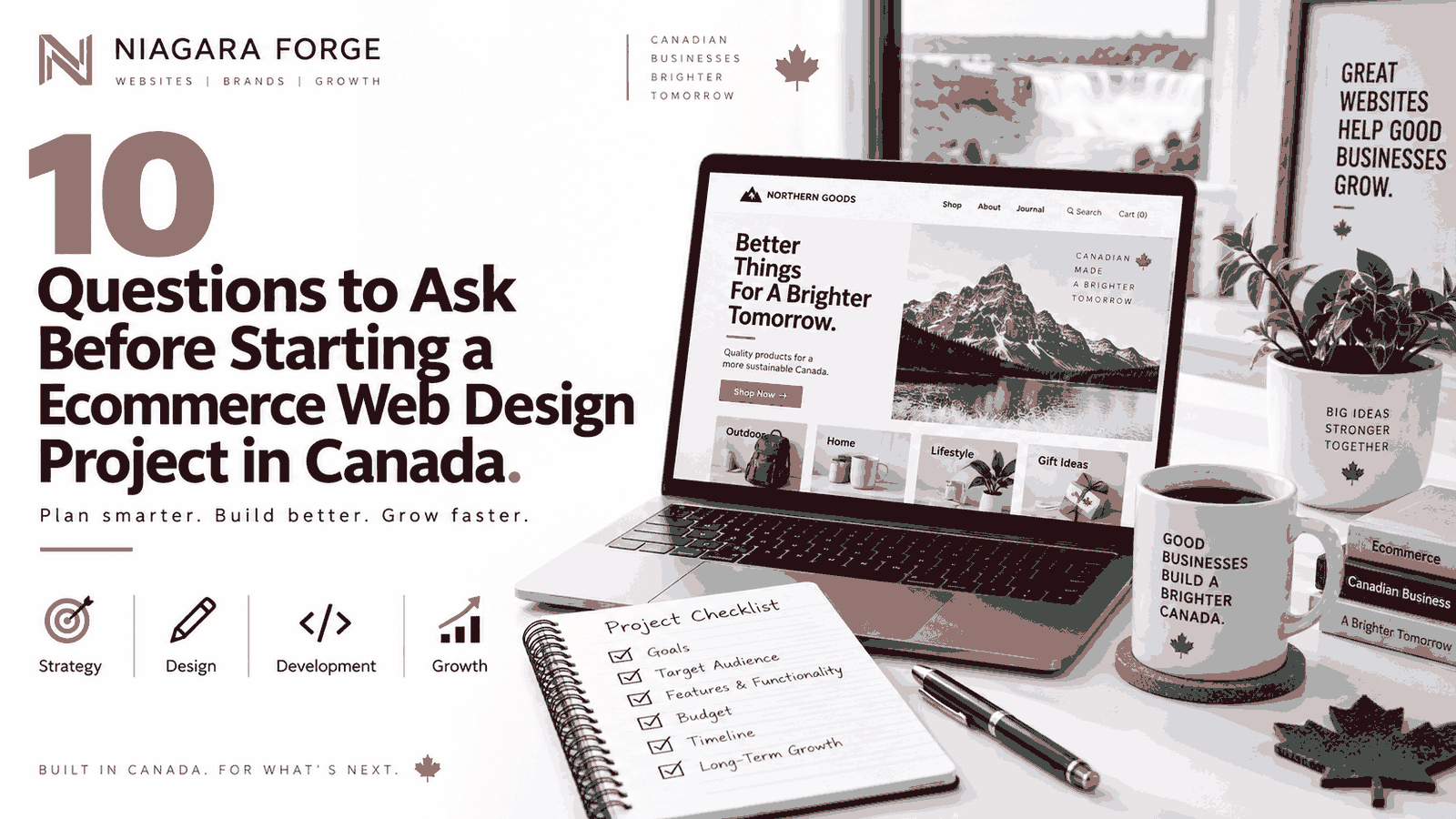




Comments (2)
Pingback: Custom Web Design in Edmonton: Strategy, Cost & What to Expect
Pingback: Ecommerce Web Design in Vancouver: Strategy, Cost & What to Expect