



Why Ecommerce Web Design Matters for Canadian Local Service Businesses
Canadian consumers now expect to complete everyday transactions online, and local service businesses are no exception. A salon in Halifax, a plumbing company in Saskatoon, or a tutoring studio in Mississauga all compete for the same attention as national brands. When a website makes it easy to browse, book, and pay, it stops being a digital brochure and starts functioning as a revenue channel. That shift is exactly what ecommerce web design for local service businesses in Canada is built to deliver: a storefront experience tailored to services, not just physical products.
The Shift to Online Transactions in Canadian Local Markets
Across Canada, the way people find and hire local services has changed. Mobile searches for nearby providers, online reviews, and instant booking options now shape purchasing decisions. A customer who needs a furnace repaired in Winnipeg or a dog walker in Victoria rarely wants to call during business hours and wait for a callback. They want to see availability, compare packages, and confirm a time slot within minutes.
This behaviour is not limited to major cities. Smaller communities from Thunder Bay to Charlottetown have adopted the same digital habits, partly because reliable internet access and mobile payments are widespread. For local businesses, the risk is not losing a single sale; it is losing visibility to competitors whose websites already support online scheduling and payment. Ecommerce functionality has become a baseline expectation rather than a premium add-on.
Benefits of Integrating Ecommerce for Service-Based Businesses
Adding ecommerce features to a service website creates measurable advantages that go beyond convenience. The most immediate gains come from removing friction between interest and payment.
- Expanded reach: Online booking and payment let a local business serve customers beyond its immediate neighbourhood, including clients who prefer to arrange everything outside regular hours.
- Streamlined bookings: Calendars, service packages, and deposits can be managed automatically, reducing phone tag and double-booking errors.
- Higher revenue per customer: Upsells such as add-on treatments, maintenance plans, or gift certificates are easier to present at checkout.
- Improved cash flow: Deposits and prepayments reduce no-shows and give owners more predictable income.
- Better data: Transaction records reveal which services sell, which seasons are busiest, and where marketing spend works hardest.
These benefits matter especially for small teams. A two-person landscaping crew or a solo massage therapist cannot afford to spend hours on administrative coordination. Ecommerce tools handle the repetitive work so the business can focus on delivering the service.
Key Differences Between Traditional Websites and Ecommerce-Enabled Sites
A traditional local service website typically presents information: an about page, a list of services, a contact form, and perhaps a gallery. An ecommerce-enabled site adds transactional layers that change how the site is built and maintained.
| Feature | Traditional Website | Ecommerce-Enabled Site |
|---|---|---|
| Primary goal | Inform and generate inquiries | Inform, book, and collect payment |
| Booking | Contact form or phone call | Real-time calendar and instant confirmation |
| Payments | In person or by invoice | Secure online checkout, deposits, and subscriptions |
| Inventory or availability | Manually updated or omitted | Automatically synced with bookings and stock |
| Customer accounts | Rarely offered | Optional profiles for history and rebooking |
The practical difference is that an ecommerce-enabled site must be designed around user flows, trust signals, and payment security from the start. Canadian businesses also need to consider local expectations such as transparent pricing in Canadian dollars, provincial tax handling, and mobile-first layouts for customers on the go. When these elements are done well, the website becomes a working member of the team rather than a static placeholder.
Understanding the Canadian Ecommerce Landscape for Local Services
Canada offers a distinctive environment for local service businesses moving into ecommerce. Unlike pure product retailers, service providers such as plumbers, cleaners, landscapers, salons, and repair specialists sell bookings, consultations, and on-site work rather than shippable goods. That distinction shapes nearly every design and marketing decision. Canadian consumers are comfortable buying online, but they still expect local relevance, transparent pricing, and fast human contact when the purchase involves a person entering their home or business. Understanding the national market, regional differences, and competitive dynamics helps local service businesses build an ecommerce presence that feels trustworthy rather than generic.
Canadian Consumer Online Shopping Trends
Canadian online shopping behavior has matured well beyond occasional browsing. Consumers routinely compare options on mobile devices, read reviews, check service areas, and book appointments without calling. Several trends matter most for local service providers:
- Mobile-first research: Many customers search while away from a desktop, so booking forms, click-to-call buttons, and pricing pages must work smoothly on small screens.
- Trust signals before purchase: Reviews, license numbers, insurance details, and local addresses reduce hesitation for services performed in person.
- Flexible payment expectations: Interac, credit cards, and digital wallets are all common, and deposits or prepayments are increasingly accepted for bookings.
- Bilingual expectations: In some markets, French and English content is not optional but a baseline requirement for credibility.
- Convenience over novelty: Customers want quick scheduling, clear cancellation terms, and confirmation messages, not elaborate shopping experiences.
For service businesses, this means the ecommerce site should prioritize booking flow, local proof, and simple payment options over large product catalogs.
Regional Variations in Ecommerce Adoption Across Canada
Canada is not a single uniform market. Ecommerce adoption and consumer expectations vary by region, and local service businesses should adapt their design and messaging accordingly.
| Region | Common Ecommerce Pattern | Design Implication |
|---|---|---|
| Ontario | High volume, dense competition in urban centres | Strong differentiation, fast load times, detailed service pages |
| Quebec | Strong preference for French-language experiences | Bilingual or French-first interface and support content |
| British Columbia | Mobile-heavy usage, environmental awareness | Clean design, mobile booking, sustainability messaging |
| Prairies | Practical buyers, wide service areas | Clear coverage maps, transparent travel or call-out fees |
| Atlantic Canada | Community trust and word-of-mouth matter greatly | Local testimonials, community ties, personal tone |
These patterns are tendencies, not absolutes, but they help explain why a single national template often underperforms a region-aware design.
Competitive Analysis: How Local Service Businesses Can Stand Out Online
Local service businesses often compete against national franchises, directory listings, and informal referrals. A well-designed ecommerce presence can separate a local provider from all three. Consider these practical differentiators:
- Hyperlocal SEO: Service-area pages that mention real cities, neighbourhoods, and response times outperform generic “we serve Canada” claims.
- Instant booking: Let customers choose a date and time, pay a deposit, and receive confirmation without waiting for an email reply.
- Transparent pricing: Display starting rates, package tiers, or diagnostic fees so visitors can self-qualify before contacting you.
- Verified reviews: Show recent, location-specific testimonials and link to third-party profiles where possible.
- Accessible design: Follow WCAG guidance so older customers and people with disabilities can complete bookings easily.
A competitive audit should compare your site against the top three local results for each core service. Check page speed, mobile usability, booking steps, and trust content. If a competitor requires a phone call while you offer instant online scheduling, that is a measurable advantage worth highlighting.
When structuring service pages, clean semantic markup also helps search engines understand your offerings. A simple example of an accessible booking button is shown below.
<a href="/book-now" class="cta-button" aria-label="Book a local service appointment online">Book Now</a>Combined with regional awareness and strong trust signals, that kind of clarity helps local service businesses compete effectively in Canada’s evolving ecommerce landscape.
Essential Features of an Ecommerce Website for Local Service Businesses
An ecommerce website for a local service business is not simply an online store with a shopping cart. It is a hybrid platform that must sell services, manage appointments, collect payments, and build trust with customers who live nearby. In Canada, where customers expect convenience and bilingual support in many regions, the right feature set can make the difference between a booking and a bounce. The following features are the foundation for any local service provider selling online.
Online Booking and Scheduling Systems
For service providers such as salons, mechanics, cleaners, and consultants, online booking is the single most important feature. Customers want to see real availability and reserve a time without calling during business hours. A strong booking system should display a live calendar, allow customers to choose a specific staff member or location, and send automatic email or SMS confirmations. It should also support buffer times between appointments, deposits, and cancellation policies. In Canada, where time zones span from Newfoundland to British Columbia, the system must handle local time correctly and ideally offer English and French interfaces for markets such as Quebec and New Brunswick. Integration with Google Calendar, Outlook, and popular Canadian scheduling tools reduces double-booking and no-shows.
Secure Payment Gateways and Canadian Payment Options
Payment processing must feel familiar and safe. Canadian customers expect to pay with major credit cards, Interac Debit, and increasingly Interac e-Transfer, especially for local services. A secure checkout should use SSL encryption, tokenization, and compliance with PCI DSS standards. Supporting multiple currencies is rarely necessary for local businesses, but displaying prices in Canadian dollars with clear taxes, including GST, HST, and PST depending on the province, is essential. Offering deposits or full prepayment can reduce cancellations, while saved payment methods encourage repeat business. Popular Canadian-friendly gateways include Moneris, Stripe, Square, and PayPal, each with different fee structures and hardware options.
Customer Review and Rating Integration
Local service businesses live and die by reputation. Integrating reviews directly into service pages and booking confirmations helps new customers trust the business. A good system allows verified customers to leave star ratings and written feedback after a completed service, and it should display an average rating prominently. Responding to reviews, both positive and negative, shows engagement. Embedding Google Reviews or a native review module keeps social proof visible without sending visitors off-site. For Canadian businesses, reviews should be moderated for spam and comply with privacy laws such as PIPEDA when collecting personal information.
| Feature | Primary Benefit | Canadian Consideration |
|---|---|---|
| Online Booking | 24/7 reservations, fewer phone calls | Bilingual support, multiple time zones |
| Payment Gateway | Faster checkout, upfront revenue | Interac, CAD pricing, GST/HST/PST |
| Reviews & Ratings | Builds trust, improves SEO | PIPEDA compliance, Google Reviews |
Together, these features create a professional ecommerce experience that meets local expectations and keeps service businesses competitive across Canada.
Design Principles for Effective Ecommerce Websites
Canadian service-based businesses operate in a unique ecommerce landscape: customers often book appointments, request quotes, or purchase packages rather than buy physical goods. The design principles below help ensure your online storefront converts visitors into paying clients, whether they are in Toronto, Vancouver, or a rural community in Nova Scotia.
User Experience (UX) Best Practices for Service-Based Ecommerce
Service-based ecommerce differs from product retail because the “product” is often intangible, time-based, or location-dependent. Your UX should reduce uncertainty and make the next step obvious.
- Clear service hierarchy: Organize services by category, location, or urgency so visitors find relevant offerings in one or two clicks.
- Transparent pricing or quote prompts: If exact pricing is impossible, provide starting rates, package tiers, or a visible “Get a Quote” button on every service page.
- Trust signals: Display Canadian business credentials, provincial licensing, insurance badges, and customer reviews near booking buttons.
- Frictionless booking flow: Limit checkout or booking forms to essential fields. Allow guest checkout and offer multiple payment options such as Interac, credit cards, and digital wallets.
- Post-purchase clarity: Confirm appointments, send reminders, and explain cancellation policies in plain language.
Mobile-First Design for On-the-Go Canadian Consumers
Many Canadians search for local services while commuting, traveling, or managing errands. A mobile-first approach is not optional; it is the baseline for conversion.
- Thumb-friendly navigation: Place primary actions within easy reach at the bottom of the screen.
- Fast loading: Compress images, use responsive media, and minimize third-party scripts to perform well on slower rural networks.
- Click-to-call and map integration: Make phone numbers and directions tappable so mobile users can act immediately.
- Responsive booking calendars: Ensure date and time selectors work smoothly on small screens without horizontal scrolling.
- Offline resilience: Cache key pages so users can review service details even with intermittent connectivity.
Accessibility Standards and Compliance in Canada
Accessibility is both a legal and ethical requirement in Canada. Depending on your province and organization type, you may need to comply with the Accessible Canada Act, the Accessibility for Ontarians with Disabilities Act (AODA), or similar provincial legislation. Designing for accessibility also expands your market reach.
| Requirement | Practical Implementation |
|---|---|
| Perceivable content | Use alt text for images, captions for video, and sufficient color contrast. |
| Operable interface | Ensure full keyboard navigation and visible focus states. |
| Understandable forms | Label every field, provide error suggestions, and avoid jargon. |
| Robust compatibility | Follow WCAG 2.1 AA and test with screen readers such as NVDA or VoiceOver. |
One practical way to check accessibility is to run an automated audit and then manually test keyboard navigation. For example, using the command line with a popular auditing tool:
npx @axe-core/cli https://your-service-business.ca --exitThis command scans your live site for common accessibility violations and returns a non-zero exit code if issues are found, making it easy to integrate into a deployment pipeline. Pair automated checks with manual testing, because no tool catches every barrier.
By combining thoughtful UX, mobile-first performance, and genuine accessibility compliance, Canadian service businesses can build ecommerce experiences that feel local, trustworthy, and effortless for every customer.
Choosing the Right Ecommerce Platform for Canadian Local Service Businesses
For a Canadian local service business, the ecommerce platform is more than a place to sell products. It is the booking engine, the payment processor, and often the first impression a customer gets. Whether you run a mobile detailing company in Halifax, a pet grooming salon in Saskatoon, or a home cleaning service in Mississauga, the platform you choose should handle product sales, service bookings, and Canadian payment methods without forcing you into unnecessary complexity.
Comparing Major Ecommerce Platforms: Pros and Cons
The three platforms most often considered by Canadian service businesses are Shopify, WooCommerce, and Wix. Each has a different sweet spot.
| Platform | Pros | Cons |
|---|---|---|
| Shopify | Reliable hosting, strong Canadian payment and tax support, easy product and service listings, large app marketplace | Monthly cost adds up, transaction fees if you do not use Shopify Payments, less flexible for highly custom service workflows |
| WooCommerce | Free core plugin, full control over design and data, excellent for content-heavy local service sites, no platform lock-in | Requires WordPress hosting, security, and updates, steeper learning curve, plugin conflicts can break checkout |
| Wix | Fast setup, drag-and-drop editor, built-in booking tools, affordable entry pricing | Limited scalability, fewer advanced ecommerce features, harder to migrate if the business grows |
For a small service business that needs to sell packages and accept deposits, Wix or Shopify is often enough. For a business that wants to publish local SEO content alongside its store, WooCommerce tends to be the stronger long-term choice.
Factors to Consider: Scalability, Cost, and Ease of Use
Before committing, weigh three practical factors against how you actually operate.
- Scalability: Will the platform handle more services, staff, locations, or product lines without a rebuild? Shopify scales well for product-heavy businesses; WooCommerce scales with server resources; Wix has a lower ceiling.
- Cost: Look beyond the monthly fee. Consider hosting, premium plugins or apps, payment processing rates, and the cost of a developer for custom work. A “free” platform can become expensive if it needs constant patching.
- Ease of use: If you or your team will update availability, prices, and promotions weekly, choose a platform you can manage without calling a developer. Shopify and Wix win here; WooCommerce rewards those with some technical comfort.
- Canadian requirements: Confirm support for GST/HST/PST, Interac debit, Canadian credit cards, and local shipping or service-area rules.
Integrating Local Service-Specific Tools (e.g., Calendly, Acuity)
Most local service businesses need scheduling more than they need a traditional cart. Tools like Calendly and Acuity Scheduling integrate with Shopify, WooCommerce, and Wix through apps, embeds, or plugins. A typical setup lets a customer buy a service package, then immediately choose an appointment time.
When evaluating integrations, check that the tool supports Canadian time zones, buffer times between appointments, staff calendars, SMS reminders, and deposit or prepayment collection. Also confirm that the booking data flows into your ecommerce platform so you can track revenue in one place. If you offer both products and services, choose a platform and booking tool that share a single checkout experience rather than sending customers to two different systems.
Canadian Legal and Regulatory Considerations for Ecommerce
Building an online store for a local service business in Canada means more than choosing the right theme or payment gateway. Federal and provincial rules shape how you collect data, charge tax, and sell to consumers. Getting these details wrong can lead to fines, forced refunds, or lost trust. The three areas below cover the essentials every Canadian ecommerce site should address before launch.
Privacy Laws: PIPEDA and Provincial Regulations
The Personal Information Protection and Electronic Documents Act (PIPEDA) governs how private-sector organizations collect, use, and disclose personal information during commercial activity. If your site takes orders, bookings, or newsletter signups, you are almost certainly subject to it. PIPEDA requires meaningful consent, limited collection, and reasonable safeguards. Your checkout and contact forms should link to a plain-language privacy policy that explains what you gather, why, how long you keep it, and who you share it with.
Some provinces have their own substantially similar private-sector laws, which apply instead of PIPEDA within that province. Alberta’s Personal Information Protection Act (PIPA), British Columbia’s PIPA, and Quebec’s Law 25 are the main examples. Quebec’s Law 25 is especially strict, adding requirements around privacy officers, breach notification, and consent for tracking technologies. If you serve customers across provinces, design to the strictest standard you touch.
- Post a clear privacy policy before collecting any personal data.
- Use consent checkboxes for marketing; never pre-tick them.
- Encrypt data in transit with TLS and restrict internal access.
- Report breaches involving real risk of significant harm to the Privacy Commissioner and affected individuals.
- Honour access and correction requests within the timeframes your governing law sets.
Tax Compliance: GST/HST and Provincial Sales Tax
Most Canadian businesses must register for the Goods and Services Tax (GST) once revenue exceeds the small supplier threshold, and the Harmonized Sales Tax (HST) applies in participating provinces. The Canada Revenue Agency administers GST/HST and requires you to charge the rate based on the buyer’s location. That means your ecommerce platform needs tax logic tied to the shipping or service address, not a single flat rate.
| Tax | Where It Applies | Typical Rate |
|---|---|---|
| GST | All provinces and territories | 5% |
| HST | Ontario, Nova Scotia, New Brunswick, Newfoundland and Labrador, Prince Edward Island | 13%–15% |
| QST | Quebec | 9.975% |
| PST/RST | British Columbia, Saskatchewan, Manitoba | 6%–7% |
Display tax-inclusive or tax-added pricing consistently, and show the breakdown at checkout. Keep records for at least six years. If you sell digital services or goods into Quebec, British Columbia, or Saskatchewan, registration may be required even without a physical presence there.
Consumer Protection and Distance Selling Regulations
Provincial consumer protection statutes and the federal Competition Act govern online sales. They require clear pricing, no misleading claims, and disclosure of material terms before purchase. Distance selling rules generally give buyers a cooling-off period for certain contracts, and refund or cancellation policies must be easy to find. Your site should state total cost, delivery or service timelines, and return conditions before the customer pays.
- Show the full price, taxes, and any fees before checkout.
- Provide written confirmation of the transaction.
- Publish refund, cancellation, and dispute-resolution policies.
- Avoid dark patterns that hide costs or force consent.
- Comply with anti-spam rules for commercial emails under CASL.
A practical way to centralize tax logic in a storefront is to call a rate lookup during checkout. For example, a server-side function might resolve the applicable rate from the customer’s province:
function getCanadianTaxRate(province) {
  const rates = {
    ON: 0.13, NS: 0.15, NB: 0.15, NL: 0.15, PE: 0.15,
    QC: 0.14975, BC: 0.12, SK: 0.11, MB: 0.12,
    AB: 0.05, NT: 0.05, NU: 0.05, YT: 0.05
  };
  return rates[province] || 0.05;
}
Pair that logic with a privacy policy and clear consumer terms, and your Canadian ecommerce site stays on the right side of the rules while giving local customers confidence to buy.
Local SEO and Ecommerce: Attracting Canadian Customers
For a Canadian service business selling online, ranking in local search is what turns a well-designed store into a steady source of nearby customers. Someone in Mississauga searching for “emergency plumber near me” or a homeowner in Halifax looking for “eavestrough cleaning Halifax” has clear intent, and your ecommerce site should be positioned to capture it. Local SEO for ecommerce works differently than for a purely informational website: you need product and service pages that rank, a fully optimized Google Business Profile, and consistent business information across the Canadian web.
Optimizing for Local Keywords and Google My Business
Local keyword research starts with how Canadians actually search. People combine a service with a city, region, or neighbourhood: “mobile detailing Ottawa,” ” furnace repair Calgary NE,” “wedding photographer Kelowna.” Build a dedicated page for each service-and-location combination you genuinely serve, rather than stuffing every city name onto one page. Each page needs unique copy, your service details, service-area information, and a clear way to book or buy.
Google Business Profile (formerly Google My Business) is often the single highest-impact local asset for a service ecommerce business. To make it work:
- Claim and verify your profile, then complete every field, including service areas, hours, and attributes.
- Choose the most accurate primary category and add relevant secondary categories.
- Add your website link to the specific service page, not just the homepage, where possible.
- Publish regular posts about promotions, seasonal services, or new offerings.
- Upload real photos of your team, vehicles, and completed work.
Keep your name, address, and phone number (NAP) identical to what appears on your website. Inconsistent details confuse both customers and search engines.
Building Local Citations and Directory Listings
Citations are mentions of your business name, address, phone number, and website on other sites. For Canadian service businesses, a handful of high-quality citations matter more than dozens of low-quality ones. Prioritize national and provincial directories, industry-specific listings, and local chambers of commerce.
| Citation Type | Examples | Why It Helps |
|---|---|---|
| National directories | Yellow Pages Canada, Yelp Canada | Strong domain authority and broad reach |
| Industry directories | Trade association or niche listing sites | Relevant audience and contextual links |
| Local organizations | Chambers of commerce, BIA listings | Community trust and local relevance |
Aim for consistency: use the same business name, address format, and phone number everywhere. Duplicate or outdated listings dilute your local visibility.
Leveraging Customer Reviews for Local SEO
Reviews influence both rankings and buying decisions. A steady flow of recent, detailed reviews signals that your business is active and trusted. Ask satisfied customers for a review at the moment of completion, and make it easy by sending a direct link.
- Respond to every review, positive or negative, in a professional and helpful tone.
- Mention the service and city naturally in your responses where it fits.
- Display reviews on relevant service pages to reinforce local relevance.
- Never buy fake reviews; Canadian consumers and Google both penalize it.
Combine these three pillars, optimized local pages, a complete Google Business Profile, and consistent citations with active review management, and your ecommerce site becomes far more visible to the Canadian customers most likely to buy.
Payment Processing and Financial Transactions in Canada
For local service businesses selling online, the checkout experience is where trust is won or lost. Canadian buyers expect familiar payment options, transparent pricing in Canadian dollars, and strong fraud protection. Choosing the right payment stack is therefore a core part of ecommerce web design, not an afterthought bolted on at launch. The goal is to reduce friction for local customers while keeping your transaction costs and chargeback exposure under control.
Popular Payment Gateways in Canada
Canada has a mature payments market that blends global processors with domestic heavyweights. Moneris is one of the country’s largest payment processors, with deep roots in debit and credit card acquiring, and it is a common choice for businesses that want integrated in-store and online payments. Stripe is widely used by smaller service businesses and SaaS-style offerings because of its developer-friendly APIs and quick setup. PayPal remains a familiar option for buyers who prefer not to enter card details on every site. Square is popular with local service providers who already use its point-of-sale hardware, and Helcim is a Canadian alternative known for transparent interchange-plus pricing.
Interac is a defining feature of the Canadian market. Interac Debit is the country’s dominant debit network, and Interac e-Transfer is widely used for person-to-person and business payments. For ecommerce, Interac Online allows customers to pay directly from their bank account, which can appeal to buyers who are cautious about sharing card information. Supporting Interac alongside Visa, Mastercard, and American Express helps you meet local expectations rather than forcing customers into unfamiliar payment methods.
| Payment method | Typical use case | Buyer experience | Consideration for local service businesses |
|---|---|---|---|
| Interac Debit / Interac Online | Everyday purchases, local services | Pay from a Canadian bank account | Strong domestic trust; availability depends on gateway support |
| Credit cards (Visa, Mastercard, Amex) | General online checkout | Enter card details or use a digital wallet | Universal acceptance; Amex fees are often higher |
| Interac e-Transfer | Invoicing, deposits, one-off payments | Send funds via online banking | Common for service deposits; less suited to instant automated checkout |
| Digital wallets (Apple Pay, Google Pay) | Mobile and repeat purchases | Authenticate with device biometrics | Reduces checkout friction; requires compatible gateway |
Handling Multi-Currency and Cross-Border Transactions
Most local service businesses price in Canadian dollars, and displaying CAD clearly avoids surprises at checkout. If you serve customers in the United States or elsewhere, you can present prices in the buyer’s currency or settle in CAD and let the processor handle conversion. Either way, be explicit about the currency, applicable taxes, and any conversion fees. Cross-border transactions may attract different interchange rates and can trigger additional scrutiny from fraud systems, so it helps to flag them in your reporting. Canadian sales tax rules, including GST/HST and provincial taxes, should be configured in your checkout so totals are accurate before the customer commits.
Security and Fraud Prevention Best Practices
Security is both a technical requirement and a trust signal. Card data should never touch your own servers if you can avoid it; using hosted payment fields or tokenization keeps sensitive information within the gateway’s PCI-compliant environment. Enable 3-D Secure or equivalent authentication where available, since it shifts liability for certain fraud chargebacks. Address Verification System checks, CVV requirements, and velocity limits on repeated attempts all help filter out suspicious orders. For service businesses, consider deposits or partial payments for high-value bookings, and monitor chargeback patterns to refine your rules. Finally, keep your site on HTTPS, patch your platform promptly, and use a Canadian-friendly privacy policy that explains how payment data is handled.
Marketing and Promoting Your Ecommerce Website Locally
Once your ecommerce site is live, your next challenge is getting it in front of the right people — specifically, customers in your city or region. For local service businesses in Canada, broad national campaigns often waste budget. A tighter, community-focused approach tends to produce better returns because it aligns with how Canadians actually search, shop, and refer neighbours. The strategies below work together: social media builds familiarity, email keeps customers coming back, and paid local ads capture demand at the moment it appears.
Social Media Marketing for Local Service Businesses
Social platforms let you show the human side of your business while targeting people in your service area. In Canada, Facebook and Instagram remain strong for local discovery, while TikTok is increasingly effective for younger urban audiences. The key is consistency and locality rather than volume.
- Post geotagged photos from job sites, storefronts, or community events to reinforce your location.
- Use platform location targeting so your ads only reach users within your delivery or service radius.
- Encourage reviews and user-generated content — Canadian consumers often check reviews before contacting a local provider.
- Bilingual content matters in regions such as Quebec and parts of New Brunswick; even a short French caption can widen your reach.
- Respond to comments and messages quickly. Local trust is built through conversation, not broadcasting.
Email Marketing and Automation
Email remains one of the highest-ROI channels for local commerce because your list is made up of people who already know you. Build it through in-store signups, website popups, and post-purchase follow-ups, and always comply with Canada’s Anti-Spam Legislation (CASL) by obtaining express or implied consent and including a clear unsubscribe option.
Automation keeps your message timely without constant manual effort. A simple sequence might include a welcome email, a seasonal service reminder, and a re-engagement note for customers who haven’t purchased in six months. Segment by postal code or city so promotions about local events, pickup options, or regional pricing reach the right inboxes.
Local Advertising Options: Google Ads, Facebook Ads, and More
Paid advertising should complement your organic efforts. Each platform serves a different intent, so match the channel to the customer’s mindset.
| Channel | Best For | Local Tip |
|---|---|---|
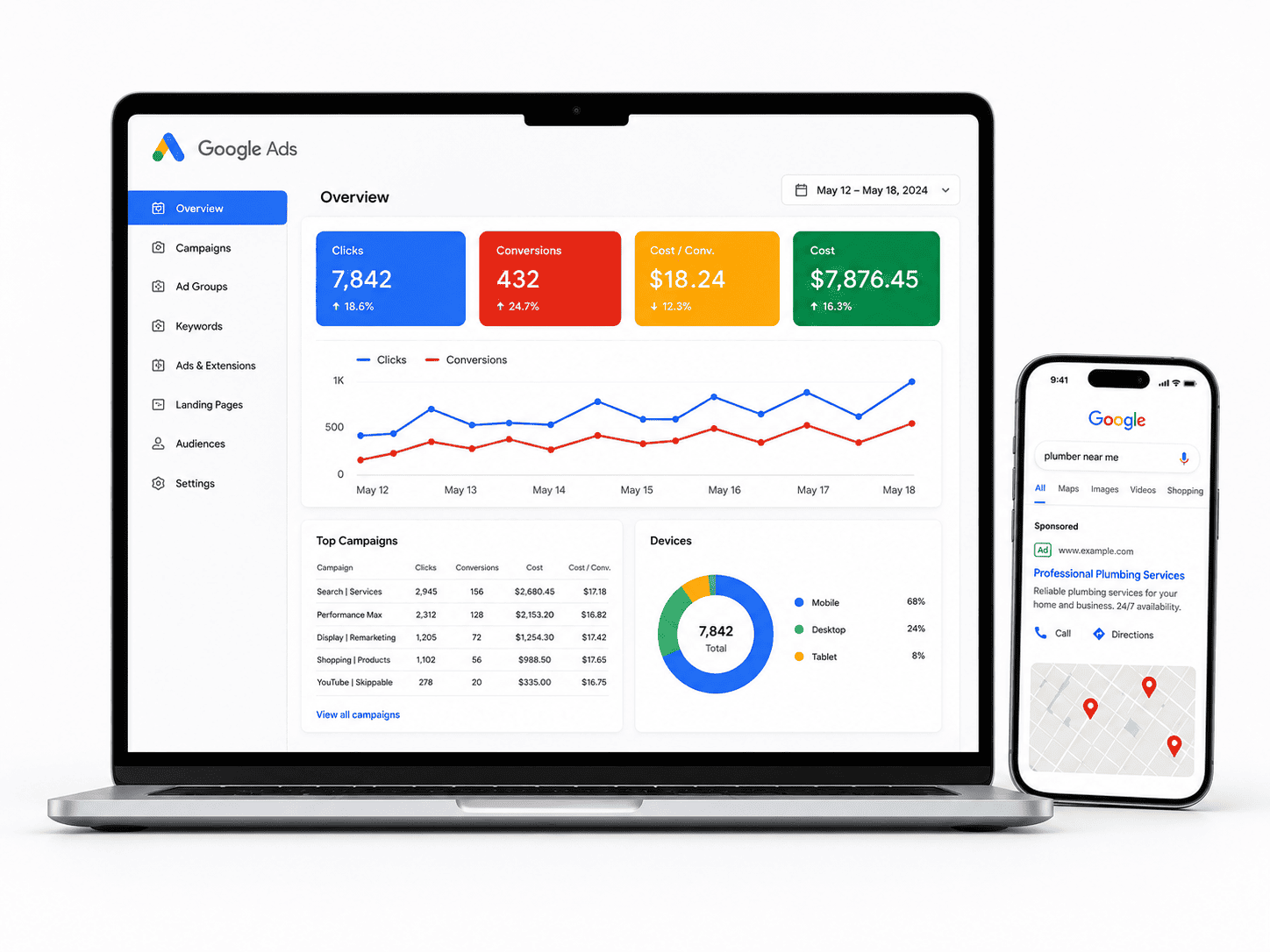
| Google Ads (Search) | High-intent searches like “plumber near me” | Use location targeting by city or radius; add call extensions |
| Google Local Services Ads | Service providers needing verified leads | Available in select Canadian markets; pay per lead |
| Facebook & Instagram Ads | Awareness, retargeting, and community engagement | Combine interest targeting with a tight geographic radius |
| Local sponsorships | Community events, sports teams, newsletters | Often cheaper than digital ads and builds local credibility |
Track results with conversion goals tied to your ecommerce checkout. Even a small budget spent on the right keywords and neighbourhoods can outperform a larger, unfocused campaign. Review performance monthly and shift spend toward the channels that bring in paying local customers.
Measuring Success and Continuously Improving Your Ecommerce Site
Launching an ecommerce site for a local service business in Canada is not the finish line. Whether you sell booking packages, maintenance plans, or physical products alongside your services, the site should evolve based on evidence rather than assumption. Measurement turns visitor behaviour into decisions you can act on, and a steady cycle of small improvements often outperforms a single large redesign.
Key Metrics to Track: Conversion Rate, AOV, and Customer Retention
Three numbers form the foundation of ecommerce health for Canadian service businesses. Conversion rate shows how many visitors complete a desired action, such as booking a service, purchasing a package, or requesting a quote. Average order value (AOV) reveals how much revenue each transaction generates, which matters when your services have different price points. Customer retention measures how many clients return or renew, a critical signal for recurring services like seasonal maintenance or subscription plans.
Track these alongside supporting metrics so you can diagnose changes rather than just observe them:
- Conversion rate by channel: Compare organic search, Google Ads, social, and email to see which sources bring ready-to-buy local customers.
- AOV by service category: Identify which bundles, add-ons, or upsells raise transaction value without hurting conversion.
- Repeat purchase or renewal rate: Measure how often clients book again within a defined window, such as 90 or 365 days.
- Cart or booking abandonment: High abandonment often points to unclear pricing, unexpected fees, or a complicated checkout.
- Lead-to-sale time: Useful for services that require a consultation before purchase.
A simple monthly dashboard keeps these figures visible. For example, if conversion rate is stable but AOV is falling, your promotions or service mix may be attracting lower-value jobs. If retention is slipping, the issue may be post-purchase communication rather than the website itself.
Using Analytics Tools (e.g., Google Analytics, Hotjar)
Google Analytics 4 provides the quantitative layer: traffic sources, page engagement, conversion events, and revenue. Configure events for the actions that matter to your business, such as clicking a “Book Now” button, submitting a quote form, or completing checkout. In Canada, ensure your analytics setup respects applicable privacy requirements, including clear consent language where required.
Quantitative data tells you what happened; qualitative tools tell you why. Hotjar and similar platforms offer heatmaps, session recordings, and on-site surveys. Use them to watch how visitors interact with pricing tables, service pages, and booking forms. A heatmap might show that most mobile users never scroll to your call-to-action, while a survey could reveal that visitors cannot tell whether you serve their city.
A/B Testing and Iterative Design Improvements
Once you have reliable data, test one meaningful change at a time. Prioritise elements closest to revenue: headlines, calls-to-action, form length, pricing presentation, and trust signals such as reviews or service guarantees.
- Formulate a hypothesis, for example: “Shortening the quote form will increase submissions.”
- Run the test long enough to gather sufficient traffic, ideally across full business cycles.
- Measure the primary metric plus guardrails, such as lead quality or refund rate.
- Keep winners, document learnings, and move to the next test.
Iterative design is not about constant change for its own sake. It is a disciplined loop: measure, learn, adjust, and repeat. For local service businesses in Canada, that loop keeps your ecommerce site aligned with real customer behaviour, seasonal demand, and long-term growth.
Frequently Asked Questions
What is ecommerce web design for a local service business?
Ecommerce web design for a local service business combines a service-oriented website with online transactions, such as booking appointments, paying deposits, purchasing packages, or buying gift certificates. Unlike a pure product store, it prioritizes trust signals, service-area pages, and local search visibility. In Canada, it should also support local payment methods, bilingual options where relevant, and compliance with PIPEDA and provincial consumer protection rules.
Do local service businesses in Canada need an online store?
Not always. If your services are booked by phone or in person, a simple booking and payment flow may be enough. An online store is useful when you sell packages, gift cards, memberships, or fixed-price services. In Canada, offering online payment can reduce no-shows and speed up cash flow, but it must comply with the Personal Information Protection and Electronic Documents Act (PIPEDA) and applicable provincial consumer protection laws.
Which platform is best for a Canadian local service ecommerce site?
The best platform depends on your catalog, booking needs, and budget. WordPress with WooCommerce offers flexibility and strong local SEO plugins. Shopify is fast to launch and handles payments and tax settings for Canada. Squarespace and Wix are simpler for small sites. For service businesses, prioritize a platform that supports appointment booking, local business schema, mobile performance, and Canadian payment gateways like Moneris, Stripe, or PayPal.
How can I improve local SEO for my Canadian service business?
Start with a verified Google Business Profile and consistent name, address, and phone number across Canadian directories. Create dedicated service-area and city pages with unique content, not duplicate templates. Use local business schema markup, collect reviews, and ensure your site loads quickly on mobile. For bilingual regions, provide French and English content. These steps help you appear in local map packs and organic results for searches like ‘near me’ in Canadian cities.
What accessibility standards apply to Canadian ecommerce websites?
In Canada, accessibility requirements vary by jurisdiction. Federally regulated organizations follow the Accessible Canada Act. Ontario, Manitoba, and Nova Scotia have provincial rules, and Quebec has strong accessibility standards. The widely used technical benchmark is WCAG 2.2 Level AA. Practical steps include alt text, keyboard navigation, sufficient color contrast, accessible forms, and captions for video. Accessibility also improves SEO and usability for all visitors.
Which payment methods should Canadian local service ecommerce sites offer?
Offer Interac e-Transfer, credit and debit cards, and digital wallets like Apple Pay and Google Pay. Many Canadian customers expect Interac, especially for larger service deposits. Stripe, PayPal, Moneris, and Square are common gateways. Display prices in CAD, clearly state taxes such as GST/HST, and explain refund and cancellation policies. Always use HTTPS and a PCI-compliant checkout to protect customer payment data.
How do I measure if my ecommerce web design is working?
Track conversion rate, average order value, booking completion rate, and cart abandonment. Use Google Analytics 4 and Google Search Console to monitor organic traffic and local queries. Monitor Core Web Vitals with PageSpeed Insights or CrUX. For local service businesses, also track calls, direction requests, and form submissions from your Google Business Profile. Set a baseline before redesign, then test one change at a time, such as a new booking flow or clearer service pricing.
What Canadian legal pages should my ecommerce website include?
Include a privacy policy that explains how you handle personal information under PIPEDA, terms of service, refund and cancellation policies, and clear contact details. If you sell to Quebec residents, comply with Quebec’s Consumer Protection Act and French language requirements. If you collect email addresses, follow Canada’s Anti-Spam Legislation (CASL) by obtaining consent and providing unsubscribe options. These pages build trust and reduce legal risk for local service businesses.
Sources and further reading
- Office of the Privacy Commissioner of Canada: PIPEDA
- W3C Web Content Accessibility Guidelines (WCAG) 2.2
- Google Search Central: Local Business Structured Data
- Google Search Central: SEO Starter Guide
- web.dev: Core Web Vitals
- Government of Canada: Anti-Spam Legislation (CASL)
- Office of Consumer Affairs: Consumer Protection in Canada
- Baymard Institute: Ecommerce UX Research
- Nielsen Norman Group: Usability and UX Articles
- Stripe: Payments for Canada
Need help with this topic?
Send us your details and we will contact you.