
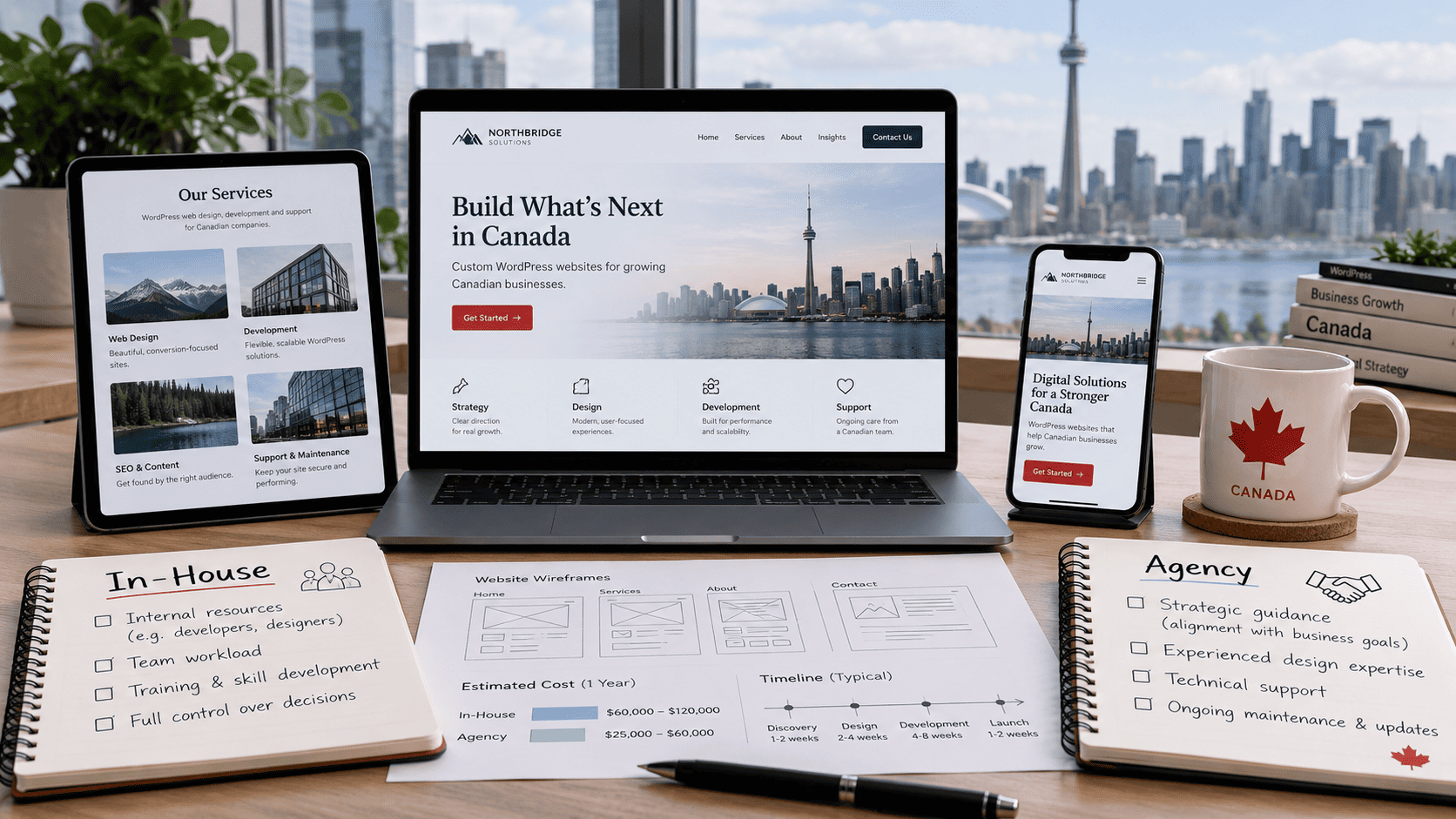
Why the In-House vs Agency Decision Matters for Canadian Companies
Choosing how to build and maintain a WordPress website is not a minor operational detail. For Canadian companies, it is a structural decision that shapes budgets, timelines, staffing, and the ability to compete online. The two dominant paths — keeping WordPress web design in-house or partnering with an agency — lead to very different outcomes in cost, control, and long-term success. Understanding those differences before committing is what separates a website that supports growth from one that quietly drains resources.
The Growing Reliance on WordPress for Canadian Businesses
WordPress powers a substantial share of websites worldwide, and Canadian businesses have embraced it for practical reasons. It is open source, flexible, and supported by a large talent pool across provinces. A small retailer in Halifax, a SaaS startup in Waterloo, and a professional services firm in Vancouver can all run on the same core platform while presenting completely different experiences.
That popularity creates both opportunity and risk. Because WordPress is widely used, many people claim familiarity with it. A developer who can install a theme is not necessarily equipped to build a secure, fast, accessible site that scales. The platform’s flexibility means the quality of the outcome depends heavily on who is doing the work — and that is precisely why the in-house versus agency question carries weight.
Key Factors Beyond Cost: Time, Expertise, and Scalability
Cost is usually the first consideration, but it is rarely the deciding factor in a well-run project. Three other dimensions matter just as much:
- Time: In-house teams can respond quickly to small changes, but large builds compete with daily operational demands. Agencies bring dedicated capacity and predictable delivery schedules.
- Expertise: WordPress web design requires more than coding. It involves UX, accessibility standards, performance optimization, security hardening, SEO structure, and plugin governance. Few internal teams cover all of these deeply.
- Scalability: A site that works for 10 pages may fail at 500. Agencies typically bring reusable processes, hosting knowledge, and maintenance systems that support growth without rebuilding from scratch.
Canadian companies also face specific pressures: bilingual content requirements, provincial privacy expectations, and a dispersed talent market where senior WordPress specialists may be difficult to hire locally. These factors often tip the balance toward external expertise, even when an internal team exists.
How the Wrong Choice Can Impact Your Digital Presence
Mismatching the approach to the company’s needs produces predictable problems. An under-resourced in-house effort can lead to outdated plugins, security gaps, slow load times, and a site that becomes harder to update with every passing month. Conversely, hiring an agency without clear internal ownership can result in dependency, rising retainer costs, and a loss of editorial control.
The consequences are not abstract. A slow or insecure WordPress site affects search rankings, conversion rates, and customer trust. Rebuilding a neglected site often costs more than building it correctly the first time. For Canadian businesses competing in crowded markets, the decision between in-house and agency work is ultimately a decision about how much risk and how much capability the organization is prepared to carry.
Understanding In-House WordPress Web Design
In-house WordPress web design means that a Canadian company builds, maintains, and evolves its website using its own employees rather than outsourcing the work to an external agency. The website is treated as an internal product, with design, development, content, and ongoing maintenance handled by staff who sit inside the organisation. This approach can offer deep brand familiarity and direct control, but it also requires a realistic assessment of the roles, skills, and resources needed to sustain a professional WordPress presence over time.
What Constitutes an In-House Web Design Team?
An in-house team does not have to be large, but it must cover the core disciplines of WordPress web design. In smaller Canadian companies, one person may wear several hats; in larger organisations, responsibilities are typically split across specialised roles. A functional in-house team usually includes:
- Web designer or UI specialist: Owns layout, typography, colour, imagery, and the overall visual system, often working within a brand guide.
- WordPress developer: Builds or customises themes and plugins, manages the hosting environment, and handles performance, security, and integrations.
- Content specialist or copywriter: Produces and structures pages, blog posts, product descriptions, and calls to action that align with business goals.
- SEO and analytics lead: Monitors search visibility, keyword targeting, site speed, and conversion data, then feeds insights back into design decisions.
- Project owner or marketing manager: Prioritises work, approves changes, and coordinates with legal, sales, and other departments.
Beyond people, an in-house operation needs reliable hosting, staging environments, backup and security tooling, and a documented process for updates and approvals. Without these resources, even a skilled team can struggle to keep a WordPress site stable and current.
Essential Skills for In-House WordPress Development
WordPress rewards practical, current skills. An in-house team should be comfortable with the following areas:
- Theme and template work: Customising block themes, child themes, and template hierarchies.
- Plugin management: Evaluating, installing, updating, and troubleshooting plugins without breaking site functionality.
- Front-end fundamentals: HTML, CSS, and enough JavaScript to adjust layouts and interactive elements.
- PHP familiarity: Reading and modifying theme functions, hooks, and filters when needed.
- Performance and security: Caching, image optimisation, SSL, user roles, and update schedules.
- Accessibility and SEO basics: Semantic markup, alt text, heading structure, and crawlable content.
For example, a developer checking theme details from the command line might use WP-CLI, a common tool in WordPress workflows:
wp theme list --status=activeThis command returns the active theme, helping the team confirm which theme is live before making changes. Similar commands can list plugins, update core, or run database checks, which makes WP-CLI valuable for in-house maintenance routines.
Common Scenarios Where In-House Works Well
In-house WordPress web design tends to succeed in specific situations. It is often a good fit when:
- The company has a stable website with predictable, recurring updates such as blog posts, team pages, or event listings.
- Brand and compliance requirements demand tight internal control over every published change.
- The organisation already employs developers or designers who can absorb web work alongside other duties.
- Long-term cost control matters more than rapid access to a broad range of specialist skills.
- The website is closely tied to internal systems, such as CRM or e-commerce platforms, that staff already understand.
In these cases, an in-house team can respond quickly, protect institutional knowledge, and keep the WordPress site aligned with day-to-day business priorities. The trade-off is that the company must invest in continuous learning, tooling, and backup capacity so the site does not stall when key staff are unavailable.
Understanding Agency WordPress Web Design
A WordPress design agency is a specialized studio that plans, designs, builds, and maintains WordPress websites for client organizations. Rather than treating WordPress as one tool among dozens, these firms make it their core discipline. For Canadian companies, that focus matters: agency teams already understand the platform’s strengths, its common failure points, and the plugin and hosting ecosystems that keep a site fast and secure over time. Agencies typically take responsibility for the full lifecycle of a project, from discovery and information architecture through design, development, launch, and ongoing support. That end-to-end ownership is the main reason many Canadian businesses choose an agency over building in-house, even when internal staff have some web skills.
Services Typically Offered by WordPress Design Agencies
Agencies usually bundle several connected services so that strategy, design, and technical execution stay aligned. Common offerings include:
- Discovery and strategy: stakeholder interviews, competitive review, sitemap and content planning, and measurable goals for the new site.
- UX and visual design: wireframes, responsive layouts, design systems, and accessibility-aware interfaces.
- WordPress development: custom themes and blocks, plugin configuration or custom plugin work, and integrations with CRM, e-commerce, and marketing tools.
- Content migration and SEO foundations: moving existing pages, redirect mapping, metadata, and technical SEO setup.
- Quality assurance and launch: cross-browser and device testing, performance checks, security hardening, and deployment.
- Ongoing care: updates, backups, uptime monitoring, security patching, and iterative improvements after launch.
Because these services overlap, an agency can catch problems early. A design decision that would slow page load, for example, gets flagged during wireframing rather than after development.
How Agencies Structure Their Teams for Canadian Clients
A typical agency assigns a small core team to each engagement, backed by specialists who join at specific stages. A project manager or account lead acts as the main point of contact and keeps timelines, budgets, and approvals on track. A strategist or UX lead handles research and structure. Designers and WordPress developers do the build work, often in parallel. A QA specialist tests the result, and a support or maintenance team takes over after launch.
For Canadian clients, this structure offers practical advantages. Agencies can schedule meetings within Canadian business hours, work in English or French as needed, and account for provincial privacy expectations such as PIPEDA-aligned data handling. Many agencies also coordinate with a client’s internal marketing, IT, or legal teams, so the website fits existing systems instead of becoming an isolated project.
When an Agency Becomes the Strategic Choice
An agency is often the stronger option when a project is complex, time-sensitive, or tied to business growth. Examples include a multi-site rollout, an e-commerce launch, a brand refresh, or a site that must integrate with several backend tools. Agencies also suit organizations without dedicated WordPress staff, or whose internal team is already at capacity. When continuity, security, and measurable performance matter more than short-term cost savings, the agency model tends to deliver more predictable results.
| Factor | In-House Team | WordPress Design Agency |
|---|---|---|
| WordPress depth | Varies with individual staff experience | Dedicated specialists across design, development, and support |
| Speed to launch | Depends on internal availability and competing priorities | Dedicated project team with established workflows |
| Cost pattern | Ongoing salaries and benefits | Project fees plus optional maintenance retainers |
| Continuity and coverage | Risk if a key employee leaves | Team-based knowledge and documented processes |
| Best fit | Simple, stable sites with capable internal staff | Complex, growth-focused, or deadline-driven projects |
For many Canadian companies, the agency route is less about outsourcing control and more about gaining a partner who has solved similar WordPress problems before.
Cost Comparison: In-House vs Agency for Canadian Companies
When Canadian companies weigh in-house WordPress web design against hiring an agency, the sticker price is only part of the story. Salaries, benefits, software subscriptions, and lost opportunities all shape the true cost. The table below offers a directional comparison; actual figures vary by province, city, and seniority.
| Cost Category | In-House | Agency |
|---|---|---|
| Web designer/developer salary | $65,000–$110,000 CAD annually | Included in project or retainer fee |
| Benefits and payroll costs | 15–25% on top of salary | None directly |
| Project or retainer fee | Not applicable | $5,000–$50,000+ CAD per project; retainers often $1,500–$8,000 CAD monthly |
Direct Costs: Salaries, Benefits, and Agency Retainers
In-house WordPress talent in Canada commands a meaningful salary. A mid-level developer in Toronto or Vancouver may earn $75,000–$95,000 CAD, while senior specialists can exceed $110,000 CAD. Employers also pay Canada Pension Plan (CPP), Employment Insurance (EI), and often health or dental benefits, adding roughly 15–25% to base pay. Recruitment alone can cost thousands.
Agencies bundle design, development, hosting, and support into fixed project fees or monthly retainers. A typical custom WordPress build for a Canadian small or mid-sized business ranges from $8,000 to $40,000 CAD, depending on complexity. Ongoing care plans commonly run $100–$500 CAD per month, while larger retainers for continuous improvements can reach $5,000 CAD or more.
Indirect Costs: Training, Tools, and Opportunity Costs
In-house teams face indirect costs that rarely appear on a quote:
- Training: WordPress, accessibility (AODA in Ontario), and security practices evolve constantly. Courses, conferences, and certification can cost $1,000–$5,000 CAD per person annually.
- Tools: Premium plugins, page builders, backup services, security monitoring, and staging environments often total $500–$3,000 CAD per year.
- Opportunity costs: Every hour your developer spends troubleshooting a plugin is an hour not spent on revenue-generating work. If that employee bills at $100 CAD per hour, a 10-hour fix costs $1,000 CAD in lost output.
- Coverage gaps: Vacations, illness, and turnover can stall a website project for weeks.
Agencies absorb these indirect costs through specialization and shared resources, but clients pay for that expertise in the retainer. The trade-off is predictable budgeting versus internal control.
Long-Term Financial Implications and ROI Considerations
Over three years, a single in-house hire can cost $250,000–$350,000 CAD fully loaded. An agency delivering the same scope through a build plus a care plan might cost $60,000–$150,000 CAD, depending on ongoing needs. However, in-house teams build institutional knowledge and can iterate faster on small changes.
ROI depends on volume and strategic importance. Companies with frequent, complex WordPress needs may justify an in-house lead plus an agency for peak projects. Companies with occasional updates usually achieve better ROI by outsourcing. To compare options objectively, calculate total cost of ownership, not just the hourly rate. A simple annual benchmark is:
Annual TCO = Salary + Benefits + Tools + Training + Opportunity Cost
Agency TCO = Project Fees + Retainers + Internal Review Time
Canadian businesses should also factor in time zones, bilingual support (especially in Quebec), and local privacy requirements such as PIPEDA. The cheapest option is rarely the most cost-effective once hidden expenses are included.
Control and Flexibility: Which Approach Offers More?
Control and flexibility are often the deciding factors when Canadian companies choose between building an in-house WordPress team and hiring an agency. Both models can deliver excellent results, but they distribute decision-making power very differently. Understanding where that power sits—and how quickly it can be exercised—helps you match the structure to your business reality.
Day-to-Day Control Over Design and Development
An in-house team keeps design and development decisions inside the building. Product managers, marketers, and developers can huddle in minutes, adjust a landing page, or ship a plugin update without waiting on a third party. That proximity creates tight feedback loops, especially for companies with complex internal workflows or regulated content that requires legal and compliance review at every step.
Agencies, by contrast, hold day-to-day control during the engagement. They set sprint schedules, assign designers and developers, and manage the WordPress stack—hosting, staging, updates, and security. Canadian clients typically retain approval rights at key milestones rather than controlling individual commits. The trade-off is clear: you exchange some granular control for access to specialists who already know the platform deeply.
Consider how each model handles common tasks:
- Content updates: In-house teams publish immediately; agency clients may submit tickets or use a retainer queue.
- Design changes: In-house designers iterate live; agencies scope changes against the original statement of work.
- Technical maintenance: In-house staff own updates and backups; agencies often bundle this into care plans.
Flexibility to Pivot Strategy and Respond to Market Changes
Market shifts—a new competitor, a seasonal promotion, a sudden spike in mobile traffic—reward whoever can change direction fastest. In-house teams can pivot mid-sprint because priorities live in the same room. If a Canadian retailer needs a bilingual campaign page live before a holiday weekend, an internal developer can act that afternoon.
Agencies can also pivot, but the mechanics differ. Retainer agreements and change orders define how much work falls inside the current budget. Some agencies build in monthly “flex hours” precisely for this reason; others treat every new request as a separate project. The result is that agencies often deliver stronger strategic pivots—rebrands, replatforms, major UX overhauls—while in-house teams excel at tactical, rapid-response changes.
| Scenario | In-House Advantage | Agency Advantage |
|---|---|---|
| Urgent campaign page | Same-day execution | Limited by retainer scope |
| Full site redesign | Requires hiring or upskilling | Specialists available immediately |
| Ongoing A/B testing | Continuous, low-friction | Possible but often billed hourly |
Balancing Control with Resource Constraints
Control has a cost. A full in-house WordPress capability means salaries, benefits, training, and coverage for vacations or turnover—significant fixed expenses for a small or mid-sized Canadian business. Agencies convert those fixed costs into variable ones, which preserves cash flow but reduces direct control.
A practical middle path is emerging among Canadian companies: keep one in-house WordPress generalist to own strategy, content, and vendor management, while an agency handles design systems, complex development, and peak workloads. This hybrid preserves day-to-day control where it matters most and buys flexibility when internal capacity runs thin. The right balance depends less on ideology and more on how often your website must change, how specialized those changes are, and how much uncertainty your roadmap contains.
Expertise and Skill Availability in the Canadian Market
For Canadian companies weighing in-house WordPress development against an agency partnership, the deciding factor is often not budget but talent. WordPress powers a large share of Canadian business websites, yet the depth of available expertise varies sharply by region, role, and specialization. Understanding where skilled developers live, which skills are hardest to hire, and how agencies bridge the gap helps leaders make a realistic staffing decision.
Talent Hotspots and Shortages Across Canada
Canada’s WordPress talent is concentrated in a handful of metropolitan corridors. Toronto and the Waterloo region anchor the largest pool of developers, thanks to a dense startup ecosystem, major agencies, and universities feeding graduates into web roles. Vancouver follows closely, with strong demand from tech, film, and e-commerce sectors. Montreal offers a deep bilingual talent base, particularly for agencies serving Quebec and European clients, while Ottawa benefits from public-sector and enterprise demand.
Outside these centres, the picture changes. Smaller provinces and rural communities often have fewer senior WordPress specialists, and local businesses may compete for the same handful of freelancers. The result is a familiar pattern: entry-level and mid-level WordPress skills are reasonably available nationwide, but senior architects, performance engineers, and accessibility experts are scarce almost everywhere. Companies in Atlantic Canada or the Prairies may find that the strongest candidate for an in-house role is remote, which brings its own management and retention challenges.
Access to Specialized Skills: UX, SEO, and Security
Modern WordPress work is rarely just theme and plugin development. A competitive site demands a blend of disciplines that few individuals master equally well. The most sought-after capabilities include:
- UX and accessibility: Research, wireframing, WCAG 2.1/2.2 compliance, and design systems that work within WordPress block editor constraints.
- Technical SEO: Core Web Vitals optimization, structured data, crawl budget management, and migration-safe URL strategies.
- Security and maintenance: Hardening, vulnerability patching, malware response, backup strategy, and compliance with Canadian privacy expectations such as PIPEDA.
- Performance and hosting: Caching layers, CDN configuration, database tuning, and headless or decoupled architectures.
Hiring one person to cover all of these is expensive and often unrealistic. A common practical check for any in-house or agency team is verifying that the WordPress environment is properly configured for caching and security. For example, a developer might confirm caching support with a quick WP-CLI command:
wp cache flush && wp plugin list --status=activeThis flushes the object cache and lists active plugins, a fast way to audit what is running before diagnosing performance or security issues.
Leveraging Agencies to Supplement In-House Capabilities
Agencies exist precisely because specialized WordPress skills are unevenly distributed. A Canadian agency typically maintains a cross-functional team — developers, designers, SEO specialists, and security-minded maintainers — so clients gain access to expertise without hiring for each discipline. This is especially valuable for companies that want to keep strategic control in-house while outsourcing execution.
| Need | In-House Fit | Agency Fit |
|---|---|---|
| Ongoing content updates | Strong | Costly for small tasks |
| UX redesign and accessibility audit | Often unavailable | Strong |
| Security incident response | Rare in-house | Strong |
| Peak-season development surge | Hard to scale | Strong |
The most effective model for many Canadian companies is hybrid: retain a small in-house team for day-to-day ownership and brand knowledge, then partner with an agency for specialized projects, audits, and overflow. This approach reduces hiring risk, shortens time-to-delivery, and ensures that rare skills such as advanced SEO or security hardening are available when needed rather than perpetually “planned for next quarter.”
Scalability and Long-Term Maintenance Considerations
A WordPress site is never truly finished. Plugins release updates, WordPress core evolves, security threats shift, and business goals change. How you staff that ongoing work matters as much as the initial build. For Canadian companies weighing in-house versus agency WordPress web design, the real question is not who can launch a site, but who can sustain and grow it over the next three to five years.
Scaling Your Team vs Scaling with an Agency
An in-house team scales by hiring. If your site suddenly needs a WooCommerce overhaul, multilingual support, or a custom membership system, you recruit a developer with that specialty. That takes time, budget, and management overhead, especially in competitive Canadian markets like Toronto and Vancouver where senior WordPress talent is in demand. You also carry the cost of salaries, benefits, and training whether or not there is active work.
An agency scales by reallocating existing specialists. Need a designer this month and a backend developer next month? The agency shifts resources without you posting a job. The trade-off is less direct control and a cost structure based on project or retainer fees rather than payroll.
| Factor | In-House | Agency |
|---|---|---|
| Adding new skills | Hire or train | Reassign existing staff |
| Cost model | Fixed salaries and benefits | Retainer or project fees |
| Flexibility | Limited by headcount | Scales up or down quickly |
| Knowledge retention | High if staff stay | Depends on account continuity |
Ongoing Maintenance: Who Handles Updates and Security?
WordPress maintenance is unglamorous but essential. Core updates, plugin compatibility checks, PHP version upgrades, backups, uptime monitoring, and vulnerability patching all need a reliable owner.
- In-house: You control the schedule and priorities. But if your one WordPress developer leaves, maintenance can stall. Security patches may sit unattended while you rehire.
- Agency: Maintenance is typically bundled into a care plan with defined response times. You gain process and redundancy, though you may pay for coverage you rarely use.
For many Canadian businesses without a dedicated technical department, an agency retainer provides more consistent protection. Companies with an established IT team often prefer to keep maintenance in-house for speed and cost control.
Preparing for Future Technological Changes
WordPress itself will keep evolving: block editor improvements, new PHP requirements, headless setups, and tighter privacy rules under Canadian and provincial regulations. Future-proofing means choosing an approach that can absorb change without a full rebuild.
- In-house excels when your team stays current through training and community involvement.
- Agencies often bring broader exposure to emerging tools and patterns across many clients.
The strongest long-term strategy is rarely all-or-nothing. Many Canadian companies keep strategic oversight and content in-house while outsourcing development, security, and major upgrades to an agency. That hybrid model combines institutional knowledge with specialized capacity, so your WordPress site can scale with the business instead of becoming a liability.
Canadian-Specific Factors: Bilingualism, Privacy, and Time Zones
Generic advice about WordPress web design often ignores the realities of operating in Canada. Three factors in particular — official bilingualism, federal and provincial privacy law, and a country that spans six time zones — can tip the balance between hiring in-house talent and working with an agency. Each factor affects cost, risk, and day-to-day workflow in ways that are easy to overlook until a project is underway.
Bilingual Website Needs (English and French)
Under the Official Languages Act, federal institutions must communicate with the public in both English and French, and many provincial and territorial bodies follow similar expectations. Even private companies that sell nationally or hold government contracts frequently choose to publish in both languages. For WordPress, that means more than duplicating pages: you need a multilingual architecture that keeps content, menus, metadata, and URLs in sync.
Common approaches include plugins such as WPML or Polylang, or a multisite network with one site per language. Each option carries trade-offs in licensing cost, database structure, and translation workflow. An in-house team must either include a fluent French writer and editor or build a reliable translation pipeline. An agency with Canadian market experience typically has that pipeline ready and can advise on which multilingual setup suits your content volume and governance model.
Compliance with Canadian Privacy Regulations (e.g., PIPEDA)
The Personal Information Protection and Electronic Documents Act (PIPEDA) governs how private-sector organizations collect, use, and disclose personal information in commercial activity. Alberta, British Columbia, and Quebec have their own substantially similar private-sector laws, and Quebec’s Law 25 adds further requirements, including privacy impact assessments and consent rules for certain technologies. Public-sector bodies fall under separate legislation.
For a WordPress site, compliance touches contact forms, analytics, cookies, newsletter sign-ups, and any plugin that sends data to a third party. Practical steps include:
- Publishing a clear privacy policy that names the data collected and the purpose.
- Obtaining meaningful consent before non-essential tracking, especially for visitors in Quebec.
- Reviewing plugins and hosting locations to understand where personal data is stored or transferred.
- Documenting retention periods and a process for access and deletion requests.
An in-house team can embed these practices into daily operations, but only if someone owns the responsibility. An agency can provide templates, audits, and remediation, though ultimate accountability under PIPEDA remains with your organization.
Time Zone Coordination and Local Support
Canada spans from Newfoundland Standard Time to Pacific Time, a spread of four and a half hours, plus daylight saving changes that most provinces observe but Saskatchewan and parts of British Columbia and Quebec do not. A developer in another country may be asleep during your business hours, slowing approvals and incident response.
Local or same-time-zone support matters most for urgent issues: a checkout failure, a security alert, or a campaign launch. The table below summarizes how the two staffing models typically compare on these Canadian factors.
| Factor | In-House Team | Agency |
|---|---|---|
| Bilingual content | Requires in-house French fluency or a managed translation vendor | Often has established EN/FR editors and multilingual WordPress experience |
| Privacy compliance | Direct control, but responsibility may be spread across roles | Can provide audits and documented processes; client retains legal accountability |
| Time zone coverage | Aligned with your office hours by definition | Depends on agency location; Canadian agencies offer closer overlap |
| Ongoing cost | Salary, benefits, and tooling for one or more specialists | Project or retainer fees that scale with need |
None of these factors decides the question on its own. They do, however, raise the bar for any partner you choose: bilingual capability, demonstrable privacy knowledge, and support hours that match your operations are not optional extras for Canadian companies.
Hybrid Models: Combining In-House and Agency Resources
For many Canadian companies, the choice between in-house and agency WordPress web design is not binary. A hybrid model blends internal staff with external expertise, letting each side focus on what it does best. An in-house team often understands the brand, products, and internal workflows intimately, while an agency brings specialized design skills, development capacity, and experience across many projects. When structured well, this combination can deliver better results than either approach alone.
When a Hybrid Model Makes Sense
A hybrid model is worth considering when your needs are uneven across the project lifecycle. Common triggers include:
- Seasonal or project-based demand: Your marketing team can handle routine updates, but a major redesign or new multilingual site needs extra capacity.
- Skill gaps: You have content writers and a marketing coordinator, but no senior WordPress developer or UX designer on staff.
- Ongoing maintenance plus periodic innovation: Internal staff manage day-to-day content, while an agency handles performance optimization, security hardening, or new integrations.
- Regulatory or accessibility requirements: Canadian organizations in healthcare, finance, or government may need external specialists for WCAG compliance and privacy reviews.
- Budget constraints: Hiring full-time specialists for every discipline is expensive; a hybrid model spreads cost across internal and external resources.
If your team has strong content and brand knowledge but limited technical depth, or if your agency partner needs internal guidance to stay aligned with business goals, a hybrid approach is likely a good fit.
Strategies for Effective Collaboration
Hybrid success depends on clear boundaries, communication, and shared tools. Consider these practices:
- Define ownership early: Assign specific responsibilities for design, development, content, QA, and deployment. A simple RACI chart can prevent overlap.
- Use a shared staging environment: Both teams should work in the same WordPress staging site with version control for code and a clear process for pushing changes to production.
- Standardize handoff formats: Agree on design files, component libraries, and coding standards. For example, require that custom blocks be registered in a shared plugin rather than the theme.
- Schedule regular syncs: Weekly check-ins and a shared project board keep internal and external contributors aligned.
- Document decisions: Maintain a decision log for architecture, plugin choices, and content models so knowledge stays with the company, not just the agency.
For technical handoffs, a practical command can help both teams verify the WordPress environment before deployment. For instance, running WP-CLI to check plugin status ensures consistency:
wp plugin list --status=active --format=tableThis command lists active plugins, helping internal staff and agency developers confirm that the staging and production environments match before launch.
Case Examples of Successful Hybrid Implementations
Several Canadian organizations have used hybrid models effectively. A mid-sized Ontario university combined its internal communications team with an agency to redesign its faculty sites. The internal team managed content migration and stakeholder approvals, while the agency built a custom block library and improved accessibility. The result was a faster launch and a site the internal team could maintain confidently.
A Vancouver-based e-commerce retailer used its in-house developer for daily site maintenance and a Toronto agency for a headless WordPress integration with its inventory system. The internal developer handled content updates and minor fixes, while the agency focused on API development and performance tuning. This division kept costs predictable and reduced reliance on a single external partner.
A Quebec professional services firm took a similar approach: its marketing team wrote and published content, while an agency handled security audits, plugin updates, and quarterly performance reviews. The hybrid arrangement gave the firm agency-level expertise without losing day-to-day control.
These examples show that hybrid models work best when roles are explicit, tools are shared, and both sides commit to transparent communication. For Canadian companies balancing budget, speed, and quality, the hybrid path often provides the most practical route to a strong WordPress presence.
Decision Framework and Best Practices for Canadian Companies
Choosing between an in-house team and an agency for WordPress web design is not a binary decision based on budget alone. For Canadian companies, the right choice depends on internal capacity, long-term digital strategy, and the unique realities of operating across multiple provinces and time zones. A structured decision framework helps leaders avoid costly missteps and select a model that supports sustainable growth.
Key Questions to Ask Before Deciding
Before committing to either path, leadership should answer a series of practical questions that surface hidden costs, risks, and opportunities. These questions should be revisited annually or whenever business priorities shift.
- How often will our website need updates, new pages, or design changes after launch?
- Do we have staff with proven WordPress development, UX, and accessibility expertise?
- What is the true fully loaded cost of internal hires, including benefits, training, and turnover?
- How quickly must we respond to security incidents, plugin conflicts, or hosting failures?
- Does our roadmap include e-commerce, multilingual content, or integrations with Canadian payment and CRM systems?
- How will we maintain compliance with provincial privacy laws such as PIPEDA and Quebec’s Law 25?
- Can our internal team scale during peak periods without delaying core business work?
Evaluating Your Internal Capabilities and Strategic Goals
A candid capability assessment prevents overconfidence in internal resources. Many Canadian companies underestimate the breadth of skills required for professional WordPress web design, from custom theme development and performance optimization to SEO, analytics, and ongoing maintenance.
| Capability Area | In-House Strength | Agency Strength |
|---|---|---|
| Speed to launch | Slower if hiring or training is needed | Faster with established processes and teams |
| Deep WordPress expertise | Limited to existing staff knowledge | Broad, current, and specialized |
| Cost predictability | Fixed salaries but variable opportunity cost | Project or retainer fees with clear scope |
| Strategic alignment | High if digital is a core competency | High if the agency understands your sector |
| Long-term maintenance | Depends on staff retention | Contracted support and SLAs |
Strategic goals should carry more weight than short-term savings. If WordPress is central to lead generation, client portals, or e-commerce, investing in specialized expertise usually pays for itself. If the site is primarily informational and changes infrequently, a lean internal approach may be sufficient.
Recommendations for Making a Future-Proof Choice
Canadian companies should design their decision for change, not for the current moment. A hybrid model often works best: retain strategic control and content ownership internally while partnering with an agency for design, development, and technical maintenance.
- Document your website’s purpose, success metrics, and ownership before choosing a model.
- Require full access to code, hosting, and analytics regardless of who builds the site.
- Prioritize accessibility standards and bilingual capabilities where relevant to your market.
- Build a maintenance budget from day one, whether handled internally or outsourced.
- Review the in-house versus agency decision annually as your team and goals evolve.
The most future-proof choice is the one that keeps your WordPress site secure, fast, and aligned with business objectives, while preserving your ability to adapt as Canadian market conditions and internal capacity change.
Frequently Asked Questions
What is the main difference between in-house and agency WordPress web design?
In-house WordPress design uses your own employees to plan, build, and maintain the site, giving you direct control and deep brand knowledge. An agency provides an external team with specialized WordPress skills, established processes, and broader experience across industries. In-house teams may be more responsive day to day, while agencies often deliver faster launches and more scalable support. The right choice depends on your budget, timeline, internal skills, and long-term maintenance needs.
Which option is more cost-effective for Canadian companies?
Agency projects usually have higher upfront costs, often ranging from $10,000 to $50,000 or more, but can be faster and more predictable. In-house costs are spread across salaries, benefits, software, and training, which may be lower over several years but require continuous investment. Canadian companies should compare total cost of ownership, including maintenance, hosting, security, and accessibility updates. For one-time builds, agencies often win on speed; for ongoing control, in-house can be more economical long term.
How do Canadian privacy laws affect WordPress design choices?
Canadian companies must comply with PIPEDA and, in some provinces, additional privacy laws. This affects cookie consent, analytics, contact forms, and data storage. In-house teams can integrate privacy requirements directly into development, while agencies should demonstrate Canadian privacy experience. Both approaches must include privacy policies, consent mechanisms, and secure data handling. Choosing a team familiar with Canadian regulations reduces legal risk and builds user trust.
Can an agency help with Canadian accessibility standards like AODA?
Yes, many agencies specialize in accessible WordPress design and can help meet AODA, WCAG 2.1 AA, and related Canadian requirements. They often provide audits, remediation, and training. In-house teams can also achieve compliance but may need external training or audits. Accessibility is ongoing, so both options require commitment. Agencies with proven accessibility portfolios can accelerate compliance and reduce the risk of costly retrofits.
What are the pros and cons of hiring an in-house WordPress designer?
Pros include deep brand understanding, direct communication, faster small updates, and full control over priorities. Cons include recruitment costs, limited skill diversity, vacation coverage, and difficulty scaling for large projects. In-house teams may also struggle with emerging WordPress trends. For Canadian companies with continuous website needs, in-house can be efficient. For one-off or complex builds, the cons may outweigh the benefits.
What are the pros and cons of hiring a WordPress agency?
Pros include access to specialized designers, developers, SEO experts, and project managers, plus proven processes and faster delivery. Agencies can scale teams up or down and bring cross-industry experience. Cons include higher upfront costs, less day-to-day control, and potential communication gaps. For Canadian companies needing a high-quality launch or ongoing support, agencies often provide better value. For simple sites with frequent small changes, in-house may be more practical.
How should Canadian companies decide between in-house and agency?
Start by defining your goals, budget, timeline, and required skills. If you need a complex site quickly and lack internal expertise, an agency is usually better. If you have a dedicated team and ongoing incremental needs, in-house may be more efficient. Consider total cost of ownership, compliance requirements, and long-term maintenance. Many Canadian companies use a hybrid model: an agency for the initial build and in-house for ongoing updates.
What ongoing maintenance does a WordPress site need?
WordPress sites require regular core, theme, and plugin updates, security monitoring, backups, performance checks, and content updates. Canadian companies must also maintain privacy compliance and accessibility. In-house teams handle these tasks directly but need dedicated time. Agencies offer maintenance plans that include updates, security, and support. Without maintenance, sites become vulnerable to hacks, slowdowns, and compliance issues, so budgeting for ongoing care is essential.
Sources and further reading
- WordPress.org
- Office of the Privacy Commissioner of Canada – PIPEDA
- Web Content Accessibility Guidelines (WCAG) 2.1
- Canada.ca – Privacy Act
- Statistics Canada – Business and ICT use
- Canadian Anti-Fraud Centre
- WordPress Support Forums
- WordPress Developer Resources
- W3C – Web Accessibility Initiative
- Office of the Privacy Commissioner of Canada – Privacy Laws