

Introduction: Understanding Shopify Web Design Costs in Canada
Shopify has become one of the most widely used e-commerce platforms for Canadian businesses of all sizes. From independent retailers in Toronto and Vancouver to growing brands shipping across the country, Shopify offers a reliable foundation for selling online. Yet one of the first questions many business owners ask is a practical one: how much does Shopify <a href=”https://niagaraforge.ca/service/web-design/”>web design cost in Canada? The honest answer is that it depends. Two stores on the same platform can cost a few hundred dollars or tens of thousands of dollars, and understanding why that range exists is the key to budgeting wisely.
Design costs vary because Shopify web design is not a single product. It is a combination of strategy, theme selection or custom development, content creation, app configuration, and ongoing optimization. A simple store using a pre-built theme and minimal customization sits at one end of the spectrum. A fully custom storefront with unique branding, advanced functionality, and integrations sits at the other. Your final cost reflects where your project falls along that spectrum, along with the expertise of the person or team doing the work.
Why Shopify is a Top Choice for Canadian Businesses
Shopify’s popularity in Canada is not accidental. The platform is Canadian-founded, and it is built to handle the realities of running an online store without requiring business owners to manage servers, security patches, or payment infrastructure themselves. Key advantages include:
- All-in-one infrastructure: Hosting, security, and updates are handled by Shopify, so merchants can focus on products and customers.
- Canadian payment and shipping support: Native integration with major payment gateways and carriers makes domestic and cross-border selling simpler.
- Multi-currency and bilingual flexibility: Stores can serve English and French-speaking customers and sell in multiple currencies.
- Scalability: The same platform supports a startup’s first sale and a national brand’s peak-season traffic.
- App ecosystem: Thousands of apps extend functionality without custom development for every feature.
The Importance of Professional Web Design for E-commerce Success
In e-commerce, design is not decoration. It directly influences whether visitors trust your store, find what they need, and complete a purchase. Professional Shopify design affects:
- Credibility: A polished, consistent storefront signals that your business is legitimate and reliable.
- Conversion: Clear navigation, fast-loading pages, and well-placed calls to action reduce friction in the buying journey.
- Mobile experience: Most Canadian shoppers browse and buy on phones, so responsive design is essential rather than optional.
- Brand differentiation: Custom design helps your store stand out in crowded product categories.
- Search visibility: Clean structure and performance-focused builds support better organic search results.
Overview of Cost Factors: From DIY to Full-Service Agencies
Shopify web design pricing in Canada is shaped by several variables. Understanding them helps you compare quotes fairly and avoid surprises.
| Cost Factor | What It Includes | Typical Impact on Price |
|---|---|---|
| Approach | DIY theme setup, freelancer, or agency | Lower for DIY, highest for full-service agencies |
| Theme choice | Free theme, premium theme, or custom theme | Custom themes cost significantly more |
| Customization level | Layout changes, branding, unique features | Each custom element adds design and development time |
| Content and assets | Copywriting, photography, product uploads | Often billed separately from design |
| Apps and integrations | Reviews, subscriptions, ERP, CRM, shipping tools | Configuration time and possible app fees |
| Ongoing support | Maintenance, updates, optimization | Recurring monthly or hourly costs |
In the sections that follow, this guide breaks down realistic Canadian price ranges for each approach, explains what you should expect at each budget level, and offers guidance on choosing the right designer or agency for your store.
Key Factors That Influence Shopify Web Design Pricing in Canada
Shopify web design pricing in Canada is not a fixed number. It moves with the scope of your store, the level of customization you need, and how much you plan to maintain the site after launch. Two Canadian merchants can both say they want a “Shopify store,” yet one pays a few hundred dollars for a theme setup while the other invests tens of thousands in a custom build. Understanding the variables below helps you compare quotes fairly and budget with confidence.
Theme Choice: Free vs. Premium vs. Custom
The theme is the visual and structural foundation of your store, and it is often the first major cost driver. Shopify offers free themes such as Dawn that are fast, mobile-friendly, and suitable for simple catalogs. Premium themes from the Shopify Theme Store typically cost a one-time fee in the range of CAD $200 to $500 and include more sections, layouts, and design polish. Custom themes, built or heavily modified by an agency or freelancer, are priced by development hours and can run from CAD $3,000 to $20,000 or more depending on complexity.
Theme choice also affects future costs. A free theme keeps the initial budget low but may require paid apps or developer time to achieve a distinctive look. A premium theme offers a middle path. A custom theme delivers exactly what your brand needs but demands the largest upfront investment and ongoing developer involvement for updates.
Complexity of Customizations and Integrations
Once the base theme is selected, customization determines how far the final cost climbs. Common variables include:
- Number of products and variants, including how they are imported, organized, and displayed.
- Custom product pages, bundles, subscriptions, or configurators.
- Third-party integrations such as ERP, CRM, POS, accounting, shipping, and payment gateways.
- Bilingual or multilingual storefronts, which are especially relevant for Canadian businesses serving English and French customers.
- Custom checkout logic, wholesale portals, or B2B features.
Each integration adds discovery, configuration, and testing time. A simple currency or review app may take an hour, while syncing inventory with an ERP or building a custom quote tool can take days or weeks. This is why detailed scoping matters: the same feature request can be a small tweak or a major development project depending on your existing systems.
For developers working locally, a practical way to inspect theme files and estimate customization effort is to pull the theme with the Shopify CLI. For example, after installing the CLI and authenticating, you can run:
shopify theme pull --store your-store.myshopify.com --theme 123456789Reviewing the theme structure before quoting helps avoid surprises and keeps Canadian pricing grounded in actual work.
Ongoing Maintenance and Support Costs
Launch day is not the end of the budget. Shopify stores need updates, bug fixes, app maintenance, performance checks, and seasonal campaign support. Ongoing costs may include:
| Ongoing Item | Typical Canadian Cost Pattern |
|---|---|
| Monthly retainer | CAD $200–$2,000+ per month based on hours and responsiveness |
| Hourly support | CAD $75–$200 per hour for experienced developers |
| App subscriptions | CAD $0–$500+ per month across your app stack |
| Theme and platform updates | Periodic project fees or included in a retainer |
Some merchants handle minor updates in-house and hire help only for larger projects. Others prefer a monthly retainer for predictable support. Either way, maintenance should be part of your total cost of ownership, not an afterthought.
Every Shopify project is unique. Product count, design ambition, integrations, and the level of ongoing care you want all shape the final price. A clear scope and an honest conversation about priorities will give you the most accurate Canadian quote.
DIY Shopify Design: Costs and Considerations
Building a Shopify store yourself is the most budget-friendly route into ecommerce, and for many Canadian entrepreneurs it is a sensible first step. You can launch a functional store without hiring a designer, but the true cost of DIY is a mix of visible expenses—themes and apps—and less obvious ones like your time and the opportunities you give up. Understanding both sides helps you decide whether to build it yourself or invest in professional help.
Free vs. Paid Themes: What You Get
Shopify offers a selection of free themes, including current options such as Dawn, Refresh, Craft, Sense, and Taste. These themes are clean, responsive, and optimized for speed and accessibility, which makes them a legitimate choice for new stores. The trade-off is limited flexibility: fewer layout variations, restricted customization options, and a design that can look similar to countless other stores.
Paid themes from the Shopify Theme Store typically range from about $100 to $400 CAD as a one-time purchase. Premium themes generally include more sections, advanced product page layouts, built-in upsell features, and stronger support. If you want a distinctive look without custom code, a paid theme is often the better foundation.
| Factor | Free Themes | Paid Themes |
|---|---|---|
| Upfront cost | $0 | Approx. $100–$400 CAD one-time |
| Design flexibility | Limited layouts and settings | More sections, templates, and customization |
| Support | Shopify documentation and community | Theme developer support included |
| Best for | Testing an idea on a tight budget | Brands wanting a polished, unique storefront |
Essential Apps and Their Monthly Fees
Apps fill the gaps left by themes, and their costs add up quickly. Common needs for a Canadian store include:
- Email marketing: Free tiers exist, but paid plans often start around $10–$30 CAD per month as your list grows.
- Reviews: Free options are available; advanced plans can run $15–$50 CAD monthly.
- Upsells and bundles: Typically $10–$40 CAD per month.
- Shipping and tax tools: Often free or low cost, but some Canada-specific solutions charge monthly fees.
- Currency and localization: Useful for selling across provinces and borders, often $10–$30 CAD monthly.
A realistic DIY store might use three to six apps, adding roughly $30–$150 CAD per month to your operating costs.
Hidden Costs: Time, Learning Curve, and Missed Opportunities
The biggest hidden cost is your time. A first-time Shopify build can easily take 40 to 100 hours or more when you factor in theme setup, product uploads, photography, copywriting, app configuration, and testing. If your time is worth $25 per hour, that is $1,000 to $2,500 in opportunity cost—often more than a professional design would charge for a starter store.
There is also a learning curve. Shopify is user-friendly, but design decisions, conversion best practices, and mobile optimization require judgment that comes from experience. A DIY store may function perfectly while still lacking the polish, trust signals, and conversion flow that turn visitors into buyers. Those missed sales are the hardest costs to measure, and they are the reason many Canadian merchants eventually hire a professional after an initial DIY attempt.
Freelancer vs. Agency: Pricing Models and What to Expect
When budgeting for Shopify web design in Canada, the choice between a freelancer and an agency significantly affects both cost and the working relationship. Freelancers typically offer lower rates and direct communication, while agencies provide broader teams, structured processes, and accountability. Understanding their pricing models helps Canadian businesses align expectations with budget and project complexity.
Freelancer Rates: Hourly vs. Project-Based
Canadian Shopify freelancers usually charge between CAD $40 and $120 per hour, depending on experience and location. Junior freelancers may start near $40–$60 per hour, while senior specialists with strong portfolios in Toronto or Vancouver often charge $80–$120 per hour. Project-based pricing is common for defined scopes. A basic Shopify theme setup might cost CAD $1,500–$3,000, while a customized store with app integrations, product migration, and responsive design can range from CAD $4,000 to $10,000. Freelancers often request a deposit of 30–50% before starting.
Because freelancers handle multiple roles, timelines can be flexible but less predictable. A simple project may take two to four weeks; complex builds can stretch to eight weeks or more.
Agency Pricing: Packages and Retainers
Canadian Shopify agencies typically charge CAD $75–$200 per hour, with project minimums often starting at CAD $10,000. Many agencies offer tiered packages:
| Package Type | Typical Price Range (CAD) | What’s Included |
|---|---|---|
| Starter / Template Setup | $3,000–$7,000 | Theme installation, basic branding, up to 20 products |
| Custom Design & Development | $10,000–$25,000 | Custom theme, advanced apps, migrations, SEO setup |
| Enterprise / Plus | $25,000–$75,000+ | Shopify Plus, multi-language, custom integrations, CRO |
Retainers are common for ongoing support: CAD $1,000–$5,000 per month for maintenance, updates, and conversion optimization. Agencies usually require formal contracts and may bill in phases (discovery, design, development, launch).
Pros and Cons of Each Option for Canadian Businesses
Freelancer pros: lower cost, direct communication, flexibility, often faster for small projects. Cons: limited capacity, risk of availability gaps, fewer complementary skills (e.g., copywriting, SEO), and less redundancy if they become unavailable.
Agency pros: multidisciplinary teams, proven processes, project management, scalability, and support after launch. Cons: higher cost, less direct access to the person doing the work, and potential overhead in communication.
Key factors to evaluate include experience, portfolio relevance to your industry, communication style, and whether they provide post-launch support. Always request a detailed scope, timeline, and written estimate. For Canadian businesses, local agencies may offer better alignment with bilingual requirements or provincial regulations, while freelancers can be cost-effective for straightforward builds.
Ultimately, the right choice depends on your budget, timeline, and the complexity of your Shopify store. A freelancer suits smaller, well-defined projects; an agency is better for larger, integrated e-commerce initiatives.
Typical Shopify Web Design Cost Ranges in Canada
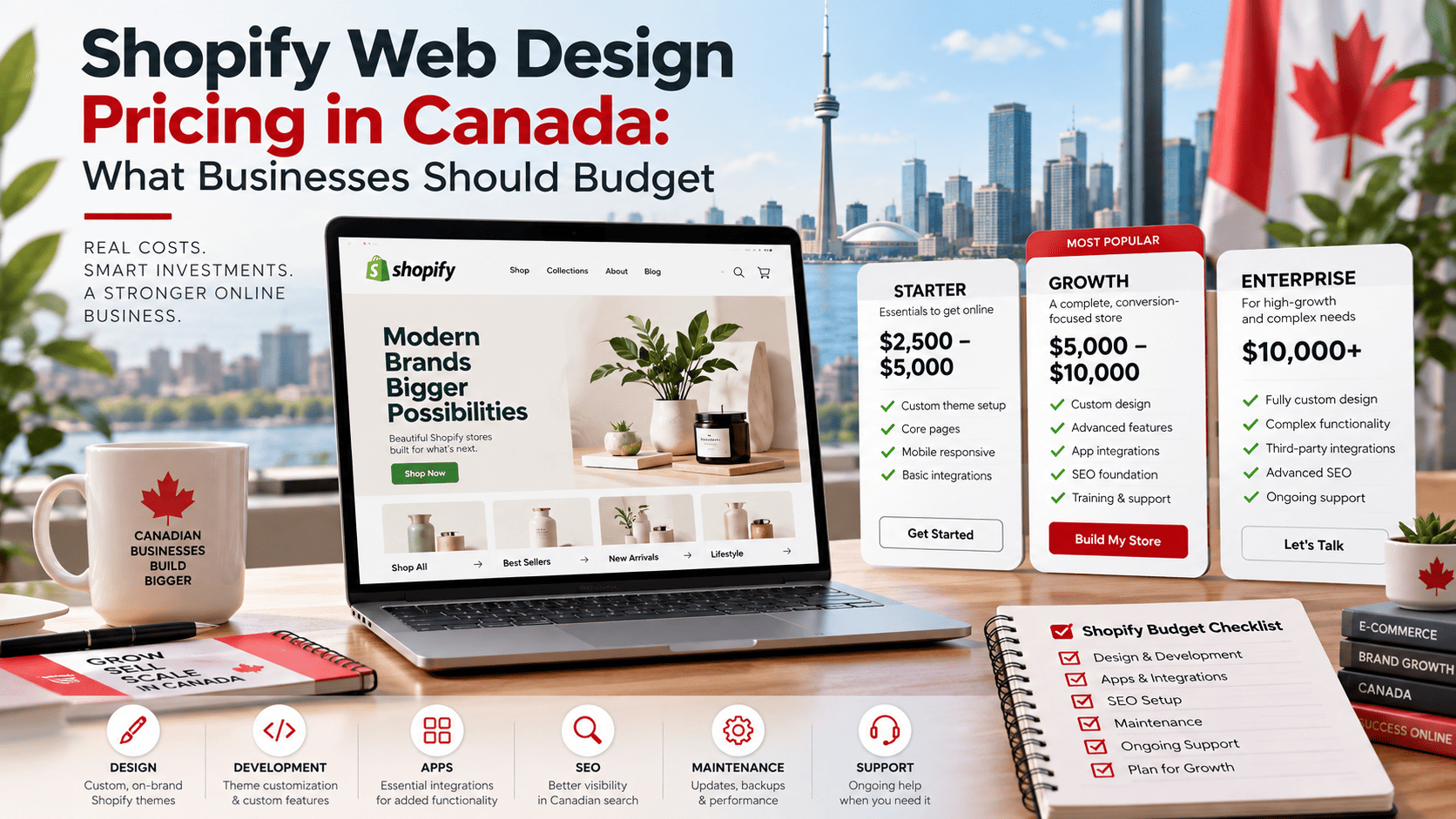
One of the first questions Canadian merchants ask when planning an online store is how much Shopify web design will cost. The honest answer is that pricing depends heavily on the scope of work, the experience of the designer or agency, and how much customization your brand requires. That said, most projects in Canada fall into one of three broad tiers: a basic template setup, a customized theme with advanced features, or a fully custom design and development build. The ranges below reflect general market expectations and are intended as a planning guide rather than a fixed quote. Actual pricing can vary significantly based on your location, timeline, integrations, and the complexity of your product catalog.
Basic Template Setup: $500 – $2,000
At the entry level, you are paying for configuration rather than design. A freelancer or small studio purchases a premium Shopify theme, installs it, uploads your logo and brand colours, adds your products, and configures basic navigation, payment gateways, and shipping settings. The work is largely templated, which keeps costs low and timelines short—often one to two weeks.
This tier suits new businesses, side hustles, and merchants testing a product idea before investing further. Keep in mind that a basic setup rarely includes copywriting, custom graphics, or conversion rate optimization. You are essentially getting a functional store on a proven theme, not a tailored brand experience.
- Premium theme license and installation
- Logo, colour, and font adjustments
- Product upload and collection setup
- Basic apps for payments, shipping, and taxes
- Minimal or no custom coding
Customized Theme with Advanced Features: $2,000 – $10,000
This is the most common range for established Canadian small and mid-sized businesses. Here, a designer starts with a premium theme but modifies it substantially—custom homepage sections, tailored product pages, unique collection layouts, and branded elements that go beyond stock options. Advanced features often include upsell and cross-sell functionality, subscription options, multi-currency support, bilingual storefronts for English and French markets, and integrations with CRM, ERP, or email marketing platforms.
Costs rise with the number of custom sections, the depth of third-party integrations, and whether custom Liquid coding is required. A project in this tier typically takes three to eight weeks and usually includes some strategy, UX input, and testing across devices. It offers a strong balance between visual distinctiveness and budget control, which is why many Canadian retailers land here.
- Substantial theme customization and custom sections
- Advanced app integrations and automation
- Conversion-focused product and checkout pages
- Bilingual or multi-currency configuration
- Speed and mobile optimization
Fully Custom Design and Development: $10,000+
At the top tier, you are commissioning a bespoke Shopify experience built from the ground up. This involves original UX research, wireframes, custom visual design, and hand-coded Liquid templates or a headless architecture. Projects at this level often include complex product configurators, wholesale or B2B portals, custom checkout extensions, advanced analytics, and integrations with inventory, fulfillment, or subscription systems.
Canadian agencies and senior development teams typically charge $10,000 to $50,000 or more for these builds, with enterprise projects exceeding that range. Timelines stretch from two to six months, and ongoing retainers for maintenance, A/B testing, and feature development are common. This tier is best suited to brands with high traffic, complex operations, or a strong need for differentiation in a competitive market.
- Original UX and visual design
- Custom Liquid or headless development
- B2B, wholesale, or configurator functionality
- Deep ERP, CRM, and fulfillment integrations
- Ongoing optimization and support retainers
Across all three tiers, remember that these figures are general ranges. A quote from a Toronto agency may differ from one in Halifax or Vancouver, and rush timelines, extensive content migration, or unusual integrations can push costs higher. Always request a detailed scope of work and confirm what is included before committing.
The Role of Shopify Experts and Certified Partners
When budgeting for a Shopify store in Canada, the single biggest variable is rarely the platform itself. It is the person or agency building on it. Shopify offers a free tier of do-it-yourself tools, but most Canadian merchants who want a polished, conversion-ready storefront hire help. That help falls into two broad camps: generalist freelancers and agencies, and Shopify Experts or Certified Partners. The second group typically charges more, and understanding why helps you decide whether the premium is justified for your project.
What Certification Means and Why It Matters
Shopify maintains a partner directory that distinguishes between ordinary partners and those who have met specific criteria. A Shopify Expert is a vetted partner with a proven track record, often including a portfolio of live stores, client reviews, and demonstrated expertise in areas such as theme development, app integration, or conversion optimization. A Certified Partner has completed Shopify’s formal training and exams, which cover platform architecture, Liquid templating, checkout extensibility, and best practices for performance and security.
Certification matters because Shopify’s ecosystem changes constantly. Themes, APIs, and checkout rules are updated regularly. A certified partner has demonstrated current knowledge rather than relying on habits from older versions of the platform. For a Canadian merchant selling across provinces or into the United States, that currency of knowledge reduces the risk of building on deprecated features or running afoul of tax and shipping configurations.
The directory also gives you a practical filter. You can search by location, budget, and specialty, then review verified client feedback. That transparency is not available for random freelancers found on job boards.
Cost Premium for Expert Services
Expert and Partner rates in Canada generally run higher than generalist rates. The table below illustrates typical ranges, though actual quotes depend on scope, complexity, and the partner’s seniority.
| Service Type | Typical Canadian Rate | What It Usually Covers |
|---|---|---|
| Generalist freelancer | $40–$75 per hour | Theme tweaks, basic setup, small customizations |
| Shopify Expert | $75–$150 per hour | Custom theme work, app integration, migration, CRO |
| Certified Partner agency | $100–$200+ per hour | Full builds, Plus projects, multi-store, strategy |
For a typical small-business store build, the difference can mean several thousand dollars. A generalist might quote $3,000 to $6,000 for a customized theme, while an Expert or Partner may quote $8,000 to $20,000 for the same nominal scope. Part of that premium pays for project management, quality assurance, and a team that can absorb delays. Part pays for the reduced likelihood of costly rework.
When It’s Worth the Investment
Hiring an Expert or Certified Partner is most defensible when the cost of failure is high. Consider the premium in these situations:
- You are migrating from another platform. Product, customer, and order data must move without breaking SEO or checkout. A botched migration can cost more in lost revenue than the partner’s fee.
- You need custom functionality. Subscription logic, B2B pricing, or complex shipping rules require someone who knows Shopify’s APIs and limits.
- You are on Shopify Plus. Plus stores involve higher revenue and stricter requirements; an experienced partner is close to mandatory.
- You plan to scale. A store built to grow avoids a rebuild in eighteen months.
- You lack internal technical capacity. If no one on your team can evaluate a developer’s work, a vetted partner reduces your risk.
Conversely, if you are launching a simple store with a stock theme, a handful of products, and a tight budget, a skilled generalist may deliver everything you need. The Expert premium buys certainty, specialization, and accountability. Whether that is worth the added cost depends on how much a mistake would cost you. For many Canadian merchants with real revenue at stake, the answer is yes.
Additional Costs to Budget For: Apps, Integrations, and Maintenance
The initial design and development quote is only part of your Shopify investment. Ongoing expenses for apps, integrations, and maintenance can add hundreds or even thousands of dollars per year, and they significantly affect the total cost of ownership. Budgeting for these items upfront prevents surprises and keeps your store performing reliably as it grows.
Must-Have Apps and Their Subscription Fees
Shopify’s built-in features cover the basics, but most Canadian merchants rely on third-party apps for reviews, email marketing, upsells, and shipping. Most apps charge monthly recurring fees, often tiered by order volume or subscriber count, and many add usage-based charges once you exceed a free plan.
| App Category | Typical Monthly Cost (CAD) |
|---|---|
| Product reviews | $15–$50 |
| Email and SMS marketing | $20–$150 |
| Upsell and cross-sell | $10–$40 |
| Shipping and labels | $10–$60 |
| Loyalty and rewards | $25–$100 |
A store using five to eight apps can easily spend $100–$400 per month, or $1,200–$4,800 annually. Note that Shopify charges in USD for most apps, so Canadian merchants should factor in exchange rate fluctuations.
Integration Costs with CRM, ERP, and Marketing Tools
Connecting Shopify to a CRM, ERP, or marketing platform streamlines operations but rarely comes free. Costs depend on the complexity of the connection and whether you use a ready-made app or custom middleware.
- Native or app-based integrations: $0–$50 per month, suitable for simple data syncing.
- Middleware platforms: $30–$300 per month for tools that connect multiple systems.
- Custom API development: $1,500–$10,000 or more as a one-time cost, plus ongoing support.
- ERP connectors: Often priced by transaction volume or SKU count, which can escalate quickly.
Marketing tools such as Klaviyo, HubSpot, or Mailchimp typically charge based on contact list size, so integration costs rise alongside your audience.
Annual Maintenance and Support Packages
Websites need regular care. Theme updates, security patches, speed optimization, and bug fixes are ongoing tasks that protect your revenue. Many Canadian agencies offer retainer packages, while others bill hourly.
- Basic care plans: $100–$300 per month for updates, backups, and minor fixes.
- Growth retainers: $500–$2,000 per month for conversion optimization, new features, and campaign support.
- Hourly support: $75–$150 per hour for ad-hoc work.
Platform costs also apply: Shopify plans range from roughly $39 to $399 per month in Canada, and premium themes cost $200–$400 one-time. Together, these recurring expenses mean the true annual cost of a Shopify store often exceeds the original build fee. Planning for them ensures your store stays competitive, secure, and profitable over the long term.
How to Get Accurate Quotes and Compare Proposals
When you ask, “How Much Does Shopify Web Design Cost in Canada?”, the answer depends less on the market rate than on the scope you define. Two Canadian agencies can quote $3,000 and $30,000 for the “same” store and both be right, because one is delivering a customized theme and the other is building custom features, migrations, and integrations. Accurate quotes come from accurate briefs. Vague requests attract padded estimates or lowball figures that grow later through change orders.
Preparing a Detailed Project Brief
Your brief is the single biggest lever on quote accuracy. Send the same document to every designer or agency so proposals are comparable. Include:
- Business context: products, target market, Canadian provinces you sell to, and whether you sell in person or wholesale.
- Store size: number of products, variants, collections, and expected SKU growth over 12 months.
- Scope: new build, redesign, migration from another platform, or theme customization only.
- Design direction: brand assets, reference sites, and whether you need logo or identity work.
- Functionality: subscriptions, pre-orders, bundles, B2B pricing, multi-currency, French-language content, and POS needs.
- Integrations: ERP, CRM, email, reviews, loyalty, shipping carriers, and payment options.
- Content: who writes copy, sources photography, and enters products.
- Timeline and budget range: launch date, hard deadlines, and the range you can realistically invest.
- Deliverables: design files, theme code, documentation, training, and post-launch support.
A brief that answers these points lets a designer price the work instead of guessing, which is exactly what prevents surprise invoices.
Questions to Ask Potential Designers
Use the same questions in every conversation so you can compare answers side by side:
- How many Shopify stores have you launched, and can you share live examples?
- Will you use a premium theme, a custom theme, or Shopify’s free themes?
- Who owns the theme code and design files when the project ends?
- What is your process for revisions, and how many rounds are included?
- Do you handle Shopify Markets, multi-currency, and bilingual English–French setups?
- What happens if the project runs past the deadline?
- What does post-launch support cost, and for how long?
- Are you working with Canadian tax, privacy, and accessibility requirements in mind?
Red Flags and What to Avoid
Be cautious when a proposal has no line-item scope, only a single lump sum. Watch for quotes that exclude product uploads, app subscriptions, or theme licences without saying so. Avoid designers who cannot show live Shopify work, who promise an unusually fast turnaround for a complex build, or who ask for full payment upfront. Also treat “unlimited revisions” as a warning: it usually signals an unclear approval process. Finally, confirm whether quoted prices include GST/HST and whether ongoing app fees are part of the estimate.
| Proposal Element | What a Strong Proposal Shows | What to Question |
|---|---|---|
| Scope and deliverables | Itemized pages, templates, apps, and integrations | Vague “full store setup” with no list |
| Timeline | Phased milestones with client review dates | One launch date with no interim checkpoints |
| Pricing structure | Fixed price per phase or clear hourly rates | Lump sum with no breakdown |
| Ownership and handover | Written confirmation you own code and assets | No mention of file transfer or access |
| Support | Defined warranty period and support rates | “We’ll always be around” with no terms |
Compare proposals on scope first, price second. The lowest quote is rarely the cheapest once missing deliverables, app fees, and change orders are added. A clear brief and consistent questions turn “How Much Does Shopify Web Design Cost in Canada?” from a guessing game into a decision you can defend.
Ways to Save on Shopify Web Design Without Compromising Quality
Shopify web design in Canada can range from a few hundred dollars for a simple theme setup to five figures for a fully custom storefront. The good news is that you do not need to spend at the top of that range to get a store that looks professional and converts well. With a bit of planning, you can reduce upfront costs while keeping the door open for future growth. The key is to cut spending on features that do not drive revenue yet, not on the fundamentals that customers notice immediately.
Leveraging Pre-Made Themes and Templates
The fastest way to lower design costs is to start with a high-quality Shopify theme rather than a custom design. Premium themes from the Shopify Theme Store or established marketplaces typically cost between CAD $200 and $500, and many are built with performance, accessibility, and mobile responsiveness already handled. A designer can then spend a few hours customizing colors, fonts, and sections instead of building every element from scratch.
When choosing a theme, look for:
- Fast loading speed and clean code
- Mobile-first layouts, since most Canadian shoppers browse on phones
- Built-in support for the features you need now, such as product filters or a blog
- Regular updates from the theme developer
Avoid buying multiple themes “just in case.” One well-chosen theme, properly configured, will almost always outperform a cheap theme that needs heavy patching later.
Phased Approach: Launch First, Enhance Later
Many businesses overspend because they try to launch with every feature imaginable. A phased approach lets you go live sooner and pay for enhancements only when revenue supports them. Launch with the essentials: homepage, product pages, cart and checkout, shipping and payment settings, and a contact page. Then add secondary features in later phases.
| Phase | Typical Focus | Cost Impact |
|---|---|---|
| Phase 1: Launch | Core pages, theme setup, basic branding | Lowest upfront cost |
| Phase 2: Optimize | Email capture, reviews, upsells, analytics | Moderate, tied to early sales |
| Phase 3: Scale | Custom features, advanced integrations, A/B testing | Higher, funded by growth |
This structure also gives you real customer data before you invest in custom work, so you spend on what actually improves conversion.
Negotiating Scope and Payment Terms
Before hiring a Canadian designer or agency, define exactly what is included. Ask for a written scope that lists pages, revisions, integrations, and timelines. Vague scopes lead to change orders and surprise invoices. If your budget is tight, ask what can be moved to a later phase rather than removed entirely.
Payment terms are negotiable too. A common structure is a deposit to begin, a milestone payment at design approval, and the balance at launch. Some freelancers will accept smaller monthly payments for larger projects. Always confirm whether GST/HST applies based on your province and the designer’s location.
Finally, remember that the cheapest quote is not always the best value. A slightly higher price for a designer who understands Shopify’s checkout, SEO basics, and Canadian shipping settings can save you far more in rework. Balance short-term savings against long-term goals, and invest where it counts: a fast, trustworthy store that makes buying easy.
Conclusion: Making an Informed Decision for Your Canadian Shopify Store
Understanding how much Shopify web design costs in Canada is less about finding a single magic number and more about matching your investment to your ambitions. Across this guide, we have seen that quotes can range from a few hundred dollars for a basic template setup to well over $20,000 for a fully custom, conversion-focused storefront. The right answer for your business depends on what you need the store to do today and where you want it to go tomorrow.
Recap of Cost Factors and Ranges
Several variables consistently shape Canadian Shopify design pricing. Keeping them in mind will help you compare quotes fairly rather than simply choosing the lowest bid.
- Project scope: A simple theme customisation costs far less than a bespoke design with custom sections and templates.
- Number of products and collections: Large catalogues require more setup, data migration, and navigation planning.
- Custom functionality: Integrations, subscriptions, wholesale portals, and advanced filtering add development hours.
- Content and copywriting: Professional product descriptions and brand messaging are often billed separately.
- Ongoing support: Maintenance, updates, and optimisation may be charged monthly or hourly.
- Partner experience: Freelancers, small studios, and established Canadian agencies each price differently.
As a general guide, budget-conscious businesses might expect to invest a few thousand dollars, while growing brands with complex requirements should plan for a mid-to-high five-figure range. These figures are directional, not fixed, because every Canadian store has a unique mix of needs.
Aligning Design Investment with Business Goals
Design spending should follow strategy, not precede it. Before requesting quotes, clarify what success looks like for your store. A boutique brand launching its first collection may prioritise beautiful visuals and a fast setup. A scaling retailer may need advanced search, bilingual functionality, and seamless integration with Canadian shipping and payment providers.
Ask yourself these questions:
- Is my primary goal launching quickly, or building a long-term brand asset?
- Do I need custom features that a premium theme cannot provide?
- How much revenue must the store generate to justify the investment?
- Will I handle updates in-house or rely on a partner?
When the answers point to growth, professional design tends to pay for itself through higher conversion rates, stronger trust, and fewer costly rebuilds later.
Next Steps: Research, Quotes, and Choosing the Right Partner
With your goals clear, move into the selection process deliberately.
- Research Canadian Shopify partners: Look for portfolios, client reviews, and experience in your industry.
- Request detailed quotes: Ask for a breakdown of design, development, content, and support costs.
- Compare value, not just price: A slightly higher quote may include strategy, SEO, and training that save money later.
- Check communication and timelines: Confirm who your point of contact will be and when milestones are due.
- Start with a clear brief: The more specific your requirements, the more accurate every quote will be.
Investing in professional Shopify design is rarely the cheapest option, but it is often the most cost-effective over time. A well-built Canadian store loads quickly, ranks better, converts more visitors, and adapts as your business grows. Take the time to assess your needs, set a realistic budget, and choose a partner who understands both Shopify and the Canadian market. That informed decision is the foundation of a store that works hard for your brand for years to come.
Frequently Asked Questions
How much does a basic Shopify store design cost in Canada?
A basic Shopify store design in Canada typically costs between $1,500 and $5,000. This usually includes a premium theme, logo placement, essential apps, product uploads, and basic on-page SEO. DIY templates can cost under $500, while freelancers often charge $2,000–$4,000. Agency-built basic stores may start around $5,000. Final pricing depends on page count, custom features, and the designer’s experience. Always request a detailed scope before comparing quotes.
What is the average cost of hiring a Shopify agency in Canada?
Canadian Shopify agencies generally charge $5,000 to $25,000+ for custom ecommerce design and development. Mid-complexity stores often fall in the $8,000–$15,000 range. Agency pricing includes strategy, UX/UI design, custom theme development, app integrations, QA, and launch support. Enterprise or highly customized builds can exceed $30,000. Agency rates are higher than freelancers because teams include project managers, designers, and developers, plus ongoing support options.
Are Shopify web design costs in Canada different from the US?
Shopify web design costs in Canada are often slightly lower than in the US when quoted in local currency, but the difference is usually modest. Canadian agencies may charge CAD $75–$150 per hour, while US agencies often charge USD $100–$200 per hour. However, exchange rates, taxes, and regional demand can narrow the gap. For cross-border projects, always confirm currency, tax treatment, and whether ongoing support is billed in CAD or USD.
What hidden costs should Canadian businesses budget for?
Beyond design, budget for Shopify subscription fees, premium apps, domain and email hosting, product photography, copywriting, taxes (GST/HST/PST), and ongoing maintenance. Apps can add $20–$200+ monthly. Custom development, migrations, and third-party integrations may be quoted separately. Canadian businesses should also account for payment processing fees and potential translation costs for English and French storefronts. A 10–20% contingency buffer is wise for scope changes.
How long does a Shopify web design project take in Canada?
Timelines vary by complexity. A basic theme setup can take 2–4 weeks. A custom-designed Shopify store typically takes 6–12 weeks. Larger builds with custom features, integrations, or multi-language support can take 3–6 months. Canadian agencies often experience slower timelines around holidays and tax season. Clear milestones, prompt feedback, and complete content upfront are the biggest factors in keeping your project on schedule.
Can I build a Shopify store myself to save money in Canada?
Yes. DIY Shopify builds can cost as little as $100–$500 for a theme, plus your time. This suits simple stores with few products and standard features. However, DIY designs may convert less effectively and can require paid apps or developer help later. If you value speed, custom branding, SEO, and conversion optimization, hiring a Canadian freelancer or agency often delivers better long-term return on investment.
What ongoing costs should I expect after my Shopify site launches?
After launch, expect Shopify subscription fees (Basic to Advanced), premium app subscriptions, domain renewal, email marketing tools, and occasional developer support. Canadian businesses should also budget for SEO, content updates, theme maintenance, and conversion rate optimization. Many agencies offer care plans from $200–$1,000+ per month. Ongoing costs typically range from 10–20% of the initial build cost annually, depending on store complexity and growth plans.
Sources and further reading
- Shopify Pricing Plans
- Shopify Theme Store
- Statistics Canada – Retail Ecommerce Sales
- Innovation, Science and Economic Development Canada – Digital Economy
- Canada Post – Ecommerce in Canada
- Shopify Blog – Ecommerce Website Cost
- Baymard Institute – Ecommerce UX Research
- Nielsen Norman Group – Ecommerce UX
- Google Search Central – SEO Starter Guide
- web.dev – Core Web Vitals