
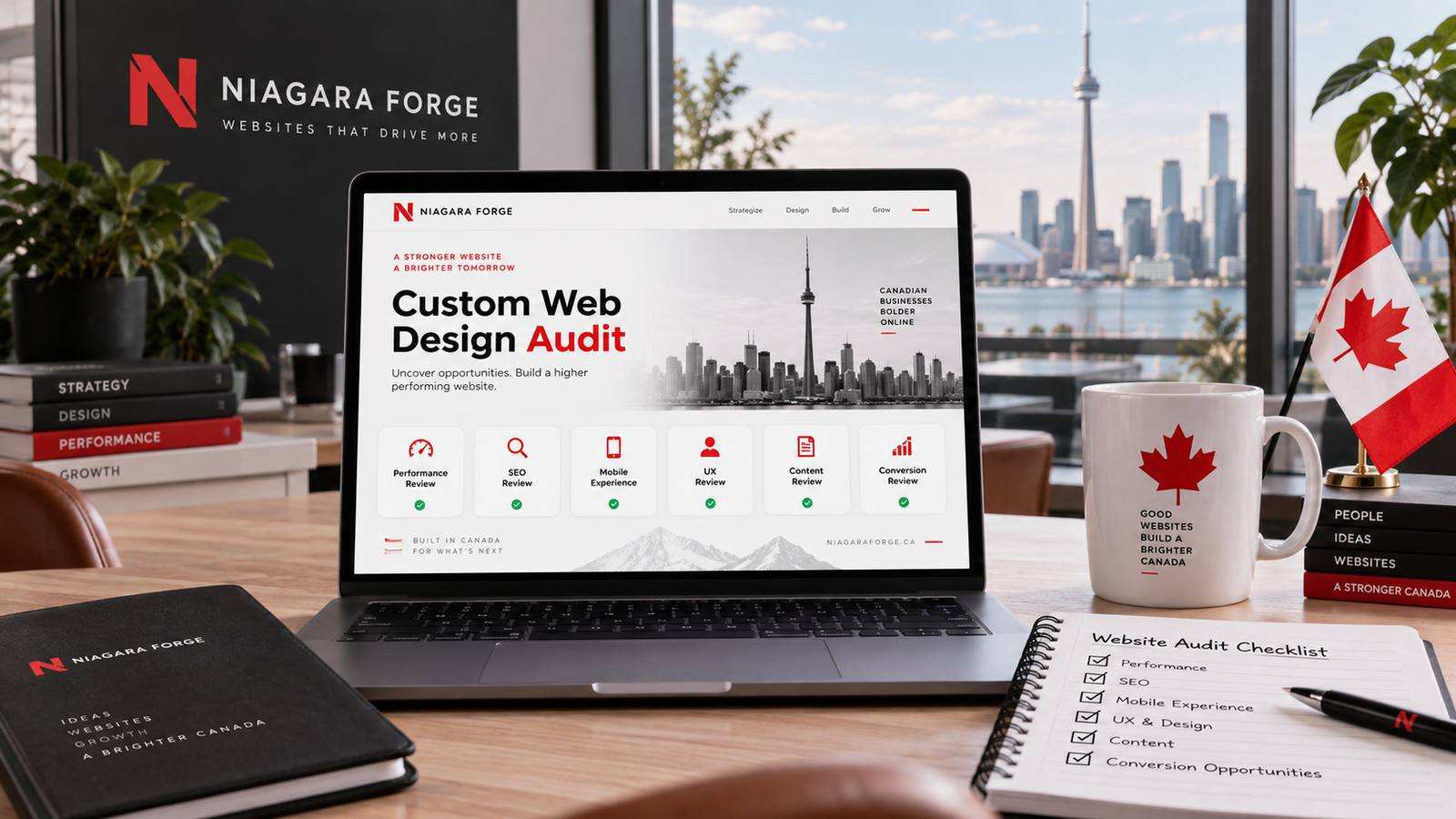
1. Why a Pre-Hire Web Design Audit Matters for Canadian Businesses
Before you sign a contract with a <a href=”https://niagaraforge.ca/service/web-design/”>web design agency in Canada, a structured audit of your current digital presence—and your future needs—is not a bureaucratic hurdle. It is a strategic safeguard. Canadian businesses operate in a unique digital ecosystem: bilingual expectations in many regions, varying provincial consumer protection laws, and a user base that increasingly expects fast, accessible, and locally relevant online experiences. A pre-hire audit forces you to define these realities on paper, turning vague desires into measurable requirements. Without this step, you are essentially hiring a creative partner based on portfolio aesthetics alone, which is a high-risk gamble for your operational budget and brand reputation.
The Cost of a Mismatched Agency Partnership
The true cost of a mismatched agency rarely appears on the initial invoice. It surfaces months later as rework fees, missed launch deadlines, and a website that fails to convert Canadian visitors because it ignores regional nuances—such as proper French-language typography or province-specific payment gateways. Consider the hidden expenses:
- Change orders: Agencies without a clear scope will charge premium rates for every “small adjustment” you request after the design mockups are approved.
- Lost revenue: A site that loads slowly on rural internet connections or lacks clear bilingual navigation will drive potential customers to competitors.
- Migration costs: If you need to switch agencies mid-project, you pay twice for architecture and content migration, and you may lose proprietary code.
- Legal exposure: A non-compliant design regarding Canadian Accessibility Standards (AODA in Ontario, for example) can lead to fines and reputational damage.
An audit identifies these risks before you commit. It forces you to ask the agency pointed questions about their experience with Canadian hosting providers (e.g., data residency in Canada), their approach to bilingual content management systems, and their track record with multi-regional e-commerce tax calculations. This is not about distrust; it is about due diligence.
How an Audit Reduces Project Risk and Scope Creep
Scope creep is the silent killer of web design budgets. It happens when project boundaries are fuzzy. A pre-hire audit creates a fixed reference point. By documenting your current site’s weaknesses (e.g., broken forms, non-responsive layouts, poor SEO structure) and your desired outcomes (e.g., 20% faster load times, integrated booking system), you hand the agency a precise brief. This document becomes your contractual shield.
When an agency later claims that “user testing was not included,” you can point to the audit’s deliverables list. When they suggest adding a third-party translation plugin as a “bonus,” you can reject it because the audit already specified native bilingual architecture. Furthermore, an audit helps you distinguish between essential features and nice-to-haves. You might discover that a custom blog section is unnecessary if your primary goal is lead generation, freeing up budget for more critical elements like conversion rate optimization. This clarity reduces the emotional friction that often leads to endless revision cycles and mutual frustration.
Aligning Your Audit with Canadian Digital Standards
Your audit checklist must go beyond generic usability principles. It should incorporate Canadian-specific digital standards that agencies outside the country—or even those unfamiliar with local regulations—might overlook. At minimum, your audit should verify the following:
| Audit Area | Canadian Consideration |
|---|---|
| Language & Localization | Does your CMS support French and English content without duplicating URLs? Is the French version professionally translated, not machine-translated? |
| Accessibility Compliance | Does the design meet WCAG 2.1 AA standards, which are referenced by the Accessible Canada Act and provincial laws like Quebec’s standards? |
| Data Privacy | Does the proposed hosting ensure data stays within Canada or complies with PIPEDA? Are analytics tools configured to anonymize IPs? |
| Regional User Behaviour | Does the design account for different shopping habits in Ontario vs. British Columbia (e.g., delivery expectations, local payment methods like Interac Online)? |
Conducting this review before you approach an agency does not mean you must have all the answers. Instead, it equips you with the right questions. You will be able to evaluate an agency’s response with a critical eye, rejecting vague promises of “best practices” in favour of concrete proposals that reference Canadian digital infrastructure. Ultimately, this audit transforms the hiring process from a beauty contest into a technical and strategic partnership assessment. It protects your investment by ensuring that the agency you choose understands not just how to build a website, but how to build your website for your Canadian audience. The few hours spent on this audit will save you months of costly corrections and give you the confidence to move forward with a clear, shared vision.
2. Defining Your Custom Web Design Goals and Success Metrics
Before you evaluate a single agency portfolio or schedule a discovery call, the audit must begin internally. A custom web design project fails most often not because of poor execution, but because of undefined expectations. When you cannot articulate what success looks like, no agency can reliably deliver it. This internal clarity transforms your website from a digital brochure into a measurable business asset.
Setting SMART Goals for Your Website Redesign
Your redesign objectives must be specific, measurable, achievable, relevant, and time-bound. Vague aspirations like “modernize our brand” or “improve user experience” are not actionable. Instead, define outcomes that tie directly to revenue or operational efficiency.
- Specific: “Increase qualified demo requests from Ontario-based manufacturing firms by 25% within six months of launch.”
- Measurable: “Reduce average checkout time from 4 minutes to under 2 minutes, tracked via session recording and form analytics.”
- Achievable: “Grow organic traffic for our 15 priority service pages from 2,000 to 3,500 monthly visits, given our current domain authority and content budget.”
- Relevant: “Support the launch of our new bilingual (EN/FR) service tier, which requires a content architecture that switches cleanly between languages.”
- Time-bound: “Achieve a 1.5% conversion rate on the new quote request form by Q4, compared to the current 0.8% baseline.”
Write these goals down and share them with every shortlisted agency. A strong partner will challenge your assumptions, but they should never have to guess what you are trying to accomplish.
Mapping Business Objectives to Design Features
Once your SMART goals are locked, translate each objective into a concrete design requirement. This mapping becomes your audit checklist during agency demos and proposal reviews.
| Business Objective | Required Design Feature | Question to Ask the Agency |
|---|---|---|
| Generate 30 B2B leads/month | Prominent, sticky call-to-action above the fold; multi-step form with progress indicator | “How do you handle form abandonment analytics and A/B testing of CTA placement?” |
| Increase e-commerce average order value by 15% | Product recommendation engine, cross-sell modules on cart page, one-page checkout | “What is your process for integrating third-party recommendation APIs without slowing page speed?” |
| Boost blog readership and newsletter signups | Unobtrusive exit-intent popup, related-article footer, estimated reading time | “Can you show examples of content layouts that improved dwell time without harming Core Web Vitals?” |
This table also forces you to prioritize. If your budget is fixed, you may need to drop a feature that serves a secondary goal. Knowing which objectives are non-negotiable prevents scope creep later.
Key Performance Indicators to Track Post-Launch
Define your KPIs before the agency writes a line of code. Post-launch, you will need a baseline to measure against. The agency should provide a tracking plan that includes event-level analytics, not just page views. For a custom build, this often means tagging specific user interactions.
Consider a simple JavaScript event you can implement after launch to track a key micro-conversion:
document.getElementById('quote-submit').addEventListener('click', function() {
  dataLayer.push({
    'event': 'quote_form_start',
    'form_id': 'quote-submit',
    'form_location': 'header_cta'
  });
});
This snippet sends a custom event to your analytics platform when a user clicks the main quote button. You can then compare this click rate against the final form submission rate to identify drop-off points.
Standard KPIs to monitor include:
- Conversion rate per page and per traffic source
- Bounce rate on key landing pages (target under 45% for relevant traffic)
- Average session duration and pages per session
- Cart abandonment rate (for e-commerce)
- Cost per lead or cost per acquisition
Review these metrics monthly for the first quarter. If a target is missed, ask whether the issue is design, content, or traffic quality. A reputable agency will provide a post-launch optimization roadmap, not a static handoff.
3. Reviewing the Agency’s Portfolio with a Critical Eye
When evaluating a Canadian web design agency, aesthetics are only the surface. A portfolio can look polished yet fail where it matters most: user experience, performance, and adaptability to your specific market. Use this framework to assess whether their custom solutions genuinely serve Canadian audiences—who expect fast, accessible, and mobile-first experiences across diverse regions and connection speeds.
What to Look for in a Custom Design Portfolio
Move beyond visual appeal and examine each project against functional criteria. For every case study, ask:
- User flow clarity: Can a first-time visitor identify the primary action (e.g., booking, purchasing, contacting) within five seconds? Look for obvious navigation patterns and logical content hierarchy.
- Mobile responsiveness depth: Open the live site on your phone. Do buttons remain tappable (minimum 44×44 px)? Is text readable without zooming? Does the layout adapt meaningfully, not just stack blocks?
- Load speed indicators: Use Google’s PageSpeed Insights or WebPageTest on their live projects. Aim for under 2.5 seconds on 4G for a typical e-commerce or lead-gen page. If their own portfolio site is slow, their client work likely suffers.
- Industry-specific relevance: For Canadian audiences, check if the design accounts for bilingual needs (French/English toggles, proper character encoding), regional pricing (CAD, provincial taxes), or local compliance (e.g., PIPEDA for privacy, AODA for Ontario accessibility). A generic template won’t address these.
Red Flags in Agency Case Studies
Critical review means spotting warning signs that indicate shallow work or inflated claims:
- Vague metrics: “Increased engagement” without specific numbers (e.g., conversion rate uplift, bounce rate reduction) suggests no real testing or analytics culture.
- Stock-heavy or template-like designs: If multiple portfolio pieces share identical layouts, imagery, or component libraries, you’re not getting custom work—you’re paying for a reskinned theme.
- No live links or password-protected demos: Agencies should provide at least one working URL per case study. Screenshots alone cannot demonstrate interactivity or performance.
- Ignoring maintenance or scalability: If case studies never mention content management, post-launch support, or how the site handles traffic spikes (e.g., for seasonal Canadian retail), the agency may not plan for longevity.
Evaluating Mobile and Accessibility in Past Projects
Canadian legal and user expectations increasingly centre on inclusive design. When reviewing past work, check for tangible evidence of accessibility and mobile excellence, not just claims. Use this comparison table to structure your assessment:
| Checklist Item | What to Verify | Pass/Fail Example |
|---|---|---|
| Keyboard navigation | Tab through the live site—can you reach every link, button, and form field without a mouse? Visible focus indicators? | Pass: All interactive elements receive a clear outline. Fail: Focus jumps to hidden elements or disappears entirely. |
| Colour contrast | Use WebAIM’s contrast checker on text and UI elements. WCAG AA requires 4.5:1 for normal text, 3:1 for large text. | Pass: Body text on white background meets 12:1 ratio. Fail: Grey links on light grey background at 2:1. |
| Touch target size | On a mobile viewport, measure buttons and links. Apple and Google recommend at least 44×44 px. | Pass: All primary CTAs are 48×48 px. Fail: Inline links are 20×20 px and cause mis-taps. |
| Media queries & breakpoints | Resize the browser from 320px to 1440px. Does content reflow without horizontal scrolling or overlapping elements? | Pass: Layout adjusts at 768px and 1024px cleanly. Fail: Images overflow at 375px, cutting off text. |
| Performance on throttled networks | Use Chrome DevTools with “Fast 3G” and “Mid-tier mobile” settings. Load the page and note time to first contentful paint (under 1.8s is good). | Pass: Hero loads in 1.2s with lazy-loaded below-fold media. Fail: 5MB hero image blocks render for 4s. |
Additionally, request the agency’s approach to ARIA labels, alt text, and semantic HTML. If they cannot articulate how they test with screen readers (e.g., VoiceOver on iOS or NVDA on Windows), their accessibility work is likely superficial. For Canadian projects, also confirm whether they consider provincial accessibility laws—Ontario’s AODA, for instance, has specific compliance deadlines that affect public and private sectors. A portfolio that demonstrates these elements across diverse industries—not just one showcase project—indicates a repeatable, rigorous process rather than a lucky outlier. Ultimately, your audit should reveal whether the agency builds for real users in real Canadian conditions, not just for award submissions.
4. Verifying Technical Expertise and Development Capabilities
A visually stunning website can fail silently if its technical foundation is weak. Before hiring a Canadian agency, you must probe beyond portfolios and into the engineering choices that will affect speed, scalability, and legal compliance. The right questions will separate agencies that assemble templates from those that build robust, future-proof systems.
Core Technologies to Expect from a Modern Agency
Ask directly about the front-end and back-end stacks they use. A credible agency should articulate why they chose React, Vue, or plain JavaScript for interactivity, and whether they follow semantic HTML5 and WAI-ARIA accessibility standards. On the server side, they should explain their preference for Node.js, Python (Django/Flask), or PHP (Laravel) without jargon evasion. Demand evidence of version control (Git) and a continuous integration/deployment pipeline. For example, they should be able to show you a basic deployment script:
# Example: automated production deploy after passing tests
git push origin main
ssh deploy@server "cd /var/www/site && git pull && composer install --no-dev && npm run build && systemctl reload nginx"
Also verify they use responsive testing across real devices, not just browser resizing. Look for agencies that mention Core Web Vitals optimization—Largest Contentful Paint under 2.5 seconds is a non-negotiable benchmark.
Assessing CMS and Hosting Recommendations
Custom does not mean “no CMS.” A modern agency will recommend a headless CMS (like Strapi or Contentful) for full flexibility, or a decoupled WordPress if you need editorial ease. Ask these questions:
- Can the CMS be migrated away from if we change vendors? (Avoid proprietary lock-in.)
- Do they provide staging environments and automated backups?
- What hosting do they suggest? For Canadian audiences, recommend servers in Canada or with a Canadian edge node to reduce latency.
- Are they familiar with cloud providers like AWS, Azure, or Google Cloud, and can they explain the cost scaling?
Beware of agencies that push shared hosting for a custom build—that contradicts the purpose. A proper custom site should have dedicated or managed cloud hosting with auto-scaling capabilities.
Security and Privacy Compliance in Canada (PIPEDA Basics)
Under the Personal Information Protection and Electronic Documents Act (PIPEDA), any website collecting personal data from Canadians must obtain consent, limit collection, and safeguard information. Your agency must demonstrate concrete measures:
- Encryption: TLS 1.2 or higher for all data in transit; AES-256 for data at rest.
- Access controls: Role-based authentication, not just a single admin password.
- Data retention: Automated deletion schedules for user data after a defined period.
- Breach protocol: A documented plan to notify the Privacy Commissioner and affected users within 72 hours.
Ask if they have experience with privacy impact assessments and whether they will provide a data flow diagram. Request a sample of their security headers configuration, such as:
# Nginx example for PIPEDA-aligned headers
add_header Strict-Transport-Security "max-age=31536000; includeSubDomains" always;
add_header X-Content-Type-Options "nosniff" always;
add_header X-Frame-Options "SAMEORIGIN" always;
Also confirm they do not store data on US-only servers without a cross-border transfer assessment, as that can trigger additional PIPEDA obligations. A technically proficient agency will voluntarily discuss these details—if they hesitate, treat that as a red flag.
5. Examining User Experience (UX) and Conversion Strategy
When evaluating a Canadian web design agency, you are not merely purchasing a visual refresh. A custom website is a strategic business asset, and its primary function is to guide visitors toward a desired action—whether that is a product purchase, a service inquiry, or a newsletter subscription. An agency that treats design as decoration rather than a conversion tool will cost you leads. Before signing a contract, scrutinize how the agency approaches user experience (UX) and whether their process demonstrates a clear, evidence-based conversion strategy.
How UX Design Drives Conversions
UX is the bridge between a user’s intent and your business goal. A well-structured UX reduces friction, builds trust, and makes the path to conversion feel intuitive. Conversion-centred design is not about adding more buttons; it is about removing obstacles. Consider these tangible checks:
- User journey mapping: Ask the agency to walk you through a sample journey map for your primary buyer persona. They should be able to articulate the steps from landing page to checkout, including emotional states and potential drop-off points.
- Call-to-action (CTA) placement: Effective CTAs are not randomly placed. The agency should explain the rationale behind each CTA’s position, colour, and wording—whether it is above the fold for high-intent users or after a value proposition for hesitant ones.
- Visual hierarchy: A conversion-focused designer uses size, contrast, and whitespace to direct attention. They should be able to justify why a headline, image, or form field receives prominence over another element.
If an agency speaks only about aesthetics and trends, and cannot connect design decisions to measurable outcomes like click-through rates or form completions, treat that as a red flag. A mature agency will reference conversion rate optimization (CRO) principles and A/B testing as part of their iterative design process.
Requesting Evidence of User Testing and Research
Custom design should be informed by actual user behaviour, not guesswork. A reputable agency will have a documented research phase. When interviewing candidates, do not accept generic promises. Instead, request specific artefacts:
- Usability test reports: Ask for anonymized examples of previous usability tests, including task success rates and recorded pain points. Look for evidence that they tested prototypes with real users, not just internal stakeholders.
- Heatmaps and session recordings: A data-driven agency will use tools like Hotjar or Microsoft Clarity. They should be able to show you how they identified a confusing navigation menu or a poorly performing checkout field in a past project.
- Research methodology: Inquire about their recruitment process. Do they test with five users in a moderated session, or do they rely on unmoderated remote tests? Their answer reveals their rigour and budget allocation.
Furthermore, ask how they will validate your specific assumptions about your Canadian audience. For instance, if you serve both English and French markets, their testing plan must account for linguistic and cultural nuances in CTA phrasing and layout expectations. If they cannot produce a single case study or test summary, they are likely designing from a template mindset.
Accessibility (WCAG) as a Core UX Requirement
Accessibility is not an optional add-on; it is a core component of conversion strategy. In Canada, the Accessibility for Ontarians with Disabilities Act (AODA) sets legal standards, and the Web Content Accessibility Guidelines (WCAG) 2.1 AA is the accepted technical benchmark. A site that excludes users with visual, motor, or cognitive impairments directly shrinks your potential market. Moreover, accessible design often improves UX for all users—clear labels, sufficient contrast, and keyboard navigation benefit everyone.
During your audit, verify the following:
- WCAG compliance statement: Does the agency explicitly commit to WCAG 2.1 AA in their proposal? Vague language like “we make sites accessible” is insufficient.
- Testing tools: They should use automated tools (e.g., axe, WAVE) but also conduct manual keyboard testing and screen reader testing with tools like NVDA or VoiceOver.
- Design handoff: Ask how they ensure accessibility is maintained during development. Do they provide annotated design files with contrast ratios and focus states?
Finally, request a walkthrough of a past project’s accessibility audit report. A transparent agency will show you both the issues found and the fixes applied. If they cannot demonstrate a process for catching colour-blindness issues or missing form labels, your conversion funnel will have silent barriers that no amount of traffic can overcome. Prioritize an agency that treats accessibility as a measurable UX requirement, not a legal afterthought.
6. Assessing SEO Readiness and Content Integration
A custom web design that ignores search engine fundamentals is a costly visual exercise. Before hiring an agency in Canada, verify that their design process treats SEO as a structural requirement, not a post-launch afterthought. The agency should demonstrate how every template, navigation hierarchy, and page-load decision supports crawlability and user intent. Ask for their technical checklist and insist on seeing how they handle schema markup, canonical tags, and server response codes during the design phase, not just in a handoff document.
Technical SEO Elements Embedded in Design
The design system must accommodate technical SEO without compromising aesthetics. Key elements to audit in their portfolio or proposal include:
- Semantic HTML5 structure: Proper use of header, nav, main, and footer tags so search engines parse content hierarchy correctly.
- Mobile-first responsive grids: Ensure breakpoints do not create hidden content or lazy-loading that blocks indexing.
- Core Web Vitals budgets: Design mockups should include estimated image weights, font-display settings, and JavaScript payload limits.
- URL architecture: Clean, descriptive slugs generated from the CMS, with no query parameters or session IDs in canonical paths.
- Structured data integration: JSON-LD for local business, breadcrumbs, and product or service schemas should be part of the template code.
Request a performance test of a similar project they built. Use Google’s PageSpeed Insights or Lighthouse to verify that their designs routinely score above 90 for mobile and desktop. If they cannot provide a live example, treat that as a red flag.
Content Strategy and CMS Integration for SEO
Custom design must align with your content workflow. The agency should map out how editorial teams will publish without breaking SEO rules. Evaluate their CMS setup for these capabilities:
- Automated XML sitemap generation and ping on content updates.
- Meta title and description fields with character counters and previews.
- Redirect management tools for URL changes, especially during site migration.
- Image alt text and compressed file naming conventions enforced at upload.
- Internal linking suggestions based on keyword clusters, not just manual placement.
For a practical example, the agency should implement a reusable template for blog or service pages that includes an H1 placeholder, a meta description field, and an Open Graph image slot. If they use a headless CMS, ask how they handle server-side rendering or static generation to avoid JavaScript-rendered content that search engines may miss. A simple check: inspect their proposed page template code for a <title> tag that is not hardcoded but pulls from a field like <?= $page->meta_title ?> (or equivalent in their stack). This proves they separate design from content logic.
Local and Bilingual SEO for Canadian Markets
Canadian search behaviour is not uniform. French-speaking users in Quebec often search with different phrasing and use Google.ca with language preferences set to French. English-speaking users in Toronto may include provincial qualifiers like “Toronto plumber” or “Ontario e-commerce lawyer.” Your agency must demonstrate how design supports these nuances:
- Hreflang tags: For bilingual sites, ensure the design includes logic for
<link rel="alternate" hreflang="fr-ca">anden-caon every page, not just the homepage. - Local landing page templates: Design modules for city-specific content that avoid duplicate text across pages.
- Currency and unit formatting: Ensure locale-aware fields for CAD, metric measurements, and date formats (YYYY-MM-DD for French, MM-DD-YYYY for English).
- Keyword research integration: The agency should show how they use tools like Google Keyword Planner with location filters for “Canada” and “Quebec” separately, not just default English data.
Ask for a sample wireframe of a bilingual service page. Verify that the French version does not use machine-translated slugs, and that the design accommodates longer French text without breaking layout. Also check if the agency tests search results on Bing, which still holds meaningful market share in Canadian enterprise and government sectors. A robust design audit includes a crawl test with locale-specific user agents to confirm that both language versions render correctly and return the appropriate hreflang signals. If they propose a single template for both languages without conditional content blocks, push back—this often leads to thin translations and poor local relevance.
7. Evaluating Project Management and Communication Processes
Before signing a contract for a custom web design in Canada, you are not just hiring designers and developers—you are entering a long-term operational partnership. The quality of your experience will hinge on how the agency structures work, communicates progress, and handles the inevitable friction points of a bespoke build. A beautiful portfolio means little if the agency disappears for two weeks or fails to document decisions. During your vetting calls, move beyond creative talk and ask pointed, practical questions about their internal workflows.
Understanding the Agency’s Project Lifecycle
Ask every candidate agency to walk you through their exact process from kickoff to launch. A reputable firm will have a defined, repeatable lifecycle—typically discovery, strategy, wireframing, visual design, development, testing, and deployment. For each phase, request concrete deliverables and the expected duration. For instance, ask: “What does your discovery phase include—user personas, technical audits, content mapping?” and “Who is the single point of contact during development?” You should also clarify whether the project manager is separate from the lead designer or developer. In Canada, where time zones and bilingual requirements (English/French) can add complexity, confirm the agency has resources to handle your specific regional needs. Finally, ask what happens if a phase runs over schedule: Does the timeline shift automatically, or do they have a buffer? A transparent agency will share their risk management approach, including how they handle dependencies like content delivery from your side.
Communication Channels and Reporting Cadence
Define the rhythm of updates before work begins. A common professional standard is a weekly status call (30–45 minutes) plus a written summary via email or a tool like Slack, Asana, or Jira. Ask for specifics: Who attends the weekly call? Will you receive a dashboard link showing live progress on tasks? Do they use a shared tool where you can comment directly on design mockups (e.g., Figma) or do they send static PDFs? Also, clarify emergency communication—what is the response-time guarantee for critical issues (e.g., a broken staging site)? For Canadian clients, note that agencies on the West Coast may have limited overlap with East Coast business hours; confirm their core collaboration hours. Request a sample of a previous client’s weekly report (redacted) to gauge the level of detail. If the agency cannot articulate their reporting cadence without hesitation, treat that as a red flag.
Handling Revisions, Feedback, and Change Orders
Custom builds always evolve, but unmanaged revisions can derail budgets. Ask these exact questions: “How many revision rounds are included per design phase (e.g., homepage or inner page)?” and “What constitutes a revision versus a new feature?” Most agencies offer two to three structured feedback loops per deliverable. Clarify how they collect feedback—do they require consolidated comments from one stakeholder, or do they accept scattered emails from your team? Inquire about their change order process: If you request a new functionality mid-build, how do they scope, price, and schedule that change? A written change order should include cost, timeline impact, and a sign-off requirement. Also, ask how they handle subjective feedback like “make it pop.” A strong agency will guide you toward objective criteria (e.g., conversion goals, brand guidelines) rather than endless aesthetic tweaks. Finally, confirm who owns the code and design files upon final payment—this protects you if you part ways after launch. Document all these policies in the contract, not just in the sales pitch.
8. Clarifying Pricing, Contracts, and Ownership Rights
Before signing with a Canadian custom web design agency, you must dissect the financial and legal scaffolding of your engagement. A beautiful proposal can mask vague pricing or restrictive ownership clauses. In Canada, both provincial and federal laws—such as the Copyright Act—default ownership of a website’s code, visual design, and written content to the creator unless a written assignment explicitly transfers those rights to you. Without clarity, you risk paying for a site you do not legally own.
How to Compare Custom Design Proposals
Do not compare proposals solely on total price. Instead, normalize each quote by breaking it into fixed deliverables and recurring costs. Canadian agencies often quote in CAD, but some may include HST/GST separately or bundle hosting and maintenance without itemizing them. Use this checklist when reviewing each proposal:
- Scope granularity: Does the quote list every page template, custom feature, and integration? Vague phrases like “up to 10 pages” signal hidden overage fees.
- Revision limits: How many design revision rounds are included? Typical Canadian agency packages include 2–3 rounds; each additional round may cost $150–$500 per page.
- Third-party costs: Are licences for premium plugins, stock photography, or font subscriptions itemized? These are often billed at cost plus a 10–20% administration fee.
- Post-launch support: Does the proposal include 30 days of bug fixes, or is support billed hourly at $100–$200? Confirm response times in writing.
- Payment schedule: Standard Canadian practice is 25–50% deposit, with milestones tied to deliverables—never pay 100% upfront.
Request a line-item breakdown from each agency. If two quotes differ by more than 30%, ask the higher bidder to justify the gap—often it reflects additional UX research or accessibility compliance (AODA) work, which is legally required for Ontario public sector sites but valuable for all businesses.
Essential Contract Clauses for Canadian Clients
Your contract should be governed by the laws of your province (e.g., Ontario or British Columbia) and must include these non-negotiable clauses:
- Acceptance criteria: Define what constitutes “complete” (e.g., passes Lighthouse performance scores, WCAG 2.1 AA, and cross-browser testing on Chrome, Safari, Firefox, and Edge).
- Termination for convenience: Allow you to cancel with 14–30 days’ written notice, with payment only for work completed to date. This protects you if the agency underdelivers.
- Confidentiality and data handling: Given PIPEDA (Personal Information Protection and Electronic Documents Act), the agency must agree to protect any user data it touches and delete it upon project completion.
- Warranty period: A minimum 90-day warranty for coding defects is standard in Canada, with the agency obligated to fix bugs at no extra cost.
- Dispute resolution: Prefer mediation or arbitration in your province over litigation to save time and money. Specify which court has jurisdiction if disputes escalate.
Ownership of Design Assets and Intellectual Property
Under Canada’s Copyright Act, the agency automatically owns the copyright to the website unless the contract contains an explicit assignment. Do not rely on a verbal promise. Your contract must state that, upon full payment, the agency assigns to you all rights, title, and interest in the following:
| Asset Category | What Must Be Transferred | Common Pitfall to Avoid |
|---|---|---|
| Source code | All custom HTML, CSS, JavaScript, PHP, and database schemas in editable form | Agency retains code rights and only grants a limited licence to use the site |
| Design files | Original Figma, Sketch, or Adobe XD files, plus exported assets (SVG, PNG, web fonts) | Only final screenshots are delivered, preventing future edits without rehiring the agency |
| Written content | All copy, meta descriptions, and user-generated text created by the agency | Content remains under agency copyright, forcing you to rewrite pages later |
| Data and analytics | All user data, form submissions, and analytics configurations (e.g., Google Tag Manager) | Agency claims ownership of collected data, violating PIPEDA compliance for your business |
Finally, confirm that any third-party tools (e.g., WordPress, Shopify) are used under their respective open-source or commercial licences, and that the agency will not insert proprietary code that locks you into their hosting environment. With these checks in place, you can proceed with confidence, knowing your investment is protected under Canadian law.
9. Checking Post-Launch Support, Maintenance, and Training
A custom website is not a “set-and-forget” asset. Unlike a template site that receives generic updates from its parent company, your bespoke build contains unique code, integrations, and design decisions that require tailored oversight. Before you sign a contract with a Canadian agency, you must clarify what happens after the launch champagne is gone. Without a clear support structure, a minor plugin conflict or a security patch can cascade into downtime, lost revenue, and a damaged brand reputation.
What to Expect in a Support and Maintenance Plan
Ask the agency to itemize their post-launch care. A professional plan typically includes three layers:
- Warranty period: Most agencies offer a 30- to 90-day bug-fix window at no cost. Confirm what counts as a “bug” versus a “change request.” For example, a broken checkout button is a bug; moving the button to the left is a change.
- Preventive maintenance: Monthly or quarterly tasks such as core updates, plugin/theme patches, database optimization, and security scans. For a custom codebase, this also means reviewing your own scripts for deprecations.
- Uptime monitoring: Does the agency provide 24/7 server monitoring, or do they rely on you to notice the site is down? Ask if they use a third-party tool (e.g., UptimeRobot, Pingdom) and how you receive alerts.
When reviewing a maintenance proposal, look for a defined schedule. A vague “we’ll keep things updated” is insufficient. Request a sample report from a previous client—this shows what you will receive after each maintenance cycle.
Training and Documentation for Your Team
Your internal staff will need to edit content, add blog posts, or manage product listings without breaking the design. A good agency will not just hand over the keys—they will teach you how to drive. Insist on the following deliverables:
- Live training sessions: At least two recorded walkthroughs (one for content editors, one for administrators) covering the CMS dashboard, media library, and common workflows.
- Custom documentation: A PDF or internal wiki that maps your specific site structure, custom post types, and any bespoke fields. Generic “WordPress 101” guides are not enough.
- Handover code notes: For developers on your side, request a technical spec sheet listing the framework, hosting environment, API keys, and any custom functions.
A practical test: ask the agency to demonstrate how your team would add a new page with a custom layout. If they cannot explain it without jargon, your training is insufficient.
Service Level Agreements (SLAs) and Response Times
An SLA is the legal backbone of your support relationship. In Canada, agencies vary widely—some offer 24/7 emergency support, others only work business hours in their time zone. Before hiring, get these four numbers in writing:
| Severity Level | Example Issue | First Response Time | Resolution Target |
|---|---|---|---|
| Critical (P1) | Site down, payment gateway failing | 1 hour (24/7) | 4 hours |
| High (P2) | Broken form, login error | 4 business hours | 24 hours |
| Medium (P3) | Styling glitch, minor bug | 1 business day | 3 business days |
| Low (P4) | Feature request, question | 2 business days | Next sprint |
For a practical example, if your agency uses Git-based deployment, ask if they provide a rollback command. You might request something like git revert HEAD --no-edit && git push origin main as part of their emergency runbook—but only if your team understands Git. Otherwise, the SLA should state that the agency will perform rollbacks for you. Finally, verify who owns the source code and any staging environment. If you leave the agency, you must be able to migrate without hostage-taking.
10. Building Your Agency Shortlist and Conducting Reference Checks
After completing your custom web design audit, you will have a clear picture of your project’s technical requirements, budget constraints, and desired user experience. The next step is transforming those findings into a disciplined selection process. A structured shortlist prevents decision fatigue and ensures you compare agencies on objective criteria rather than polished sales pitches. Begin by reviewing your audit notes and extracting the top five non-negotiable outcomes—for example, mobile load speed under three seconds, WCAG 2.1 AA compliance, or a CMS your in-house team can manage. Use these as the foundation for your agency evaluation.
Creating a Scorecard for Agency Evaluation
A scorecard turns subjective impressions into measurable comparisons. Create a simple spreadsheet with columns for each agency and rows for weighted criteria derived from your audit. Assign weights based on your priorities—for instance, technical capability 30%, communication 20%, portfolio relevance 20%, pricing transparency 15%, and post-launch support 15%. Rate each agency from 1 to 5 per criterion, then multiply by the weight to get a total score out of 100.
Include these specific checkpoints on your scorecard:
- Audit alignment: Does their proposal directly address the issues you found (e.g., accessibility gaps, slow server response)?
- Portfolio evidence: Have they built sites for similar industries with comparable content volume or e-commerce complexity?
- Technical stack: Do they use modern, maintainable frameworks (e.g., headless CMS or standard WordPress) that match your team’s skills?
- Process documentation: Do they provide a written timeline with milestones, deliverables, and revision limits?
- Contract clarity: Are ownership of code, domain, and hosting clearly stated in the proposal?
Set a minimum threshold—for example, eliminate any agency scoring below 70. This removes low performers early and keeps your shortlist to three or four serious candidates.
Questions to Ask Agency References
Reference calls reveal how an agency behaves under pressure, which a portfolio cannot show. Contact at least two references per shortlisted agency, ideally from projects with a similar scope and timeline. Prepare a script based on your audit’s risk areas. Ask open-ended questions that require concrete examples:
- “During the project, what was the most significant technical challenge, and how did the agency communicate the delay or solution?”
- “How many rounds of revisions were included, and were additional charges clearly explained before you approved them?”
- “After launch, how quickly did they respond to critical bugs, and who was your direct point of contact?”
- “Did they deliver the final files—such as source code, image assets, and documentation—without withholding them for payment?”
- “If you could start over, what would you ask the agency to do differently?”
Listen for vague answers or hesitancy. A reference who cannot name a single negative incident may be coached. In contrast, a reference who describes a problem and how the agency resolved it demonstrates honesty and accountability. Take notes during the call and compare them against your scorecard’s communication and support criteria.
The Value of a Pilot Project or Paid Trial
Even the best references cannot guarantee a perfect working relationship. A paid trial is the most reliable predictor of future performance. Before committing to a full contract, offer a small, well-defined task that mirrors your audit’s core needs. For example, if your audit identified poor mobile navigation, ask the agency to redesign a single page’s mobile menu and test it on three device types. If accessibility is a concern, request a mini accessibility audit of one existing page with a written remediation plan.
Keep the trial budget between $500 and $2,000 CAD, depending on the complexity. Define the deliverables in writing, including a deadline and a fixed price. Evaluate the agency on four dimensions:
| Criteria | What to Observe |
|---|---|
| Technical execution | Does the code validate, load quickly, and pass basic accessibility checks? |
| Communication | Do they ask clarifying questions or make assumptions? Are updates proactive? |
| Adherence to scope | Do they deliver exactly what was requested without hidden extras? |
| Responsiveness | How quickly do they reply to emails or schedule calls within business hours? |
A successful trial confirms their skills and working style. A failed trial costs you a small fee but saves you from a multi-month, high-stakes contract. If no agency passes your trial, revisit your audit—perhaps your requirements are unrealistic for your budget, or you need to adjust your timeline. In either case, the trial provides data to refine your next shortlist with confidence.
Frequently Asked Questions
What is a custom web design audit?
A custom web design audit is a systematic evaluation of a web design agency’s capabilities, past work, processes, and technical expertise before you sign a contract. It involves reviewing their portfolio, client testimonials, case studies, and asking targeted questions about strategy, UX, SEO, and ongoing support. The goal is to verify that the agency can deliver a website that meets your business goals and aligns with Canadian market expectations, including bilingual considerations and local SEO. By conducting an audit, you minimize risks and ensure a successful partnership.
Why is an audit important before hiring a web design agency in Canada?
An audit is important because it helps you avoid costly mistakes. Many agencies claim to be experts, but their actual work may not match your needs. In Canada, the market is diverse, and your website may need to support both English and French, comply with provincial regulations (e.g., Quebec’s language laws), and be optimized for local search. An audit allows you to verify that the agency has experience with such requirements, can deliver a mobile-friendly and accessible website, and will provide ongoing support. It also helps you compare proposals objectively and negotiate better.
What should I look for in an agency’s portfolio during an audit?
When reviewing a portfolio, look for diversity in industries and design styles, but also relevance to your sector. Check if the websites are visually appealing, load quickly, and are mobile-responsive. Evaluate the user experience: is navigation intuitive? Are calls-to-action clear? Look for evidence of SEO best practices, such as clean URLs, meta tags, and optimized images. Also, review case studies that show measurable results, like increased traffic or conversions. If possible, contact some of the agency’s past clients to ask about their experience.
How can I audit an agency’s technical and SEO capabilities?
To audit technical and SEO capabilities, ask about their development stack (e.g., WordPress, custom CMS), page speed optimization practices, and whether they follow Web Content Accessibility Guidelines (WCAG). Inquire about their SEO approach: do they conduct keyword research, optimize meta tags, and create XML sitemaps? Ask for examples of websites they’ve optimized for local SEO in Canada. You can also use tools like Google PageSpeed Insights or GTmetrix to test their past projects. A reputable agency should be transparent about their methods and provide clear answers.
What contract and pricing items should be included in the audit?
Your audit should include a careful review of the contract and pricing. Ensure the contract clearly outlines deliverables, timelines, payment schedules, and ownership of the website and content. Check for clauses on revisions, maintenance, and support after launch. Be wary of hidden costs, such as extra charges for plugins or stock images. Also, confirm who is responsible for domain registration and hosting. A transparent agency will provide a detailed breakdown and avoid vague terms. If possible, have a lawyer review the contract, especially if the project is large.
How do I verify an agency’s reputation and client satisfaction?
To verify an agency’s reputation, start by reading online reviews on platforms like Google, Clutch, or the Better Business Bureau. Look for consistent positive feedback and any red flags. Ask the agency for references and contact them directly. Prepare questions about communication, meeting deadlines, problem-solving, and post-launch support. You can also check their social media presence and blog for thought leadership. In Canada, look for agencies that are members of professional associations like the Canadian Marketing Association or the Interactive Advertising Bureau of Canada.
What are common red flags in a web design agency?
Common red flags include a lack of portfolio or using stock templates, poor communication, vague answers, and pressure to sign quickly. Be wary of agencies that don’t ask about your business goals, target audience, or SEO strategy. Also, watch out for extremely low pricing, which may indicate subpar work or hidden fees. If an agency refuses to provide references or doesn’t have a clear process, that’s a warning sign. Additionally, ensure they don’t lock you into a proprietary CMS that makes it hard to switch providers later.
How does the audit help with a website redesign project?
If you’re redesigning an existing website, an audit helps you identify what’s working and what’s not before you approach an agency. You can use tools like Google Analytics to assess your current traffic, bounce rates, and conversion paths. Conduct a content inventory and check for SEO issues. This preparation allows you to communicate your goals clearly and ask targeted questions. An agency that offers a pre-project audit as part of their process is more likely to deliver a redesign that improves performance, rather than just a new look.
Sources and further reading
- Web Content Accessibility Guidelines (WCAG) 2.1
- Google PageSpeed Insights
- Google Search Central: SEO Starter Guide
- Canadian Marketing Association
- Canadian Internet Registration Authority (CIRA) – .ca Domain
- WebAIM: Web Accessibility in Mind
- Nielsen Norman Group: UX Research & Testing
- WordPress.org – Official Site
- Shopify Partners: E-commerce Website Design
- Search Engine Land: SEO News and Guides
Need help with this topic?
Send us your details and we will contact you.