

Introduction: Understanding Web Design Costs in Canada
If you are searching for “how much does a <a href=”https://niagaraforge.ca/service/web-design/”>web design company cost in Canada,” you have likely noticed that prices range from a few thousand dollars to well over six figures. This wide gap is not a sign of inconsistency among agencies; it reflects the fundamental differences in project scope, technical complexity, and the level of strategic thinking required. A simple five-page brochure site for a local bakery will never cost the same as a custom e-commerce platform with inventory management, payment gateways, and a membership portal. Budgeting for web design in Canada means more than just picking a number from a quote—it means aligning your business goals with the right type of investment. Under-budgeting can lead to a site that fails to convert visitors, while over-budgeting on features you do not need wastes capital that could fuel other growth initiatives.
This guide is designed to demystify the pricing landscape for Canadian business owners, marketing managers, and entrepreneurs. Instead of offering a single flat rate, we break down the cost drivers, typical price ranges by project type, and the hidden expenses that often surprise first-time buyers. You will learn why a Vancouver-based agency charges differently from a freelance designer in Halifax, and how factors like ongoing maintenance, content creation, and SEO integration affect your total investment. By the end, you will be equipped to evaluate quotes with confidence, ask the right questions, and make a budget that reflects your actual needs—not just the industry average.
Why Canadian Web Design Pricing Varies So Much
Several structural factors cause price variation across Canada. These include:
- Geographic location: Agencies in Toronto, Vancouver, and Montreal typically charge 20–40% more than those in mid-sized cities due to higher office rents, salaries, and competition.
- Team composition: A full-service agency with project managers, UX designers, developers, and QA testers will cost more than a solo freelancer who handles everything alone.
- Custom vs. template: Custom-coded designs require more hours and specialized skills, whereas template-based builds are faster and cheaper but offer less uniqueness.
- Functionality: E-commerce, booking systems, customer portals, and third-party integrations each add development time and ongoing complexity.
- Content readiness: If you provide all copy, photos, and videos, you pay less. If you need the company to write, photograph, and edit, expect a substantial surcharge.
- Post-launch support: Some quotes include a month of free fixes; others sell annual maintenance plans separately.
Understanding these variables helps you see why a quote for the same “five-page website” can differ by 300%—it is rarely the same product underneath.
What This Guide Will Help You Understand
This article will clarify the realistic price brackets you should expect in 2025, broken down by project type:
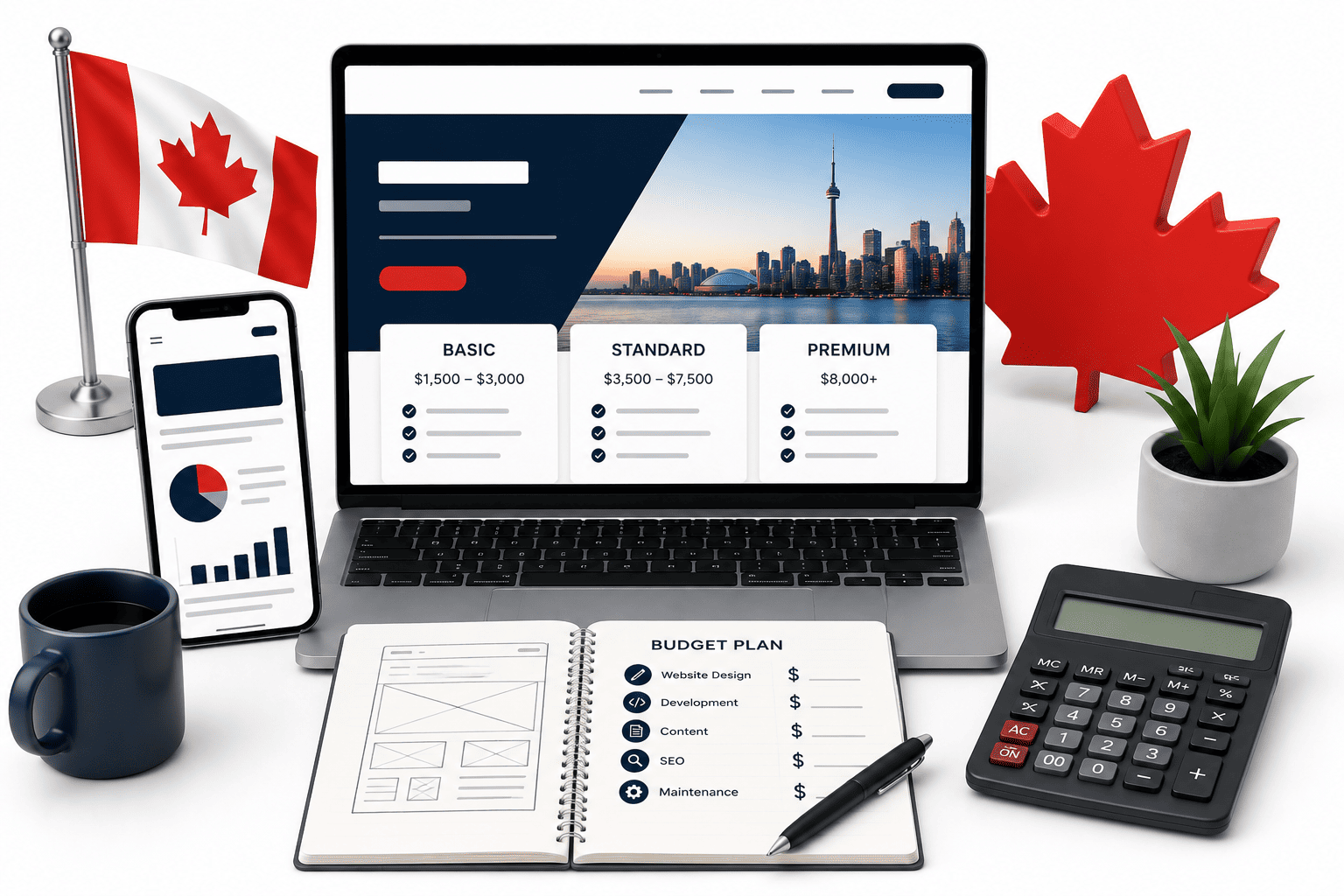
| Project Type | Typical Canadian Price Range (CAD) | Timeline |
|---|---|---|
| Basic brochure site (5–10 pages) | $2,500 – $8,000 | 2–4 weeks |
| Custom business website (10–20 pages) | $8,000 – $20,000 | 1–3 months |
| E-commerce store (up to 50 products) | $10,000 – $30,000 | 2–4 months |
| Large-scale custom platform | $30,000 – $100,000+ | 4–8 months |
You will also learn about recurring costs such as hosting, domain renewal, SSL certificates, plugin subscriptions, and content updates—all of which affect your total cost of ownership over three to five years. Finally, we will explain how to spot red flags in low-ball quotes and what to expect from premium pricing.
How to Use This Pricing Breakdown Effectively
Do not treat the ranges above as a shopping list. Instead, use them as a diagnostic tool. Start by writing down your must-have features and your “nice-to-haves.” Then, compare your list against the table to see which bracket you fall into. Next, contact at least three different providers—one large agency, one mid-sized studio, and one experienced freelancer—and ask for a detailed proposal. When reviewing quotes, focus on what is included in the base price versus what is billed as an add-on. For example, a quote that excludes mobile responsiveness or basic SEO is not a bargain; it is an incomplete project.
Also, factor in your own time. If you cannot supply content or make decisions quickly, your project will stretch beyond the estimated timeline, and some agencies charge hourly overages. Finally, remember that a website is a long-term asset. Spending slightly more upfront for a scalable, well-tested, and accessible design often saves money on redesigns and lost sales later. Use this guide to set a realistic budget, but also be prepared to justify a higher investment when the proposal clearly demonstrates a stronger return on your business goals.
Average Cost Ranges for Web Design in Canada
When asking “how much does web design company cost in Canada,” the short answer is that pricing varies dramatically based on project complexity, functionality, and the agency’s experience level. Canadian web design firms typically charge either a flat project fee or an hourly rate ranging from $80 to $200 CAD per hour. The figures below represent realistic market averages for 2025, but every quote will be tailored to your specific requirements, including the number of pages, custom graphics, copywriting, and post-launch support.
Small Business Websites: $2,000–$8,000
This tier covers most brochure-style sites for local services, restaurants, consultants, and small retailers. A typical small business package includes 5–10 pages, a mobile-responsive layout, basic search engine optimization (SEO), and a contact form. You will likely receive a pre-designed template customized with your branding rather than a fully bespoke design.
What influences the price within this range:
- Number of pages: Each additional page (e.g., blog, team, portfolio) adds $150–$400.
- Copywriting: Professional content writing adds $500–$2,000.
- Basic integrations: Booking systems, Google Maps, or newsletter signups add $300–$1,000.
- CMS training: A 1–2 hour handover session is often included, but extended training costs extra.
At the lower end ($2,000–$4,000), expect a simpler site with limited revisions. At $6,000–$8,000, you should receive a more polished design, custom imagery or stock photo licensing, and better on-page SEO setup.
E-Commerce Websites: $8,000–$30,000+
Online stores require significantly more planning, development, and testing than informational sites. The cost depends heavily on the number of products, payment gateways, shipping calculations, and whether you need custom features like member-only pricing or subscription options.
Typical inclusions in this price bracket:
- Product catalog setup (up to 100–500 products, depending on the quote).
- Secure checkout with Stripe, PayPal, or Canada-specific gateways like Moneris.
- Inventory management and order tracking dashboards.
- Basic tax and shipping rule configuration for Canadian provinces.
- Mobile-optimized shopping experience.
If you use a platform like Shopify or WooCommerce, the licensing and hosting fees are separate. A $8,000–$12,000 store typically uses a premium theme with minor customization. The $15,000–$30,000 range includes custom theme development, advanced filtering, multi-vendor setups, or integration with accounting software like QuickBooks. For large catalogs (1,000+ SKUs) or complex B2B portals, expect the quote to exceed $30,000.
Custom or Enterprise-Level Projects: $30,000+
Enterprise projects are fully bespoke builds for corporations, government agencies, or large institutions. These projects involve a dedicated team of designers, front-end and back-end developers, project managers, and quality assurance testers. The scope often includes custom web applications, user portals, multilingual support (English and French), and compliance with accessibility standards (WCAG 2.1 AA).
What drives the cost beyond $30,000:
- Custom UI/UX design: A unique interface with user research, wireframing, and usability testing can cost $10,000–$25,000 alone.
- Third-party integrations: CRM (Salesforce, HubSpot), ERP, or custom APIs add $5,000–$20,000 per integration.
- Security and compliance: SSL certificates, data encryption, and privacy policy implementation for PIPEDA or provincial laws.
- Content migration: Moving thousands of pages from a legacy system requires careful scripting and validation.
- Ongoing maintenance: Annual retainers for updates, security patches, and support often run 15–20% of the initial build cost.
For a technical comparison, here is a simplified example of how a developer might estimate a custom feature. Suppose an enterprise client needs a dynamic quote generator that calculates shipping based on postal code and product weight. The developer might break down the work as follows:
// Pseudocode for Canadian shipping quote calculation
function getShippingRate(weightKg, postalCode, province) {
  let baseRate = 10.00; // CAD flat fee
  if (weightKg > 20) { baseRate += 5.00; }
  if (province === 'BC' || province === 'ON') { baseRate += 2.50; }
  // API call to Canada Post for exact rate
  return apiCall('canadapost', { weight: weightKg, postal: postalCode });
}
The above is illustrative only; real implementations require API subscriptions and rigorous error handling. The key takeaway is that enterprise quotes reflect hours of discovery, architecture planning, and testing—not just coding.
Final note on quotes: Always request a detailed breakdown from at least three Canadian web design companies. Ask what is included in the base price (e.g., number of revisions, training, launch support) and what is billed hourly. A low quote may exclude critical items like content creation, stock photos, or post-launch bug fixes. Conversely, a high quote should be justified by a clear scope of work, milestones, and a dedicated point of contact. For budget-conscious clients, consider a phased approach: launch a smaller site first, then add features in a second phase. This keeps upfront costs predictable while still allowing for future growth.
Key Factors That Influence Web Design Pricing
Understanding what drives the cost of a website in Canada requires looking beyond a single quote. While a basic brochure site might start around $3,000 CAD, most businesses invest between $7,500 and $30,000 CAD for a functional, professionally designed website. The final price depends on several interconnected variables. Below, we break down the most significant cost drivers so you can budget realistically and avoid surprise expenses.
Number of Pages and Site Architecture
The size of your website is the most straightforward cost factor. Each page requires design work, content layout, and development. However, page count alone isn’t the whole story—the architecture matters just as much. A 10-page site with simple navigation is far cheaper than a 5-page site with complex user flows, such as member portals or multi-step checkout processes.
- Simple brochure sites (5–10 pages): $3,000–$8,000 CAD
- Standard business sites (10–20 pages): $8,000–$15,000 CAD
- Large or e-commerce sites (20+ pages): $15,000–$40,000+ CAD
When you receive a quote, ask how the agency counts “pages.” Some include templates, blog posts, and thank-you pages, while others charge per unique layout. Also, consider whether your site needs a custom content management system (CMS) structure or can use a standard template. The more custom the architecture, the higher the price.
Custom Features, Integrations, and Functionality
Features are often the largest variable in a web design quote. A simple contact form costs little, but advanced functionality can double or triple your budget. Common high-cost items include:
- E-commerce functionality: Product catalogs, shopping carts, payment gateways, and inventory management add $5,000–$20,000 CAD.
- Third-party integrations: CRM systems (e.g., Salesforce, HubSpot), email marketing platforms, or booking software typically cost $500–$3,000 CAD per integration.
- Custom animations and interactive elements: Parallax scrolling, dynamic charts, or calculators can add $1,000–$5,000 CAD.
- Multilingual support: Adding French and English versions (common in Canada) costs $2,000–$7,000 CAD depending on content volume.
Be wary of vague quotes like “e-commerce ready.” Always request a detailed scope of work listing every feature, integration, and the estimated hours for each. The more specific the proposal, the fewer surprises you’ll face during development.
Agency Experience, Portfolio, and Location
Where your web design company is based—and how much experience they have—significantly affects pricing. In Canada, rates vary widely by city and firm reputation. A boutique agency in Toronto or Vancouver will charge more than a freelancer in a smaller city like Winnipeg or Halifax, even for the same work.
| Provider Type | Typical Hourly Rate (CAD) | Typical Project Range (10-page site) | Best For |
|---|---|---|---|
| Freelance designer (small city) | $40–$80 | $3,000–$7,000 | Small businesses on a tight budget |
| Freelance designer (Toronto/Vancouver) | $75–$125 | $6,000–$12,000 | Startups needing a strong visual identity |
| Small agency (anywhere in Canada) | $100–$150 | $10,000–$18,000 | Businesses needing ongoing support and strategy |
| Large digital agency (major city) | $150–$250+ | $20,000–$50,000+ | Enterprise projects with complex integrations |
Experience matters because seasoned agencies anticipate problems, write better code, and deliver faster. They also charge for their portfolio and track record. A firm with award-winning designs or industry-specific expertise (e.g., healthcare or legal) can justify a premium. Additionally, consider that agencies in high-cost cities pay more for rent and talent, which is passed on to you. However, remote agencies in lower-cost provinces often offer competitive rates without sacrificing quality—so don’t automatically discount them.
Finally, remember that the cheapest quote rarely saves you money in the long run. Poorly built sites cost more in maintenance, security fixes, and lost conversions. Instead, compare quotes based on the team’s experience, the clarity of their scope, and how well they understand your business goals.
Hourly Rates vs. Project-Based Pricing
When you ask, “How much does web design company cost in Canada?” the answer often depends on which pricing model the agency uses. Two dominant structures exist: billing by the hour or quoting a flat fee for the entire project. Each has distinct implications for your budget, timeline, and the level of control you retain. Understanding these models before you sign a contract will prevent scope creep and sticker shock.
Typical Hourly Rates: $80–$200 per Hour
Canadian web design agencies and freelance studios commonly charge between $80 and $200 CAD per hour. The wide range reflects differences in experience, geographic location, and specialization. A solo designer in Winnipeg might bill $85/hour, while a Toronto-based agency with dedicated UX researchers and custom developers could charge $180/hour or more. Here’s what those rates typically include:
- $80–$110/hour: Junior designers, template-based builds, or small-town studios. Good for simple brochure sites.
- $110–$150/hour: Mid-level professionals with a portfolio of custom WordPress or Shopify builds. Most small-to-medium business projects fall here.
- $150–$200/hour: Senior strategists, full-stack developers, and agencies with specialized e-commerce or SaaS experience. Expect detailed discovery phases and custom integrations.
Hourly billing is transparent but risky for clients. Every revision, meeting, and plugin configuration adds to the final invoice. You must track time carefully or request weekly breakdowns.
Pros and Cons of Project-Based Quotes
Most established Canadian agencies prefer flat-rate quotes. After a discovery call, they estimate total hours and multiply by their blended rate, then add a margin for uncertainty. A typical quote might be $8,000 for a 10-page marketing site or $25,000 for a custom e-commerce build. The advantages are clear:
- Predictable budget: You know the total cost upfront, which simplifies approval and financing.
- Scope discipline: The agency defines what’s included—e.g., 5 rounds of revisions, 3 page templates—so you avoid endless back-and-forth.
- Faster delivery: Agencies work efficiently to protect their margin, avoiding time-wasting tangents.
However, flat quotes have downsides. If you request significant changes mid-project (e.g., adding a membership portal), expect a “change order” with additional fees. Also, some agencies low-ball the quote to win the contract, then cut corners on copywriting or accessibility testing. Always ask for a detailed scope document that lists deliverables, revision limits, and what happens if the project grows.
Which Pricing Model Fits Your Project?
Choose hourly billing when your project is exploratory, ongoing, or has undefined boundaries. For example, if you’re redesigning a website while simultaneously revising your brand messaging, an hourly arrangement lets you pause and adjust without penalty. Similarly, hourly works for maintenance retainers—after launch, you pay $100/hour for small updates like swapping images or fixing broken links.
Choose project-based pricing when you have clear goals and a fixed deadline. A marketing site for a new product launch, a restaurant menu with online reservations, or a professional portfolio—all fit flat quotes. You’ll also benefit from project pricing if you need stakeholder approval; a single number is easier to sell internally than a variable hourly estimate.
One practical rule: request a hybrid quote. Many Canadian agencies offer a fixed price for design and development, but bill hourly for content creation or third-party integrations. This balances budget certainty with flexibility. For example, a typical contract might state: “$12,000 fixed for design and build; $95/hour for additional copywriting or custom API work.”
Before you decide, ask the agency for a sample invoice from a past project. See how they categorize time for hourly billing or how they document scope changes for flat fees. This transparency will tell you more than any rate sheet about how much your web design company will actually cost in Canada.
DIY vs. Freelancer vs. Web Design Agency: Cost Comparison
When budgeting for a new website in Canada, the first fork in the road is choosing who builds it. The price gap between a DIY platform, a freelance designer, and a full-service agency is enormous—but so is the difference in what you get. Below is a realistic breakdown of what each option costs in 2025, along with the trade-offs that go far beyond the invoice.
DIY Website Builders: $20–$500 per Month
Platforms like Wix, Squarespace, and Shopify allow you to assemble a site from templates without writing code. The monthly fee covers hosting, a domain, and basic support. At the low end, a personal portfolio or small blog runs $20–$40 per month. E-commerce stores with premium apps, payment processing, and custom domain email can push that figure to $150–$500 per month.
What you save: upfront cost. What you spend instead: time and patience. Expect 40–80 hours of your own labour for a polished site, plus ongoing tweaks. You also absorb the learning curve for SEO, mobile responsiveness, and page speed—mistakes here can cost you in lost traffic later.
- Best for: startups testing an idea, hobbyists, or businesses with zero budget and high DIY aptitude.
- Hidden costs: premium plugins, stock photos, abandoned cart apps, and your own hourly rate if you value your time.
- Trade-off: template limitations mean your site may look generic, and you own no custom code—switching platforms later means starting over.
Freelancer Costs: $1,500–$10,000 per Project
Hiring an independent web designer or developer in Canada typically costs $1,500 for a simple landing page or small business site, rising to $5,000–$10,000 for a custom build with 5–10 pages, basic CMS integration, and on-page SEO. Freelancers often charge by the hour ($50–$150) or by fixed project scope. E-commerce or membership sites with custom functionality usually land at the top of this range.
What you get: a tailored design, direct communication, and faster turnaround than DIY (usually 2–6 weeks). However, you are responsible for project management. If the freelancer gets sick, overbooks, or disappears, your timeline slips. You also handle ongoing maintenance yourself or pay extra monthly retainers.
- Best for: established small businesses needing a professional presence without agency overhead.
- Hidden costs: revisions beyond the agreed scope, third-party plugin licenses, and hiring a separate copywriter or photographer.
- Trade-off: you trade cost savings for risk—there is no team to cover for a single point of failure, and quality varies widely.
Agency Costs: $5,000–$50,000+ per Project
A full-service web design agency in Canada charges $5,000 for a basic five-page brochure site, $15,000–$30,000 for a mid-sized business with custom features, and $50,000+ for enterprise e-commerce, custom web apps, or complex integrations. This price includes a project manager, strategist, designer, developer, and QA tester—plus post-launch support.
What you pay for: process and accountability. Agencies deliver on a contract with milestones, revision rounds, and a documented handoff. They also bring UX research, conversion optimization, and accessibility compliance that DIY and freelancers often skip. Most agencies offer ongoing maintenance plans (e.g., $200–$800 per month) for updates, security, and backups.
| Scope | Typical Agency Range | Deliverables |
|---|---|---|
| Small business (5–10 pages) | $5,000–$12,000 | Custom design, CMS, mobile responsive, basic SEO |
| Mid-market (10–25 pages, e-commerce) | $15,000–$30,000 | User flow mapping, custom plugins, payment gateways, analytics |
| Enterprise (custom app, multi-language) | $35,000–$50,000+ | Dedicated team, API integrations, load testing, SLA support |
The real trade-off: agencies are slower to start (4–8 weeks for onboarding) and require more upfront meetings. But for businesses where the website is a primary sales channel, the higher cost buys reliability, scalability, and fewer costly mistakes down the road.
Hidden Costs and Additional Expenses to Budget For
When you receive a quote from a Canadian web design company, the headline figure rarely tells the whole story. Most proposals cover the core design and development work—but the ongoing costs of running a website can add 20% to 50% to your first-year budget. Understanding these add-ons before you sign a contract prevents unpleasant surprises and helps you compare quotes fairly. Below are the most common expenses that appear after the initial build, broken down by category.
Domain, Hosting, and SSL Certificates
Your website cannot go live without three essential technical services, and none are typically included in the design fee. In Canada, these costs vary by provider and performance level:
- Domain registration: $15–$40 CAD per year for a .ca or .com domain. Premium domains (short, keyword-rich, or popular extensions) can cost hundreds or thousands.
- Web hosting: Shared hosting starts at $10–$30 CAD per month, but most business websites need a managed WordPress or VPS plan at $40–$120 CAD per month for reliable speed and uptime.
- SSL certificate: Most reputable hosts include a free Let’s Encrypt SSL, but premium extended validation (EV) certificates—which show your business name in the browser bar—cost $100–$300 CAD per year.
A common mistake is choosing the cheapest shared hosting. Canadian clients with even moderate traffic often upgrade within six months, paying double for migration and downtime. Budget $500–$1,200 CAD annually for these basics if you want professional-grade performance.
Premium Themes, Plugins, and Stock Assets
The design quote may include a free theme and basic plugins, but most functional websites require paid tools. These costs are frequently itemized separately or left out entirely:
| Asset Type | Typical Cost (CAD) | Notes |
|---|---|---|
| Premium theme (one-time) | $80–$250 | Better code quality and support than free themes |
| Premium plugins (per site) | $50–$400/year | eCommerce, booking, SEO, security, or forms |
| Stock photo/video licenses | $10–$100 per asset | Bundled subscriptions cost $150–$400/year |
| Custom fonts or icon sets | $30–$200 | Licensing fees for commercial use |
For example, a simple WooCommerce store might need a $99 theme, a $199 booking plugin, and a $250 stock photo bundle—totaling $548 in “extras” the client never saw in the original proposal. Always ask your designer for a complete list of paid assets they plan to install, and request a breakdown in writing.
Ongoing Maintenance and Support Fees
Websites are not static; they require regular updates, backups, and security monitoring. Most Canadian agencies offer maintenance plans, but these are almost always billed separately from the initial design. Expect one of two structures:
- Monthly retainer: $75–$300 CAD per month, covering core updates, daily backups, uptime monitoring, and a set number of minor content changes.
- Hourly support: $100–$175 CAD per hour for ad-hoc fixes, with a 1-hour minimum. Emergency support after hours can double that rate.
If you skip a maintenance plan, you risk security vulnerabilities and broken functionality. A single malware cleanup after an infection often costs $500–$1,500 CAD—more than a year of proactive care. For a practical example, here is a simple command to check if your server’s PHP version is outdated, a common issue that leads to plugin conflicts:
php -vRun this in your hosting terminal. If the output shows PHP 7.4 or lower, you are likely paying for extra developer time to fix compatibility issues. Ask your agency to include PHP version monitoring in your maintenance contract. The smartest approach is to bundle all these costs into your initial budget: add $1,000–$2,500 CAD to the design quote for the first year, then plan for $1,200–$3,000 CAD annually thereafter. This clarity ensures your project succeeds without financial surprises.
Regional Pricing Differences Across Canada
When you ask, “How much does web design company cost in Canada?” the answer varies significantly depending on where you’re located. While national averages hover between $3,000 and $15,000 for a standard business website, local market conditions, operating costs, and talent pools create distinct price bands from coast to coast. Understanding these regional differences helps you set a realistic budget and avoid sticker shock—or, conversely, under-budgeting for a project that requires more investment than your local market suggests.
Pricing in Major Cities: Toronto, Vancouver, and Montreal
Canada’s three largest metros command the highest rates, but not uniformly. Toronto and Vancouver sit at the top of the spectrum due to elevated commercial rents, competitive salaries for designers and developers, and a dense concentration of high-budget clients. In these cities, a custom marketing website typically ranges from $8,000 to $20,000+, with e-commerce builds starting near $15,000 and scaling to $40,000 for complex integrations. Hourly rates for senior freelancers or boutique agencies in these hubs often land between $100 and $180 per hour.
Montreal, by contrast, offers a notable value advantage. With lower overhead and a strong bilingual talent pool, agencies in Montreal frequently charge 20–30% less than their Toronto counterparts for comparable work. A standard business site might cost $5,000 to $12,000, and e-commerce projects often start at $10,000. This pricing gap makes Montreal an attractive option for companies willing to work remotely with a major-city agency without paying major-city premiums.
Mid-Sized Markets: Calgary, Ottawa, and Halifax
Mid-sized cities present a mixed picture. Calgary’s energy-sector wealth and corporate clientele push prices upward, though not to Toronto levels. Expect to pay $6,000 to $14,000 for a custom website, with hourly rates averaging $90–$140. Ottawa, driven by government and tech contracts, follows a similar pattern—budget $5,500 to $13,000 for a standard build, with a slight premium for projects requiring bilingual (English/French) content or accessibility compliance (WCAG).
Halifax, representing Atlantic Canada’s largest market, is noticeably more affordable. Local agencies often quote $4,000 to $9,000 for a professional business website, and hourly rates hover between $70 and $110. The trade-off? You may have fewer specialists available in-house, so complex features like custom web applications or advanced animation might require outsourcing, which can add project management overhead and delay timelines.
How Remote Agencies Can Affect Your Budget
Geography is no longer a hard constraint. Many Canadian companies now hire remote agencies from smaller provinces—or even from lower-cost regions like Eastern Europe or Southeast Asia—to reduce expenses. A remote agency based in Saskatoon or Moncton might charge $3,500 to $7,000 for a website that would cost double in Toronto. This can stretch your budget significantly, but it introduces variables:
- Communication friction: Time zone differences (especially with overseas teams) can slow feedback loops and extend project timelines by 2–4 weeks.
- Quality variance: Lower rates sometimes reflect less rigorous UX research or post-launch support. Always review a portfolio and request client references before committing.
- Hidden costs: Remote agencies may bill separately for project management, travel for on-site discovery sessions, or additional revisions beyond a fixed scope.
To balance savings and reliability, consider a hybrid approach: hire a local Toronto or Vancouver agency for strategy and art direction, then contract a remote development partner for coding. This structure often yields a 15–25% cost reduction compared to a full-service local agency, while retaining a senior point of contact in your time zone. Ultimately, the “best” price depends less on the city and more on the alignment between your project’s complexity, the agency’s niche expertise, and your willingness to manage remote workflows.
How to Get Accurate Quotes from Web Design Companies
When you ask “how much does web design company cost in Canada,” the first number you receive is rarely the final number. Pricing varies widely—from $3,000 for a template-based site to $50,000+ for a custom build with e-commerce and integrations. The difference between a vague estimate and a reliable quote comes down to how you prepare, what you ask, and how carefully you read the proposal. Follow this three-step process to avoid surprise invoices and scope creep.
Preparing a Detailed Project Brief
A vague request like “we need a modern website” invites vague pricing. A detailed brief gives agencies the clarity they need to quote accurately—and it also signals that you are a serious buyer. Your brief should include the following:
- Business context: Your industry, target audience, and primary competitors.
- Core goals: Lead generation, online sales, content publishing, or brand awareness.
- Functional requirements: For example, a booking system, customer portal, multilingual support, or CMS (WordPress, Shopify, Webflow).
- Content status: Do you have copy, images, and videos ready, or does the agency need to produce them?
- Integrations: CRM, email marketing, payment gateways, analytics, or third-party APIs.
- Timeline and budget range: Be honest about your constraints—agencies can often adjust scope to fit.
Send the same brief to at least three agencies. If you change the brief between quotes, the prices become incomparable.
Questions to Ask Before Receiving a Quote
Before you ask for a price, clarify what that price includes. The table below outlines the most common inclusions and exclusions you should verify with each agency.
| Scope Item | Typically Included | Often Extra / Clarify |
|---|---|---|
| Design revisions | 2–3 rounds of homepage and inner-page mockups | Additional rounds billed hourly ($75–$150/hour) |
| Content writing | Basic placeholder text or copyediting of your draft | Professional copywriting or SEO article writing |
| Responsive testing | Testing on major browsers and mobile devices | Cross-device testing on older or rare devices |
| CMS training | One recorded walkthrough (60–90 minutes) | On-site training or extended support beyond 30 days |
| Post-launch support | 30 days of bug fixes | Ongoing maintenance ($100–$300/month) |
Ask these specific questions before you receive a quote:
- “Is your quote fixed, or does it allow for change orders?”
- “Who owns the design files and the code after launch?”
- “What is your policy on third-party plugin or theme licenses?”
- “Do you charge extra for migrating content from my current site?”
- “What is the payment schedule—deposit, milestones, and final payment?”
Red Flags and What to Avoid in Proposals
Not every proposal deserves your trust. Watch for these warning signs:
- No line items: A single lump sum with no breakdown for design, development, or testing makes it impossible to compare quotes or track progress.
- “Unlimited revisions”: This usually means endless delays and a final invoice padded with hidden hourly work.
- No timeline or milestones: A proposal without dates is a proposal without accountability.
- Vague ownership clauses: If the contract doesn’t explicitly state that you own the final website files, the agency may retain rights and charge you to transfer them.
- Pressure to sign immediately: Reputable agencies give you 7–14 days to review. Urgency is a tactic to hide weak terms.
- Excluded hosting and domain: Some quotes omit these recurring costs, which add $200–$600 per year in Canada.
Finally, request a sample contract from each shortlisted agency. Read it for termination clauses, late fees, and what happens if the project stalls. A clear, fair contract is the best guarantee that the price you see is the price you pay—and that your project stays on track from kickoff to launch.
Budget-Friendly Tips Without Sacrificing Quality
Reducing the cost of a professional website in Canada doesn’t mean settling for a subpar result. The key is to strategically control scope, leverage existing tools, and plan for growth. Below are proven approaches that cut expenses while maintaining usability, performance, and visual credibility.
Start with a Minimum Viable Product (MVP)
An MVP includes only the core features necessary for your business to operate online and convert visitors. Instead of paying a developer to build every page and function upfront, define your absolute essentials—typically a homepage, service or product pages, a contact form, and basic analytics. By stripping away non-critical elements (e.g., custom animations, membership portals, or multi-language support), you can reduce initial design and development hours by 30–50%.
To identify your MVP, ask three questions:
- What action must a visitor take for my business to generate revenue or leads?
- Which pages are required to support that action?
- What can be added later without requiring a full redesign?
For example, a local bakery might launch with a menu, hours, and an order form, deferring an online storefront to phase two. Communicate this clearly with your web design company—they can quote a fixed price for the MVP and a separate rate for future features.
Leverage Pre-Built Themes and Templates
Custom design from scratch is the most expensive route. A high-quality pre-built theme (from platforms like WordPress, Shopify, or Webflow) costs between $50 and $200 CAD, compared to $2,000–$10,000 for bespoke design. Many professional agencies will install and customize a premium theme for you, which reduces their design time significantly. The result is a polished, responsive site that doesn’t look “off-the-shelf” if you choose a theme with flexible layout options.
When selecting a template, prioritize these features to avoid hidden costs:
- Responsive design (mobile-first) built into the theme’s code.
- Page builder compatibility (e.g., Elementor, Divi) so you can edit content without developer fees.
- Regular updates and positive user reviews for security and compatibility.
A practical example: if your agency uses WordPress, you can install a lightweight theme like GeneratePress or Astra (free versions available) and then add a page builder. This lets you handle minor text or image swaps yourself, saving on hourly maintenance charges.
Plan for Future Updates and Scalability
One of the biggest hidden costs in web design is rebuilding a site that can’t accommodate growth. To avoid this, agree with your provider on a scalable architecture from day one—even if you don’t use all its features immediately. This includes choosing a content management system (CMS) that supports adding new pages, blog posts, or e-commerce functionality without rewriting code.
Here’s a simple command-line example for WordPress users to check if your site is ready for future plugins and updates (run via SSH or your hosting terminal):
wp core check-update && wp plugin list --status=active --fields=name,version,updateThis command verifies that your core files and plugins are current, reducing the risk of compatibility issues when you later add features. Additionally, document your site’s structure (URLs, plugins, custom code) in a handover file. Agencies charge less for future work when they don’t have to reverse-engineer your site.
Finally, negotiate a maintenance retainer that covers monthly backups, security patches, and small content edits. This prevents surprise invoices and ensures your site remains fast and secure as you scale—without sacrificing the quality of your online presence.
Conclusion: Making an Informed Decision for Your Web Design Investment
Investing in a professional website is one of the most significant decisions you will make for your Canadian business. As this 2025 pricing guide has shown, the answer to “How Much Does Web Design Company Cost in Canada?” is never a single number—it is a spectrum shaped by your goals, your market, and the complexity of your project. The key is not to chase the cheapest quote, but to understand what you are paying for and why. A website is not an expense; it is a revenue-generating asset that works for you 24/7. By approaching your budget with clarity and comparing proposals on value rather than price alone, you position your business for sustainable online growth.
Recap of Cost Ranges and Influencing Factors
To make a confident decision, keep these 2025 benchmarks in mind. Canadian web design costs generally fall into these tiers:
- Freelancer or template-based: $1,500 – $5,000 CAD – suitable for very small businesses or short-term landing pages.
- Small to mid-size agency (standard custom design): $5,000 – $15,000 CAD – includes custom layout, basic CMS, and mobile responsiveness.
- Premium agency or e-commerce build: $15,000 – $50,000+ CAD – includes advanced functionality, custom integrations, and ongoing strategy.
These ranges shift based on several factors: the number of pages, the need for copywriting or photography, the complexity of e-commerce features (such as payment gateways or inventory systems), and the level of post-launch support. Additionally, your geographic location matters—agencies in Toronto or Vancouver typically charge 15–25% more than those in smaller markets. Do not forget recurring costs: hosting, domain renewal, maintenance, and security updates usually add $100–$500 per month. Always ask for a detailed breakdown so you can see exactly where your money goes.
Balancing Cost, Quality, and Long-Term Value
The cheapest quote is rarely the most economical over the lifetime of your website. A poorly built site will cost you more in lost leads, slow loading speeds, and frequent repairs. Conversely, the most expensive option is not automatically the best fit for a small local business. To balance these forces, focus on three things:
- Portfolio relevance: Ask to see examples from your industry. A developer who has built successful sites for Canadian service providers will understand local user behaviour.
- Clear scope of work: Ensure the proposal specifies deliverables, timelines, and who owns the design files and code. Vague contracts lead to surprise fees.
- Post-launch support: Inquire about training and maintenance packages. A site that you cannot update yourself will create dependency and hidden costs.
Long-term value also includes search engine optimization (SEO) basics. A well-coded site with fast load times and proper meta tags will reduce your future marketing spend. Similarly, a mobile-first design is non-negotiable—over 60% of Canadian web traffic comes from phones. When you weigh these factors, a mid-range investment that offers solid craftsmanship and transparent communication often delivers the best return.
Next Steps: Getting Started with Your Project
Now that you understand the cost landscape, take action with a structured approach. First, write a one-page brief outlining your business goals, target audience, and must-have features. This document will help you communicate clearly with potential partners and prevent scope creep. Next, request detailed quotes from three to five companies—mix of freelancers, small agencies, and larger firms. Compare them side by side using a simple table:
| Criteria | Quote 1 | Quote 2 | Quote 3 |
|---|---|---|---|
| Total price (CAD) | |||
| Included revisions | |||
| Monthly maintenance | |||
| SEO & analytics setup | |||
| Estimated launch date |
Finally, schedule discovery calls with your top two candidates. Ask how they handle delays, what their communication style is, and whether they provide a dedicated project manager. A transparent conversation will reveal more than any brochure. Set a realistic budget that includes a 10–15% contingency for unexpected additions, and be honest about your constraints. With this preparation, you will not only answer “How Much Does Web Design Company Cost in Canada?” for your own project—you will secure a partner who helps your business thrive online for years to come.
Frequently Asked Questions
What is the average cost to hire a web design company in Canada in 2025?
In 2025, the average cost to hire a professional web design company in Canada ranges from $3,000 to $15,000 for a standard small business website. More complex e-commerce or custom-built sites can range from $15,000 to $50,000 or more. Hourly rates typically range from $50 to $150 per hour, depending on the agency’s location and expertise. It’s important to get detailed quotes from multiple companies to compare services and pricing.
How much does a web design company charge per hour in Canada?
Canadian web design agencies charge between $50 and $150 per hour on average. Freelance designers may charge slightly less, from $30 to $80 per hour, while specialized agencies in major cities like Toronto or Vancouver can charge $150 to $250 per hour. The rate often reflects the level of expertise, the complexity of the project, and the agency’s reputation. Always request a detailed estimate that includes the number of hours and the specific tasks covered.
What are the typical pricing models used by web design companies in Canada?
Web design companies in Canada typically use one of three pricing models: fixed-price packages, hourly billing, or monthly retainers. Fixed-price packages are common for small business websites and include a set scope of work. Hourly billing is used for projects with uncertain requirements or ongoing changes. Monthly retainers are ideal for ongoing maintenance, updates, and support. Each model has its advantages, so choose one that aligns with your project needs and budget.
Are there hidden costs associated with web design services in Canada?
Yes, there can be hidden costs beyond the initial design fee. Common additional costs include domain registration (about $15-30/year), web hosting ($10-50/month), premium themes or plugins, stock photos, copywriting, SEO setup, and ongoing maintenance. Some agencies also charge extra for revisions beyond a certain number or for integrating complex features. Always ask for a full breakdown of costs before signing a contract to avoid surprises.
How much does an e-commerce website cost from a Canadian web design company?
An e-commerce website in Canada typically costs between $8,000 and $30,000 or more, depending on the number of products, payment integrations, and custom features. Basic e-commerce sites using templates can start around $5,000, while fully custom online stores with advanced functionality can exceed $50,000. Ongoing costs include payment gateway fees, hosting, and security. It’s crucial to budget for both initial development and long-term maintenance.
Why do web design costs vary so much across different Canadian provinces?
Web design costs vary across Canadian provinces due to differences in cost of living, local market demand, and the concentration of agencies. For instance, agencies in Toronto, Vancouver, and Calgary generally charge higher rates than those in smaller cities or rural areas. Additionally, agencies in provinces with higher operating costs may pass those expenses onto clients. However, remote collaboration is common, so you can hire a reputable agency from a lower-cost region to save money without sacrificing quality.
What should be included in a web design quote from a Canadian company?
A comprehensive web design quote should include a detailed breakdown of all costs, such as strategy, design, development, content creation, SEO setup, and testing. It should also specify the number of revisions, the project timeline, and any third-party expenses like hosting or domain registration. Ensure the quote clearly states what is not included to avoid unexpected charges. A transparent quote helps you compare different agencies fairly and make an informed decision.
How can I reduce the cost of web design in Canada without compromising quality?
To reduce web design costs in Canada, consider using a pre-designed template instead of a fully custom design, limit the number of pages, and provide your own content (text and images). You can also choose a freelance designer or a smaller agency rather than a large firm. Opt for a phased approach, launching a basic site first and adding features later. Finally, plan your project clearly to minimize revision requests, which can add to the final bill.
Sources and further reading
- Statistics Canada – Consumer Price Index, annual average, not seasonally adjusted
- Canadian Internet Registration Authority (CIRA) – Canadian Domain Costs
- WebAIM – Web Accessibility in Mind
- Canadian Marketing Association – Website Marketing Guide
- BBB Canada – Hiring a Web Designer
- TechSoup Canada – Web Design for Nonprofits
- Ontario Government – Small Business Web Presence
- B.C. Government – Small Business BC Website Planning
- Alberta Government – Digital Economy Strategy
- Quebec Government – Digital Transformation for SMEs
Need help with this topic?
Send us your details and we will contact you.






Comment (1)
Pingback: Small Business Web Design Edmonton: Strategy, Cost & What to Expect