

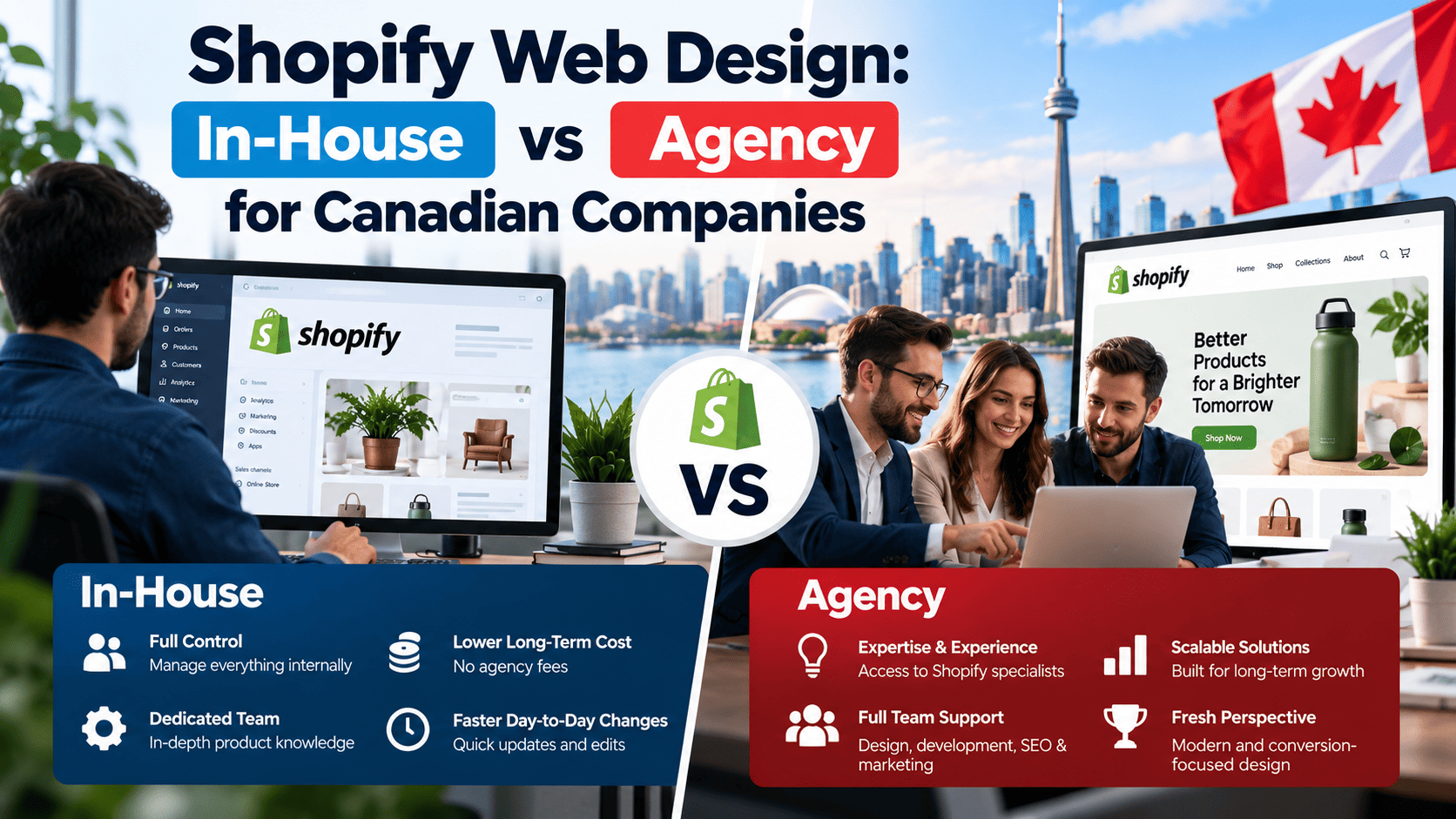
Why the In-House vs Agency Decision Matters for Canadian Shopify Stores
Choosing how to build and maintain a <a href=”https://niagaraforge.ca/service/web-design/shopify/”>Shopify store is one of the most consequential decisions a Canadian business will make online. Whether you keep web design in-house or hand it to an agency shapes not only how your store looks on launch day, but how quickly you can adapt, how much you spend over time, and how well your brand holds together as you grow. For Canadian merchants, the stakes are amplified by a market that is geographically vast, linguistically diverse, and increasingly competitive. Getting this decision right can set the foundation for years of growth; getting it wrong can quietly drain budgets and stall momentum.
The Growing Importance of Shopify for Canadian E-commerce
Shopify has become the default commerce platform for a wide range of Canadian businesses, from independent retailers in Halifax to scaling direct-to-consumer brands in Vancouver. Its appeal is practical: it handles payments, inventory, and shipping integrations without requiring a full engineering team, and it supports the multi-currency and bilingual experiences that Canadian shoppers increasingly expect.
That accessibility creates a new kind of pressure. Because launching a Shopify store is relatively easy, the real differentiator is design quality, user experience, and conversion performance. Canadian consumers are comfortable shopping across borders, which means a local store is often competing with larger American and international brands on the same screen. A generic theme and a slow, cluttered product page will not hold attention. This is why the question of who designs and maintains the store has moved from a technical detail to a strategic one.
Key Factors: Budget, Timeline, Control, and Expertise
Four factors tend to drive the in-house versus agency decision, and each plays out differently depending on your stage and resources.
- Budget: In-house work can appear cheaper because salaries are already paid, but it consumes internal capacity that could go toward marketing, operations, or product. Agencies bring higher upfront costs but often deliver faster, with fewer costly redesign cycles.
- Timeline: An agency can typically launch a polished Shopify store in weeks, drawing on established processes and specialists. In-house teams often move more slowly when design, development, and content compete with daily operations.
- Control: In-house teams keep every decision close to the brand and can iterate daily. Agencies introduce a layer of communication, but they also bring external perspective and tested patterns that internal teams may overlook.
- Expertise: Shopify’s ecosystem changes constantly, from theme architecture to app integrations and performance best practices. Agencies maintain that expertise across many clients; in-house staff must build and sustain it themselves.
For Canadian companies, two additional considerations matter. Bilingual English and French experiences are often expected rather than optional, and provincial privacy and consumer protection rules can influence how data, cookies, and checkout flows are designed. Both are easier to handle when the people building your store have done it before.
How the Wrong Choice Can Impact Your Bottom Line
The consequences of a mismatched decision rarely appear immediately. They surface as slow page loads that erode conversion, inconsistent branding that weakens trust, or a store that cannot support new product lines or markets without a rebuild. An in-house team stretched too thin may delay critical updates, while an agency engagement without clear scope can produce beautiful work that misses business goals.
Over time, these issues compound. A store that underperforms forces more spending on ads to compensate, while a rigid build limits expansion into new provinces or customer segments. The right choice, by contrast, aligns design capacity with business priorities, so every dollar spent on the store supports measurable growth rather than patching avoidable problems.
Understanding the Canadian E-commerce Landscape
Canada is not a single, uniform market. It is a patchwork of provinces, languages, and buying behaviours that can differ sharply from one region to the next. For a Canadian company planning a Shopify storefront, that reality shapes nearly every design decision — from checkout flow and product page layout to navigation labels and trust signals. A template that performs well for a Toronto fashion brand may fall flat for a Montreal retailer serving a francophone audience, or for a Prairie agricultural supplier selling B2B. This is why the question of Shopify web design: in-house vs agency for Canadian companies cannot be answered generically. The right choice depends on how well your team understands the specific Canadian audiences you serve.
Consumer Expectations and Shopping Habits in Canada
Canadian shoppers tend to research before they buy, compare prices across borders, and expect transparent costs. Cross-border shopping with U.S. retailers is common, which means your Shopify store competes not only with domestic rivals but with American sites that often display lower sticker prices. Duties, taxes, and shipping fees shown late in checkout are a frequent source of cart abandonment.
Several habits stand out:
- Mobile-first browsing: A large share of sessions begin on phones, often during commutes or in-store price checks.
- Trust in local cues: Canadian shoppers respond to domestic shipping promises, local return addresses, and recognizable payment methods.
- Seasonal concentration: Holiday and Boxing Day demand spikes require storefronts that stay fast under load.
- Bilingual expectations: In Quebec especially, French-language product information is not optional for many buyers.
Bilingual and Multicultural Design Considerations
Canada’s official bilingualism is a design constraint, not a checkbox. A Shopify storefront serving Quebec must handle French typography, longer text strings, and culturally appropriate imagery. Layouts built only for English often break when French copy expands by 15–20%.
Practical design implications include:
- Language toggles that preserve the shopper’s current page rather than dumping them on the homepage.
- Separate URL structures or subfolders for French content to support search visibility.
- Product descriptions written natively in French, not machine-translated.
- Currency and tax displays that reflect provincial differences.
Beyond language, multicultural audiences in Vancouver, Toronto, and Montreal may expect different payment options, sizing conventions, and cultural references. A one-size-fits-all theme rarely accommodates all of them.
Regional Regulations and Compliance Basics
Canadian e-commerce is governed by a mix of federal and provincial rules. Design and development choices must account for them.
| Area | Consideration |
|---|---|
| Privacy | PIPEDA at the federal level, plus Quebec’s Law 25 and similar provincial rules, affect cookie consent, data collection, and analytics. |
| Language | Quebec’s Charter of the French Language requires French prominence in commercial communications. |
| Taxes | GST/HST and provincial sales taxes vary by province and must display correctly at checkout. |
| Accessibility | Accessibility standards influence contrast, keyboard navigation, and form labelling. |
These requirements make a generic, globally themed Shopify build risky. Whether you handle design in-house or through an agency, the storefront must be built with Canadian compliance in mind from the start — not retrofitted after launch.
The Case for Building an In-House Shopify Design Team
For many Canadian companies, the decision to build an in-house Shopify design team is driven by a desire for greater creative ownership and tighter integration between brand strategy and storefront execution. Rather than briefing an external partner on every campaign, product launch, or seasonal refresh, an internal team works inside the business every day. That proximity can translate into design decisions that reflect the brand more consistently and respond to commercial priorities more quickly. However, the in-house model is not automatically cheaper or easier. It requires a realistic assessment of recruitment, training, and the ongoing cost of maintaining a specialized team in a competitive Canadian labour market.
Advantages: Brand Alignment, Speed, and Control
An in-house team develops institutional knowledge that is difficult for an agency to replicate. Designers learn the nuances of the product catalogue, the customer journey, and the brand voice over time, which reduces the back-and-forth that often accompanies external engagements. When a promotion needs a new landing page or a product line requires a redesigned collection template, internal designers can move from concept to implementation without procurement cycles or onboarding delays.
Control is another significant benefit. Canadian companies operating in regulated sectors, such as cannabis, finance, or health products, may prefer to keep design and content decisions close to legal and compliance teams. An in-house team can build compliance checks directly into its workflow rather than relying on an agency to interpret provincial or federal requirements.
Speed also improves when designers sit alongside developers, marketers, and merchandisers. A shared understanding of Shopify’s theme architecture, apps, and checkout extensibility means changes can be tested and shipped in days rather than weeks. Over the long term, this cadence can reduce the cumulative cost of small design requests that agencies often bill at hourly rates.
Challenges: Talent Acquisition, Training, and Overhead
The main obstacle is people. Canada’s tech and design talent pool is concentrated in cities such as Toronto, Vancouver, Montreal, and Waterloo, and competition for experienced Shopify designers is intense. Companies outside these hubs may struggle to attract candidates who are unwilling to relocate or who command remote-market salaries. Recruiting a single senior Shopify designer can take months, and retaining that person requires competitive compensation, benefits, and a clear career path.
Training adds another layer. Shopify’s platform evolves continuously, from theme updates to new APIs and checkout features. An in-house team must budget time for professional development, experimentation, and staying current with accessibility standards such as WCAG 2.2. Without that investment, internal teams can fall behind agencies that serve many clients and encounter a wider range of technical challenges.
Overhead is also real. Salaries, benefits, equipment, software subscriptions, and management time add up. A small Canadian retailer may find that the fully loaded cost of one in-house designer exceeds the cost of a focused agency project, especially when demand is seasonal rather than constant.
| Factor | In-House Shopify Design Team | Agency Partner |
|---|---|---|
| Brand immersion | Deep and continuous; team works inside the business daily | Strong during engagement; may fade between projects |
| Iteration speed | Fast for small, ongoing changes; limited by internal capacity | Fast for defined projects; slower for ad hoc requests |
| Cost structure | Fixed salaries and overhead; predictable but committed | Variable project or retainer fees; scalable with demand |
| Talent access | Limited to what the company can recruit and retain | Access to a broader, specialized skill set |
| Platform expertise | Requires ongoing training investment | Continuously refreshed across multiple clients |
When In-House Makes the Most Sense for Canadian Companies
In-house Shopify design tends to be the stronger choice for companies with a steady pipeline of design work, a distinctive brand that demands consistency, and the budget to support at least one senior designer plus a developer. It also suits businesses in regulated industries where compliance oversight is easier to manage internally.
Agencies remain a better fit for companies with sporadic design needs, limited hiring capacity, or a desire to tap specialized expertise for a major replatform or redesign. Many Canadian companies land on a hybrid model: a small in-house team to own the brand and day-to-day changes, supported by an agency for large-scale projects or overflow. That approach can balance control and speed with access to specialized talent, without committing to a full internal studio before the demand justifies it.
The Case for Hiring a Shopify Design Agency
For many Canadian companies, the decision between building a Shopify store in-house and partnering with a specialized agency comes down to balancing control, cost, and capability. While an internal team offers deep familiarity with the brand, a dedicated Shopify design agency brings concentrated expertise, repeatable processes, and the ability to scale resources on demand. Understanding where an agency adds the most value—and where it introduces risk—helps Canadian businesses make a more informed choice.
Advantages: Expertise, Scalability, and Fresh Perspectives
A specialized Shopify agency typically employs designers, developers, conversion strategists, and project managers who work exclusively within the Shopify ecosystem. That focus produces a broader skill set than most in-house teams can sustain, since hiring a full-time specialist for each discipline is rarely practical for a single store.
Agencies also bring proven processes. Discovery, wireframing, theme development, QA, and launch follow established workflows refined across many projects, which reduces the trial-and-error common in first-time builds. This is especially valuable for Canadian retailers competing across time zones and bilingual markets.
Scalability is another advantage. Seasonal peaks, product launches, or multi-store expansions can be absorbed by an agency without the overhead of permanent hires. An agency can also introduce fresh perspectives drawn from other industries, helping a brand avoid the tunnel vision that can develop when the same internal team designs every iteration.
- Specialized expertise: Shopify-specific design, Liquid development, and app integration.
- Proven processes: Structured discovery, QA, and launch checklists.
- Scalability: Surge capacity for launches and peak seasons.
- Fresh perspectives: Cross-industry design and conversion insights.
Potential Drawbacks: Cost, Communication, and Dependency
Cost is the most common concern. Agency engagements often require a larger upfront investment than an in-house build, and scope changes can add fees. Canadian businesses should also consider currency fluctuations when working with international agencies, since a favorable rate can shift over the course of a project.
Communication is another factor. Time zone differences with overseas agencies can slow feedback loops, while even local agencies require clear briefs and regular check-ins. Without a defined communication cadence, projects can drift.
Dependency is a longer-term risk. When an agency owns the theme code, custom apps, or documentation, the client may struggle to make changes independently. Mitigating this means insisting on clean handover materials, documented code, and training.
| Concern | Mitigation |
|---|---|
| Higher upfront cost | Request fixed-scope phases and clear change-order pricing |
| Time zone gaps | Agree on overlapping working hours and response SLAs |
| Vendor dependency | Require documented code, repositories, and handover training |
When an Agency Is the Better Choice for Canadian Businesses
An agency is often the stronger option when a Canadian company is launching a new Shopify store, replatforming from another system, or pursuing aggressive growth that exceeds internal capacity. It also makes sense when the internal team lacks Shopify-specific skills or when a redesign must meet a hard deadline, such as a holiday selling season.
Conversely, a business with a capable in-house team, a stable storefront, and only minor updates may find that internal work is more economical and faster. The practical test is whether the project demands specialized Shopify expertise and surge capacity that the internal team cannot provide without compromising its core responsibilities.
For Canadian companies weighing local versus international agencies, the trade-off is usually proximity and cultural fit against cost. A local agency may offer easier communication and familiarity with Canadian market expectations, while an international agency may deliver lower rates but require more deliberate coordination. Either way, the decision should rest on demonstrable Shopify experience, a clear process, and a handover plan that leaves the client in control of its own store.
Cost Comparison: In-House vs Agency for Canadian Companies
Choosing between an in-house team and an agency for Shopify web design is ultimately a financial decision as much as a creative one. The sticker price of each option rarely tells the full story. To compare fairly, Canadian companies need to look at direct costs, indirect costs, pricing structures, and the total cost of ownership over time.
Direct and Indirect Costs of an In-House Team
An in-house Shopify team looks affordable when you consider only salary. In practice, the true cost of an employee is significantly higher once benefits, payroll taxes, and overhead are included. A Canadian employer typically pays into the Canada Pension Plan (CPP), Employment Insurance (EI), and provincial health or payroll levies on top of base salary. Benefits such as extended health coverage, dental, and life insurance add further cost, as do vacation time, sick days, and statutory holidays.
Indirect costs are easy to overlook but add up quickly:
- Recruitment and onboarding expenses, including job postings, interviews, and training time
- Software and tooling subscriptions, such as design suites, project management platforms, and Shopify apps
- Hardware, workspace, and IT support
- Ongoing professional development and conference budgets
- Management time spent overseeing the team
- Idle capacity during slow periods, when salaried staff may have less to do
A single mid-level Shopify designer or developer in Canada can easily represent a six-figure annual commitment once all of these factors are counted.
Agency Pricing Models: Project-Based, Retainer, and Hourly
Agencies bundle labour, tools, and expertise into a single fee, which makes budgeting more predictable. The three common models are:
| Model | Best For | Cost Consideration |
|---|---|---|
| Project-based | New store builds, redesigns, migrations | Fixed quote; scope changes may trigger extra fees |
| Retainer | Ongoing optimization, CRO, content | Monthly fee; unused hours may or may not roll over |
| Hourly | Small fixes, audits, consulting | Rates vary widely by region and seniority |
Regional cost variations matter in Canada. Agencies in Toronto and Vancouver generally charge higher rates than those in Atlantic Canada, the Prairies, or smaller Quebec markets. Remote-first agencies can offer competitive pricing regardless of location, which narrows the gap.
Calculating ROI and Total Cost of Ownership
Total cost of ownership (TCO) should be measured over at least 12 to 24 months. A simple framework:
- Add all in-house costs: salaries, benefits, payroll taxes, software, hardware, training, and management overhead.
- Add agency costs: project fees, retainers, hourly work, and any change orders.
- Factor in opportunity cost: what else could your team build or sell with that time and money?
- Estimate revenue impact: conversion rate improvements, faster launches, and reduced downtime.
- Compare net cost against net return for each option.
Tax considerations also apply. Salaried employees create ongoing payroll tax obligations, while agency fees are typically deductible business expenses and may qualify for input tax credits on GST/HST. For many Canadian companies, the deciding factor is not which option is cheaper on paper, but which delivers the strongest return relative to the investment.
Talent and Expertise: What Canadian Companies Need to Consider
Choosing between an in-house team and an agency for Shopify web design often comes down to one question: who can actually build and grow the store you need? In Canada, the answer depends heavily on the talent pool you can access, the skills your project demands, and how much ongoing learning your team can sustain. Shopify design is not a single discipline. It combines user experience, interface design, front-end development, and conversion optimization, and each of those areas carries its own depth of expertise.
Key Skills for Shopify Web Design Success
A capable Shopify team needs more than someone who can pick a theme and rearrange sections. Canadian companies should look for a blend of creative and technical abilities, with Shopify-specific knowledge layered on top.
- UX and UI design: Research, information architecture, wireframes, and polished interfaces that work across mobile and desktop.
- Shopify theme development: Liquid templating, theme architecture, metafields, and custom sections that stay maintainable.
- Front-end engineering: HTML, CSS, JavaScript, and performance tuning for fast-loading product and collection pages.
- Conversion rate optimization (CRO): A/B testing, funnel analysis, checkout friction reduction, and data-informed iteration.
- App and integration management: Selecting and connecting third-party apps without bloating the storefront.
- Analytics and SEO: Tracking setup, structured data, and organic visibility for Canadian and cross-border shoppers.
These skills rarely sit in one person. That is why the in-house versus agency decision is really a question of team composition.
Access to Specialized Talent: In-House vs Agency
Canada has strong Shopify talent in hubs such as Toronto, Vancouver, Montreal, and Waterloo, but the depth varies by market. A single in-house designer-developer may handle day-to-day updates well, yet struggle when a replatforming, headless build, or complex CRO program appears. An agency typically maintains specialists across all the skills above, which means you can draw on the right expert at the right stage.
| Consideration | In-House | Agency |
|---|---|---|
| Skill breadth | Often generalist | Specialists across UX, dev, CRO |
| Shopify depth | Depends on individual experience | Repeated project exposure |
| Scalability | Limited by headcount | Flexible team sizing |
| Context and brand knowledge | Deep and continuous | Built during onboarding |
| Cost structure | Salary, benefits, tools | Project or retainer fees |
In-house teams win on context and speed for routine work. Agencies win on specialized depth for launches, redesigns, and growth experiments. Many Canadian companies blend the two: a small internal owner for daily operations, supported by an agency for high-stakes projects.
Training, Certification, and Continuous Learning
Shopify changes frequently, so expertise has a shelf life. In-house staff can build skills through Shopify’s partner resources, official documentation, and platform certifications, plus courses on Liquid, accessibility, and CRO. Agencies usually formalize this through internal reviews, partner status requirements, and dedicated learning time.
For a practical starting point, a developer can scaffold a theme locally and keep learning within a real codebase:
shopify theme init my-theme
cd my-theme
shopify theme dev --store your-store.myshopify.com
That workflow lets designers and developers test changes against a live development store before publishing. Whether the work is in-house or agency-led, the deciding factor is not just who is available today, but who can keep learning as Shopify, shopper expectations, and Canadian market conditions evolve.
Speed, Flexibility, and Scalability: Which Model Wins?
When Canadian companies weigh Shopify web design options, the deciding factor is often not the initial build but how each model performs after launch. Speed, flexibility, and scalability determine whether your store can seize a flash sale, absorb a holiday rush, or pivot to a new product line without missing a beat. In-house teams and agencies bring different strengths to these demands, and the right choice depends on your internal capacity, growth trajectory, and tolerance for coordination overhead.
Time to Market: Launching and Iterating Quickly
An in-house team typically wins on raw iteration speed for small, well-defined changes. A developer who sits with your merchandising and marketing colleagues can ship a theme tweak, a new landing page, or a checkout upsell within hours, with no onboarding, no statement of work, and no external queue. For continuous optimization—A/B tests, copy changes, seasonal banners—this proximity shortens the feedback loop considerably.
Agencies, however, often deliver a faster first launch. A specialized Shopify agency arrives with reusable components, pre-built integrations, and tested deployment processes, so it can stand up a polished storefront faster than a company hiring its first Shopify developer. The trade-off appears later: each subsequent request enters a prioritization queue, and small changes can take days rather than hours.
- In-house strength: rapid micro-iterations and same-day fixes.
- Agency strength: faster initial build using proven frameworks.
- Watch for: agencies juggling multiple clients may deprioritize minor requests.
Adapting to Seasonal Peaks and Business Growth
Canadian retail calendars—Black Friday, Boxing Day, back-to-school, and provincial holiday spikes—test scalability hard. Shopify’s hosted infrastructure absorbs traffic surges regardless of who built the site, but the surrounding work differs. An agency can surge resources on demand: extra developers for a major replatform, designers for campaign assets, and QA support before a high-traffic event. You pay for that elasticity only when you need it.
An in-house team offers deeper institutional knowledge and can respond instantly during a live incident, but it has a fixed ceiling. If one developer is on vacation during your busiest week, capacity drops. Scaling in-house means hiring, which is slow and expensive in Canada’s competitive tech labour market.
| Scenario | In-House | Agency |
|---|---|---|
| Flash sale landing page | Hours | Days |
| Holiday traffic readiness | Depends on team size | Scalable with notice |
| Major feature launch | Limited by hiring speed | Assembled from existing bench |
Communication and Project Management Workflows
Time zones matter in Canada. An agency in the same province or time zone can overlap fully with your business hours, while an offshore or cross-country partner may introduce delays of several hours per exchange. In-house teams eliminate this friction entirely—decisions happen in the hallway or a Slack thread.
Agencies compensate with structured workflows: dedicated project managers, ticketing systems, sprint cadences, and clear approval stages. This discipline suits larger initiatives but can feel heavy for a one-line CSS fix. The practical rule is simple: choose in-house when responsiveness and context matter most, and choose an agency when you need burst capacity, specialized Shopify expertise, or a launch deadline you cannot miss.
Quality, Brand Consistency, and User Experience
When Canadian companies weigh in-house teams against agencies for Shopify web design, the conversation often centers on cost and speed. Yet the more consequential difference lies in how each model handles design quality, brand consistency, and user experience. A Shopify store is not a one-time brochure; it is a living sales channel where every template tweak, app integration, and campaign landing page shapes how customers perceive the brand. How that work gets done—internally or externally—determines whether the storefront feels cohesive or cobbled together.
Maintaining Brand Consistency Across Channels
Brand consistency is easier to promise than to maintain. A Canadian retailer might run its Shopify store, an Instagram shop, a wholesale portal, and a physical location in Toronto or Vancouver. Each touchpoint needs the same logo treatment, colour palette, typography, tone of voice, and imagery style.
In-house teams often have a structural advantage here. Designers sit close to marketing, merchandising, and leadership, so they absorb brand nuances through daily exposure. When a new product line launches, the in-house designer already knows which fonts and spacing rules apply. The risk, however, is drift: without documented brand guidelines, individual team members may interpret the brand differently over time.
Agencies bring a different discipline. A reputable Shopify agency typically begins with a brand audit and builds a design system—tokens for colour, type scale, spacing, and component states—that can be reused across the store. This documentation helps Canadian companies scale without losing visual coherence. The trade-off is that agencies serve multiple clients, so brand immersion depends on how thoroughly they are briefed and how well the relationship is managed.
| Factor | In-House Team | Agency Partner |
|---|---|---|
| Brand immersion | High, through daily proximity | Depends on briefing quality and account continuity |
| Design system documentation | Often informal or undocumented | Usually formalized as a deliverable |
| User testing capacity | Limited by internal skills and time | Access to specialists and established testing methods |
| Iteration speed | Fast for small changes | Fast for project-based work, slower for ad hoc requests |
| Conversion focus | Varies with team experience | Typically embedded in process and deliverables |
The Role of User Testing and Optimization
User experience on Shopify is measurable. Tools such as heatmaps, session recordings, and A/B tests reveal where shoppers hesitate, abandon carts, or fail to find products. Both in-house teams and agencies can use these tools, but their capacity differs.
An in-house team can run continuous optimization if it has the right skills and bandwidth. That means regularly reviewing Shopify analytics, testing checkout flows, and refining product page layouts. Smaller Canadian teams, however, often lack dedicated UX researchers, so testing becomes sporadic.
Agencies frequently bring structured testing into the engagement. They may run moderated usability sessions, unmoderated tests, and multivariate experiments as part of a redesign or growth retainer. The output is evidence-based design rather than opinion-based design. Canadian companies should ask prospective agencies how they measure success and whether testing is included or billed separately.
Useful optimization practices for either model include:
- Defining primary conversion goals before testing begins
- Testing one significant variable at a time to isolate impact
- Reviewing mobile experience first, since mobile commerce continues to grow
- Documenting winning variants so learnings compound over time
Balancing Aesthetics with Conversion Goals
Beautiful design that does not convert is a costly indulgence. The best Shopify stores balance visual appeal with clear calls to action, fast load times, accessible navigation, and trustworthy product information.
In-house teams may lean toward brand expression because they are close to the creative vision. Agencies, especially those focused on ecommerce, tend to prioritize conversion metrics alongside aesthetics. Neither approach is inherently superior. The strongest outcomes occur when brand guidelines and conversion data inform each other—when a designer knows that a particular hero image performed well and that the brand palette can be applied without hurting readability.
For Canadian companies, the practical question is not which model is universally better, but which one fits the stage of the business. Early-stage brands may benefit from an agency’s structure and testing discipline. Mature brands with a dedicated design team may gain more from in-house control and continuous iteration. In either case, documented brand guidelines, regular user testing, and a willingness to let data refine design decisions are what protect quality, consistency, and customer experience on Shopify.
Risk Management and Long-Term Maintenance
Choosing between in-house and agency Shopify web design for a Canadian company is not only a question of cost or launch speed. It is also a question of who carries the risk once the store is live. Employee turnover, agency dependency, and platform updates all create different exposures depending on which model you choose. A clear-eyed risk plan helps you keep your store stable, secure, and adaptable over several years.
Employee Turnover and Knowledge Retention
With an in-house team, your Shopify store depends on the people you hire. If a developer or designer leaves, they may take undocumented decisions, custom theme logic, and app configurations with them. In Canada, where competition for Shopify and Liquid talent is strong in cities such as Toronto, Vancouver, and Montreal, turnover can be disruptive and expensive to replace.
Reduce this risk by treating documentation as a deliverable, not an afterthought. Require written notes for every theme customization, app integration, and checkout change. Keep a shared repository for theme code and a changelog for store settings. Use a private Git repository and a staging store so knowledge lives in the codebase, not only in someone’s memory. A simple command like the following helps preserve a readable history of theme changes:
git commit -m "Document checkout.liquid discount logic and app block dependencies"Also cross-train at least two people on critical tasks such as theme deployment, metafield management, and app billing. If one person leaves, the store does not stall.
Agency Dependency and Exit Strategies
Agencies offer depth, but dependency is a real risk. If your agency holds the Shopify Partner account, custom app credentials, DNS records, or theme access, leaving can become slow and costly. Canadian companies should also consider time-zone and communication gaps if the agency is outside their province or country.
Protect yourself with a written exit strategy before work begins. Ensure your company owns the Shopify store, domain, and all third-party accounts. Require handover of theme code, app configurations, and documentation. Ask for a knowledge-transfer session and a defined notice period. A short checklist can prevent lock-in:
- Store ownership and staff accounts under your company email domain
- Repository access for theme and custom apps
- Documented app list with billing owner and purpose
- DNS, domain, and email records controlled by your business
- Final handover call and 30-day support window
Ongoing Maintenance and Shopify Updates
Shopify regularly updates its platform, APIs, checkout extensibility, and theme requirements. Both in-house teams and agencies must track these changes or risk broken features, security gaps, and poor performance. Maintenance includes theme updates, app audits, speed checks, and monitoring for deprecated Liquid or API calls.
Assign clear ownership. In-house, name a primary and backup maintainer. With an agency, include a monthly retainer that covers updates, backups, and a support response time. Review your app stack quarterly and remove anything unused, since each app adds risk and page weight. Test changes in a development store before publishing, and keep a rollback plan for every theme release. Whichever model you choose, the goal is the same: your Canadian Shopify store should remain under your control, documented, and ready for the next platform change.
Making the Right Choice: A Decision Framework for Canadian Companies
Choosing between in-house and agency Shopify web design is not a permanent verdict—it is a business decision that should match your budget, timeline, internal capacity, and growth stage. The framework below helps Canadian companies move from vague comparison to a confident, defensible choice.
Key Questions to Ask Before Deciding
Before committing, run your options through a short but honest audit. The answers often make the decision obvious.
- What is the true scope? Is this a new Shopify build, a migration, a redesign, or ongoing optimization? Larger, one-time builds tend to favour agencies; continuous iteration can favour in-house teams.
- Who owns the outcome? If no internal person can manage timelines, approvals, and QA, an agency’s project management becomes part of the value.
- What is your realistic budget? Compare fully loaded in-house costs—salaries, benefits, tools, recruitment, and training—against agency retainers or project fees.
- How fast do you need to launch? Agencies can often scale a team immediately, while hiring in Canada for specialized Shopify talent can take weeks or months.
- How unique is your brand? Highly differentiated storefronts with custom Liquid, headless setups, or complex integrations usually benefit from specialized agency expertise.
- What happens after launch? Decide who handles theme updates, app conflicts, conversion testing, and seasonal campaigns before the project ends.
- What are your compliance and localization needs? Canadian companies may need bilingual storefronts, provincial tax logic, PIPEDA-aware data handling, and CAD pricing—clarify who owns that complexity.
A simple weighted scorecard can turn these questions into a comparison. Score each factor from 1 to 5 for both in-house and agency, then weight the factors by importance to your business.
| Decision Factor | Favours In-House | Favours Agency |
|---|---|---|
| Speed to launch | Slow if hiring is required | Fast to assemble a team |
| Long-term cost | Lower at high, steady volume | Lower for one-off or variable work |
| Specialized expertise | Limited to hired skill set | Broad and immediately available |
| Brand control | High and direct | High with clear briefs and governance |
Hybrid Approaches: Blending In-House and Agency
Many Canadian merchants land on a hybrid model, and for good reason. A common structure keeps strategy, merchandising, and day-to-day content updates in-house while an agency handles theme development, complex integrations, performance work, or major redesigns. Another option is a fractional arrangement: an agency leads the initial build, then trains your team to manage the storefront with a support retainer for escalations.
Hybrid models work best when roles are explicit. Document who owns the Shopify theme code, who approves design changes, who monitors app performance, and how requests move between teams. Without that clarity, hybrid setups can create duplicated effort or gaps in accountability.
When to Re-evaluate Your Web Design Strategy
Your original choice should be revisited when the underlying conditions change. Watch for these triggers:
- Your storefront roadmap has grown beyond your team’s capacity or skill set.
- In-house costs have risen while output or speed has plateaued.
- Agency costs no longer match the value delivered, or communication has become slow.
- You are expanding into new markets, languages, or sales channels.
- Shopify releases major platform changes that require specialized migration work.
- Conversion rates, site speed, or Core Web Vitals consistently underperform.
Treat the in-house versus agency decision as a living part of your Shopify strategy. Review it at least annually, and whenever a major launch, funding event, or market shift occurs. The right model is the one that keeps your storefront fast, conversion-focused, and aligned with where your Canadian business is heading next.
Frequently Asked Questions
Is it cheaper to build a Shopify store in-house or hire an agency in Canada?
In-house can appear cheaper because you avoid agency margins, but total cost includes salaries, benefits, software, training, and management time. A Canadian Shopify designer or developer may earn roughly CAD $60,000–$110,000 annually, plus overhead. Agencies typically charge project or retainer fees that bundle strategy, design, development, QA, and launch support. For a one-time build, an agency is often more cost-effective; for continuous optimization, a small in-house team may offer better long-term value.
How long does a Shopify web design project take with an agency versus in-house?
Agency timelines commonly range from 6 to 16 weeks for a custom Shopify theme, depending on scope, integrations, and content readiness. In-house timelines depend on team availability and skill level; if employees split time between ecommerce operations and design, projects can stretch to 3–6 months. Agencies usually have established processes and dedicated project managers, which can accelerate delivery, while in-house teams may move faster on small changes but slower on full redesigns.
What are the main advantages of hiring a Shopify agency in Canada?
Canadian Shopify agencies offer specialized expertise, proven processes, and access to designers, developers, strategists, and QA specialists. They can implement best practices for conversion rate optimization, accessibility, SEO, and performance. Agencies also provide project management, documentation, and post-launch support. For companies without in-house technical leadership, an agency reduces hiring risk and can deliver a polished, scalable store faster than assembling a new team.
When does an in-house Shopify team make more sense for a Canadian company?
In-house makes sense when you have frequent, ongoing changes, need deep integration with internal systems, or want to protect proprietary processes. If your ecommerce revenue is significant and you can hire experienced Shopify developers and designers, in-house teams can iterate quickly and reduce long-term agency fees. They also maintain institutional knowledge. However, you must manage recruitment, training, tooling, and coverage during vacations or turnover, which adds hidden costs.
Can a Canadian company use a hybrid model for Shopify web design?
Yes. Many Canadian companies hire an agency for strategy, initial design, and complex development, then maintain and optimize the store with an in-house team. This hybrid model balances speed and cost: agencies handle high-stakes launches, while in-house staff manage content, merchandising, and small experiments. It also builds internal capability over time. To work well, define ownership, documentation, and communication channels clearly from the start.
What should Canadian businesses check before choosing a Shopify agency?
Verify the agency’s Shopify Partner status, portfolio, and client references. Ask about their process for discovery, UX, development, QA, launch, and post-launch support. Confirm who owns the code and design files. Review their approach to performance, accessibility, SEO, and analytics. For Canadian companies, also ask about experience with Canadian payment providers, tax rules, bilingual requirements, and privacy laws such as PIPEDA. Get a detailed scope, timeline, and change-order process in writing.
How do privacy laws affect Shopify web design in Canada?
Canada’s Personal Information Protection and Electronic Documents Act (PIPEDA) governs how private-sector organizations collect, use, and disclose personal information. Shopify stores often collect customer data for checkout, marketing, and analytics. Design and development should include clear privacy notices, consent mechanisms, data minimization, and secure integrations. If you serve Quebec residents, provincial privacy rules may also apply. Work with legal counsel to align your Shopify store’s data practices with applicable Canadian laws.
Does an agency or in-house team better support Shopify SEO and conversion optimization?
Agencies often bring specialized SEO and CRO expertise, including technical audits, keyword research, structured data, and A/B testing. In-house teams can respond faster to business context and may have deeper product knowledge. The best choice depends on your goals: if you need rapid, expert-led improvements, an agency may be better; if you want continuous, incremental testing with internal stakeholders, in-house can work well. Many companies combine both, using agencies for strategy and in-house for execution.
Sources and further reading
- Shopify Partners
- Statistics Canada: Retail Ecommerce Sales
- Innovation, Science and Economic Development Canada: Digital Economy
- Office of the Privacy Commissioner of Canada: PIPEDA
- Government of Canada: Canada’s Anti-Spam Legislation (CASL)
- Canadian Marketing Association
- Nielsen Norman Group: UX Research
- Baymard Institute: Ecommerce UX Research
- Google Search Central: SEO Starter Guide
- Web Content Accessibility Guidelines (WCAG) 2.2