

Introduction: The Canadian Digital Landscape and the Custom Web Design Decision
Canada’s digital marketplace is not a smaller version of the United States. It is a distinct ecosystem shaped by official bilingualism, a geographically dispersed population across six time zones, and a growing appetite for cross-border e-commerce. For a Canadian company, a website is rarely just a brochure; it is often the primary storefront for customers in Toronto, Montreal, Vancouver, and beyond. Yet, generic templates fail to address the nuances of this market. A business in Quebec requires French-first navigation and legal compliance with provincial language laws, while a retailer in British Columbia may need seamless integration with U.S. shipping carriers. These demands make custom <a href=”https://niagaraforge.ca/service/web-design/”>web design a strategic asset, not a luxury. The decision of how to build that asset—by hiring an internal team or partnering with an external agency—carries long-term consequences for budget, brand control, and your ability to scale.
Why Canadian Businesses Need Custom Web Design
The argument for custom web design in Canada rests on three pillars: linguistic precision, regional relevance, and competitive differentiation. Off-the-shelf themes often force compromises on all three.
Bilingual and Multilingual Requirements are the most obvious differentiator. A custom build allows you to architect a true French/English experience from the ground up, including URL structures, metadata, and content delivery. An agency or in-house team can implement a language toggle that respects both official languages, rather than relying on a plugin that produces awkward machine translations. Furthermore, custom design ensures that your layout accommodates French text, which is typically 30% longer than English, without breaking your visual hierarchy.
Regional Diversity also demands a flexible design system. Canadian audiences are not monolithic. A consumer in Halifax may respond to different imagery, payment methods, and local idioms than one in Calgary. Custom web design allows you to build conditional content blocks—for example, showing local store hours, regional promotions, or province-specific tax calculations—without creating separate websites. This level of personalization is nearly impossible with a fixed template.
Finally, Cross-Border E-Commerce is a significant revenue stream for many Canadian firms. Custom design enables you to integrate with U.S. payment gateways, handle duties and taxes transparently, and optimize shipping calculators for international rates. This technical complexity requires a development approach that is tailored to your specific logistics, not a one-size-fits-all solution. In short, a custom website is the only way to fully address the legal, cultural, and commercial realities of operating in Canada.
The Core Question: Build Internally or Partner Externally?
Once you accept the need for a custom solution, the immediate strategic fork is clear: do you assemble and manage an in-house web team, or do you contract an external agency? This is not a simple cost comparison. It is a decision about your company’s core competencies and long-term operational structure.
An in-house team means hiring developers, designers, and project managers as full-time employees. This approach offers maximum direct control over every pixel and line of code. You can iterate quickly, respond to internal stakeholders instantly, and build deep institutional knowledge of your brand and technical stack. However, it also introduces significant overhead: salaries, benefits, software licenses, training, and the risk of turnover. For a small or mid-sized Canadian company, maintaining a full team of senior talent is often prohibitively expensive.
An external agency provides access to a diverse pool of specialists—UX researchers, accessibility experts, brand strategists, and backend engineers—on a project basis. Agencies are typically faster to launch because they have established workflows and can deploy multiple team members simultaneously. They also bring experience from working with other Canadian clients, which can be invaluable for navigating common pitfalls such as compliance with the Accessibility for Ontarians with Disabilities Act (AODA) or integrating with Canada Post APIs. The trade-off is less direct control over day-to-day execution, and you may face higher hourly rates than an internal salary would suggest. Yet, for many organizations, the agency model converts fixed labor costs into variable project costs, freeing up capital for other business areas.
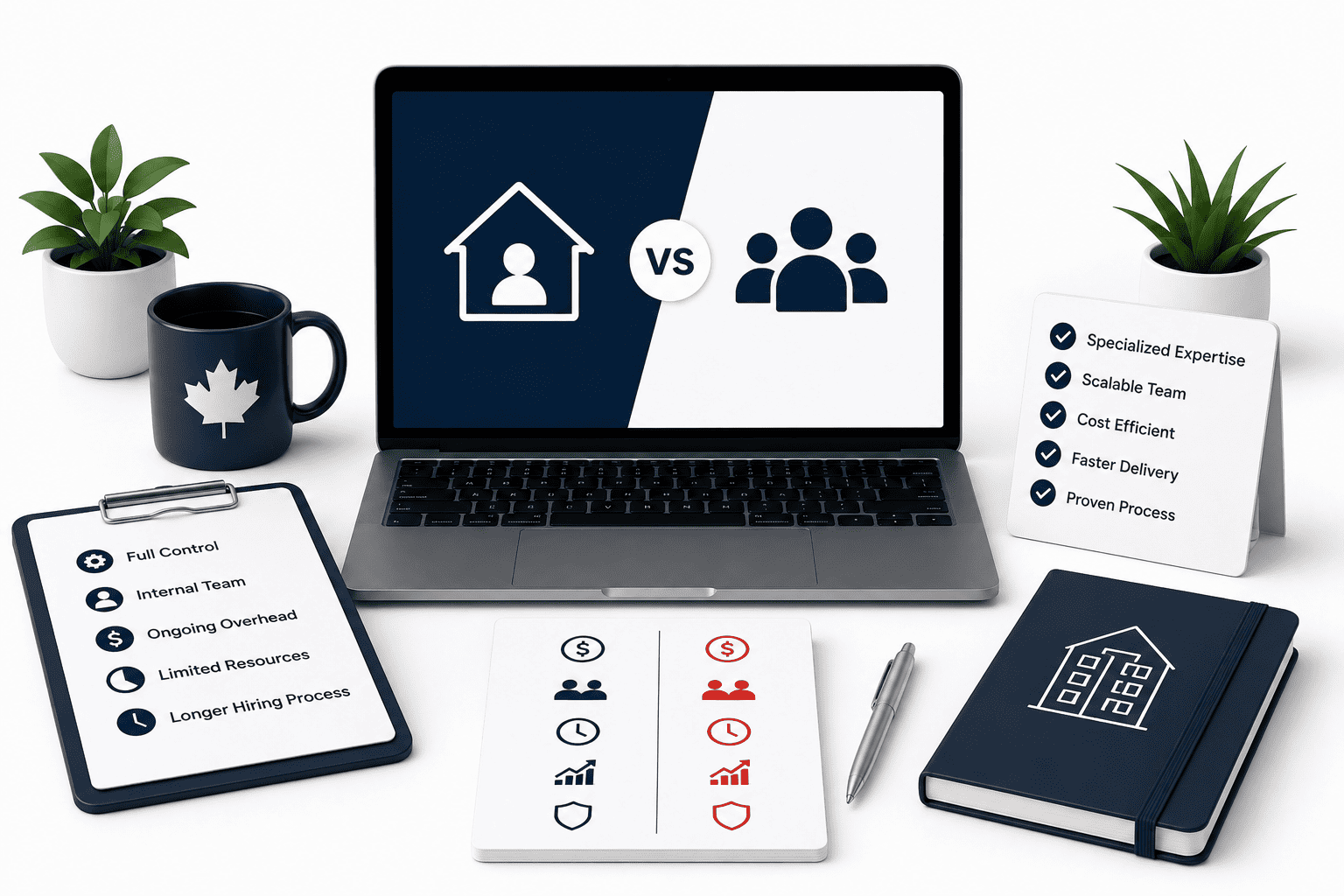
The choice also depends on your post-launch roadmap. If you plan to update content weekly and run continuous A/B tests, an internal team may be more responsive. If your needs are cyclical—such as a major site redesign every three years—an agency is often the more pragmatic choice. The table below summarizes the primary trade-offs:
| Factor | In-House Team | External Agency |
|---|---|---|
| Direct Control | High, daily oversight | Moderate, via briefs and milestones |
| Cost Structure | Fixed salaries + overhead | Project-based or retainer fees |
| Speed to Launch | Slower, due to hiring and onboarding | Faster, with existing talent pool |
| Specialized Expertise | Limited to current hires | Broad, includes niche skills |
| Scalability | Difficult to scale up/down quickly | Flexible resource allocation |
| Institutional Knowledge | High, builds over time | Low, must be transferred |
There is no universally correct answer. A startup in Ottawa with a strong technical founder might thrive with a two-person in-house squad. A national retailer with complex logistics might benefit from an agency’s breadth. The key is to assess your internal capacity honestly and to project your needs over a 24-36 month horizon, not just the initial build phase.
What This Article Covers and How to Use It
This guide is designed to help Canadian business leaders, marketing directors, and founders make an informed decision about custom web design. The following sections will delve deeper into the specific advantages and disadvantages of each model, providing practical checklists and financial frameworks. You will not find generic advice about “hiring freelancers” or “using website builders.” Instead, the focus remains squarely on the in-house versus agency dilemma within the Canadian context.
To get the most value from this article, we recommend you use it as a decision-making workbook. Before reading further, take a moment to write down your answers to these three questions:
- What is your realistic budget for the initial design and build phase? Include hidden costs like project management time and legal reviews.
- How complex are your technical requirements? For example, do you need a custom CRM integration, a multilingual CMS, or a headless commerce architecture?
- What is your tolerance for long-term maintenance risk? If your only developer leaves, can you operate your site effectively?
With these answers in hand, you will be better prepared to evaluate the detailed arguments presented in the subsequent sections. The goal is not to persuade you to choose one path over the other, but to equip you with a clear framework for aligning your web design strategy with your broader business objectives. By the end, you should be able to confidently answer the core question of whether to build internally or partner externally—and to justify that decision to your stakeholders with data and strategic reasoning.
Custom Web Design: In-House vs Agency for Canadian Companies
When Canadian companies evaluate their digital presence, the term “custom web design” is often thrown around loosely, frequently attached to projects that are, in reality, template-based with a few colour tweaks. True custom web design is a fundamentally different undertaking—one that involves bespoke user experience (UX) architecture, hand-written code, and branding that cannot be found anywhere else on the internet. Understanding this distinction is not merely academic; it directly impacts your budget, timeline, and competitive positioning, especially when you are deciding between building an in-house team or hiring an agency. This section clarifies what custom really means, why it matters for Canadian businesses, and how it sets the stage for the in-house versus agency decision.
Key Components of a Custom-Built Website
A genuinely custom-built website is not assembled from pre-existing blocks. It is engineered from the ground up, with each layer designed to serve your specific business goals and audience. The key components break down into three essential pillars:
- Bespoke UX Architecture: Custom design begins with user flows, wireframes, and interactive prototypes that map how a Canadian customer—whether in Vancouver, Toronto, or rural Quebec—will navigate your site. This includes content hierarchy, conversion paths, and accessibility considerations that are unique to your product or service.
- Tailored Front-End and Back-End Code: Instead of relying on a theme’s pre-set CSS or PHP, developers write semantic HTML, modular CSS, and JavaScript that respond to your exact specifications. On the back end, custom post types, database schemas, and API integrations are built to handle your inventory, bookings, or membership systems without plugin bloat.
- Unique Branding and Visual Language: Typography, colour palettes, iconography, and motion design are created specifically for your brand. No other site—competitor or otherwise—shares your exact visual DNA. This extends to custom illustrations, photography treatments, and even micro-interactions that reinforce your Canadian identity, such as bilingual toggles or region-specific pricing displays.
In practical terms, a custom build means that every element on the page exists because you requested it. For example, consider a simple form field for a Canadian company that ships nationwide. A template might force a single “Province” dropdown, but a custom build can intelligently detect postal codes, validate against Canada Post’s API, and update shipping rates in real time. This level of specificity is impossible with off-the-shelf themes.
Templates vs Custom: When Custom Is Worth the Investment
Templates and drag-and-drop builders (like Wix, Squarespace, or even WordPress with page builders) serve a purpose: they are fast, inexpensive, and require no coding knowledge. For a sole proprietor with a static brochure site, a template is often sufficient. However, for Canadian companies that rely on their website as a primary sales channel, a customer service portal, or a lead generation engine, the limitations of templates become costly.
Consider the following comparison to decide when custom is worth the investment:
| Factor | Template-Based | Custom-Built |
|---|---|---|
| Initial Cost | $2,000–$8,000 CAD | $20,000–$100,000+ CAD |
| Time to Launch | 2–6 weeks | 3–6 months |
| Scalability | Limited by theme’s architecture | Unlimited; can grow with your business |
| Unique Branding | Shared with thousands of other sites | Exclusive to your company |
| Performance Optimization | Often bloated with unused code | Built lean, with only necessary assets |
| Integration Flexibility | Depends on available plugins | Custom APIs and third-party systems |
| Maintenance | Frequent updates to patch theme vulnerabilities | Stable codebase with targeted updates |
Custom becomes clearly worth the investment when you need any of the following: a multilingual site that fully supports English and French with proper hreflang tags and cultural nuances; a complex e-commerce engine with Canadian tax calculations (GST, PST, HST) and shipping rules per province; a membership portal with tiered access and secure payment processing; or a site that must comply with Canadian accessibility standards (AODA) beyond what templates offer. If your business model depends on unique functionality, custom design is not a luxury—it is a necessity.
The Role of User Experience (UX) in Custom Design
User experience is the invisible architecture that determines whether a visitor becomes a customer or clicks away. In custom web design, UX is not an afterthought; it is the starting point. Unlike templates, where you are forced to fit your content into pre-defined layouts, custom design allows you to build the UX around real user behavior. For Canadian companies, this means accounting for specific realities: slower internet connections in remote regions, mobile-first usage patterns, and a bilingual audience that may switch languages mid-session.
A custom UX process typically involves:
- User Research: Conducting interviews and usability tests with actual Canadian users to identify pain points and expectations.
- Information Architecture: Structuring content so that it is intuitive for both English and French speakers, with clear navigation labels that do not lose meaning in translation.
- Wireframing and Prototyping: Creating low-fidelity and high-fidelity prototypes to test flows before any code is written. This saves substantial rework costs later.
- Accessibility Integration: Building with WCAG 2.1 AA standards from the outset, including keyboard navigation, screen reader compatibility, and sufficient colour contrast.
- Performance Budgeting: Defining a maximum load time (e.g., under 2 seconds on 4G) and designing every asset to meet that target.
One practical example of custom UX in action is a conditional form for a Canadian service company. Suppose you offer home cleaning across Ontario and Quebec. A template form might show all fields at once. A custom UX approach would use progressive disclosure: the user first selects their province, then the system dynamically shows only relevant cities, then offers a date picker that respects provincial holidays. Here is a simplified JavaScript snippet that demonstrates this logic:
document.getElementById('province').addEventListener('change', function() {
  const province = this.value;
  const citySelect = document.getElementById('city');
  citySelect.innerHTML = '';
  const cities = (province === 'ON') ? ['Toronto', 'Ottawa', 'Hamilton'] : ['Montreal', 'Quebec City'];
  cities.forEach(city => {
    const option = document.createElement('option');
    option.value = city;
    option.textContent = city;
    citySelect.appendChild(option);
  });
});
This is not a feature you can achieve with a drag-and-drop builder without significant hacks. It is the kind of tailored interaction that reduces user friction, increases form completion rates, and ultimately drives revenue. Custom UX also allows you to A/B test variations of your homepage hero, checkout flow, or navigation structure—something templates restrict due to rigid layout systems.
For Canadian companies, the UX must also respect cultural expectations. For instance, trust signals like “Certified by the Better Business Bureau” or “Canada Goose approved retailer” carry different weight than generic badges. A custom design lets you place these elements contextually, based on user research, rather than forcing them into a sidebar where they may be ignored. In short, UX in custom design is a strategic investment that directly correlates with conversion rates, customer retention, and brand loyalty—all of which factor heavily into the decision of whether to build in-house or hire an agency.
The In-House Web Design Model: Structure, Roles, and Responsibilities
For Canadian companies weighing custom web design options, the in-house model offers a distinct operational philosophy: full ownership, direct control, and deep cultural integration. Unlike agency partnerships, where work is often project-based and remote, an in-house team exists permanently within your organization. This structure fundamentally changes how design decisions are made, how quickly iterations happen, and how intimately the team understands your business. Before committing to this path, it is essential to examine the typical organizational chart, the day-to-day workflow, and the inherent alignment—or friction—with your company’s existing culture and brand voice.
Typical Roles in an In-House Web Design Team
The composition of an in-house web design team varies with company size, but a functional unit for custom work generally includes several distinct roles. Each role carries specific responsibilities that, together, form a complete product lifecycle—from initial wireframe to deployed code and ongoing optimization.
- UX/UI Designer: Owns user research, information architecture, wireframes, and visual design. This person ensures the site is intuitive and on-brand, creating the clickable prototypes that guide development.
- Front-End Developer: Translates design mockups into responsive HTML, CSS, and JavaScript. They are responsible for performance, accessibility, and cross-browser compatibility on both desktop and mobile.
- Back-End Developer: Builds server-side logic, database integrations, and CMS architecture. For custom e-commerce or membership sites, this role handles payment gateways, user authentication, and data security.
- Project Manager (PM): Coordinates sprints, sets deadlines, and acts as a liaison between the design team and executive stakeholders. The PM ensures that custom requests are scoped, prioritized, and delivered without scope creep.
- Content Strategist/Copywriter: Develops the information hierarchy, writes or edits copy, and ensures SEO best practices are baked into the design. This role is often overlooked but critical for conversion-focused custom design.
- QA Specialist: Tests the site across devices and browsers, checks for broken links, and validates form submissions. In a custom build, QA is continuous, not a one-time pre-launch checklist.
In smaller Canadian companies (under 50 employees), one person may wear multiple hats—for example, a front-end developer who also handles basic UX. Larger enterprises might add a dedicated DevOps engineer, a data analyst, or a design system manager. The key structural distinction from an agency is that these roles report to your internal leadership, not to an external account manager.
How In-House Teams Manage Projects and Workflows
In-house web design teams typically operate under agile or iterative workflows, but the cadence is more flexible than an agency’s fixed retainer. Because the team is embedded in your organization, they can respond to urgent business needs—a new product launch, a regulatory compliance update, or a sudden shift in marketing strategy—without renegotiating contracts. The workflow usually follows a predictable cycle:
- Discovery and Briefing: Internal stakeholders (sales, marketing, C-suite) submit a request. The PM and UX designer conduct a brief internal interview to understand the business goal, target user, and success metrics.
- Design and Prototyping: The UX/UI designer creates low-fidelity wireframes, then high-fidelity mockups. These are shared in a shared folder (e.g., Figma or Miro) for immediate feedback from internal teams.
- Development Sprints: Front-end and back-end developers build in two-week sprints. Daily stand-up meetings (15 minutes) keep everyone aligned. The PM tracks progress against a Kanban or Scrum board.
- Internal Review and QA: The QA specialist tests each feature as it is completed. Unlike an agency, where a client often sees only final deliverables, in-house teams can demo partial builds to a small group of internal beta users.
- Deployment and Iteration: After launch, the team monitors analytics (Google Analytics, Hotjar) and collects bug reports via internal ticketing. Improvements are scheduled in the next sprint, not billed separately.
One notable difference for Canadian companies is the handling of bilingual requirements (English/French) and provincial regulations. In-house teams can more easily integrate these into the workflow, as they are not bound by an agency’s generic templates. They can also coordinate with your legal or compliance departments directly, ensuring that privacy policies (PIPEDA) and accessibility standards (AODA in Ontario, or provincial equivalents) are met from the first draft rather than retrofitted.
Alignment with Company Culture and Brand Voice
Perhaps the strongest argument for in-house custom web design is the natural alignment with your company’s culture and brand voice. An agency must learn your brand from a briefing document; an in-house team lives it every day. This manifests in several practical ways:
- Tone and Language: In-house writers and designers absorb your internal vocabulary, customer service scripts, and even regional colloquialisms. For a Canadian company with multiple offices (e.g., Toronto and Vancouver), they understand subtle regional preferences in phrasing.
- Visual Consistency: Your in-house team has direct access to your brand guidelines, historical design assets, and past campaign materials. They can make nuanced decisions about color, typography, and imagery that match your existing marketing collateral—without waiting for an agency to request files.
- Decision-Making Speed: When a design choice conflicts with brand guidelines, an in-house designer can walk to the marketing director’s desk and resolve it in minutes. An agency might send a formal change request and wait 48 hours for approval.
- Institutional Memory: In-house teams retain knowledge of why certain design decisions were made. If a future redesign is needed, they know which elements were mandatory (e.g., a specific call-to-action for a regulated financial product) and which were experimental.
However, this alignment comes with a caveat: cultural proximity can lead to “groupthink.” In-house teams may become too close to the brand to challenge it objectively, whereas an agency brings fresh, external perspective. To mitigate this, many Canadian firms schedule quarterly design reviews with an outside consultant—a hybrid approach that preserves cultural alignment while introducing external critique.
| Aspect | In-House Team | Agency Partner |
|---|---|---|
| Brand alignment | Deep, daily immersion in culture and voice | Learned via briefs and periodic meetings |
| Project turnaround | Rapid for small iterations; slower for large builds | Faster for large, well-scoped projects |
| Cost structure | Fixed salaries + overhead (benefits, tools) | Project fee or monthly retainer |
| Communication | Direct, informal, and immediate | Formal, with account manager as intermediary |
| Specialized skills | Limited to hired roles; gaps require training | Broad talent pool available on demand |
| Accountability | Internal PM reports to your leadership | Contractual KPIs and deliverables |
| Scalability | Requires hiring for peak demand | Easily scales up or down per project |
| Innovation | Risk-averse due to internal politics | More willing to experiment with new trends |
Ultimately, the in-house model thrives in Canadian companies where brand consistency, rapid internal collaboration, and long-term ownership are more valuable than cost savings or access to a broad talent pool. It is not a cheaper alternative—it is a strategic investment in organizational capability. The decision hinges on whether your company can sustain the payroll and management overhead, and whether your leadership values the cultural alignment that only an embedded team can provide.
The Agency Model: Full-Service Partnerships and Specialized Expertise
When a Canadian company decides to invest in a custom website, the choice between building an internal team and partnering with an external agency often comes down to scale, speed, and access to specialized talent. Agencies, whether they are a two-person boutique in Vancouver or a fifty-person full-service firm in Toronto, operate on a fundamentally different principle than an in-house department: they aggregate expertise across multiple clients and industries, then deploy that expertise on demand. For Canadian businesses—especially those in competitive sectors like retail, professional services, or technology—this model offers a blend of strategic depth and executional flexibility that is difficult to replicate internally. Instead of hiring a single designer or developer, you are effectively renting a cross-functional team that has already solved problems similar to yours, often for clients in entirely different markets. This article explores how agencies structure their work, what they offer beyond basic web design, and why their cross-industry perspective can be a decisive advantage for Canadian companies.
Types of Agencies: Boutique, Full-Service, and Specialized
Agency models vary widely, but most fall into three broad categories. Understanding the difference is critical because each type brings a distinct set of strengths and constraints to a custom web design project.
- Boutique agencies typically employ fewer than ten people, often with a senior designer or developer at the helm. They offer high-touch, personalized service and are known for creative, bespoke designs. For a Canadian small or medium-sized enterprise (SME), a boutique can be ideal if you need a strong visual identity and are willing to trade some service breadth for direct access to the lead designer. However, they may outsource development or SEO, which can create coordination challenges.
- Full-service agencies range from 10 to over 100 employees and provide integrated offerings: strategy, user experience (UX) design, development, content creation, search engine optimization (SEO), and often ongoing maintenance or digital marketing. They are structured like small companies, with dedicated project managers, account directors, and quality assurance teams. For a Canadian company with complex needs—such as an e-commerce platform with custom integrations or a multi-language site for both English and French markets—a full-service agency can manage the entire lifecycle under one roof.
- Specialized agencies focus on a narrow domain, such as Shopify development, accessibility compliance (AODA), or B2B lead generation. They may be small or mid-sized, but their depth in one area is unmatched. If your project is technically demanding—say, a custom booking system for a tourism operator in British Columbia—a specialized agency can offer the precise technical expertise that a generalist in-house team might lack.
Each type has trade-offs. Boutique agencies often excel at creativity but may lack scalability. Full-service firms provide convenience but can be more expensive and process-heavy. Specialized agencies offer deep skills but may require you to hire additional vendors for other aspects of the project. The right choice depends on your company’s size, budget, and the complexity of your custom web design goals.
Agency Service Offerings: Strategy, Design, Development, and SEO
A common misconception is that an agency simply “designs” a website. In practice, a custom web design engagement with an agency is a multi-phase process that begins long before any visual mockup is created. Here is what a typical full-service agency offers, broken down by discipline:
| Service Area | What It Includes | Why It Matters for Canadian Clients |
|---|---|---|
| Strategy | Stakeholder interviews, competitor analysis, user personas, sitemap architecture, content strategy, and key performance indicator (KPI) definition. | Aligns the website with your business goals—whether that is generating leads for a Calgary law firm or driving online sales for a Montreal retailer. Agencies use frameworks like the Business Model Canvas or JTBD (Jobs To Be Done) to ground decisions in data. |
| UX/UI Design | Wireframes, interactive prototypes, visual design systems, typography, color palettes, and responsive design for mobile and tablet. | Ensures that a Canadian audience—which may include users from different provinces with varying internet speeds—has a seamless experience. Agencies also build for accessibility standards (WCAG 2.1) to comply with provincial regulations like the AODA in Ontario. |
| Development | Front-end coding (HTML, CSS, JavaScript) and back-end programming (e.g., PHP, Python, or Node.js), CMS integration (WordPress, Craft CMS, or headless solutions), and custom plugin/module development. | Handles complex requirements such as bilingual routing (e.g., /fr/ vs /en/ paths), Canadian payment gateways (e.g., Moneris or Stripe with GST/PST handling), and integration with Canadian shipping carriers like Canada Post. |
| SEO & Performance | Technical SEO audits, keyword research for Canadian search terms, schema markup, page speed optimization, and analytics setup (Google Analytics 4, Search Console). | Helps your site rank in Google.ca searches and target local queries like “custom web design Toronto” or “vancouver web agency”. Agencies also ensure proper hreflang tags for bilingual sites and optimize for Core Web Vitals to meet Google’s ranking criteria. |
| Ongoing Support | Security updates, backups, uptime monitoring, content updates, and A/B testing for conversion optimization. | Provides a safety net after launch. Many agencies offer monthly retainers for maintenance, which is often more cost-effective than hiring a full-time developer for a small business. |
Beyond these core areas, agencies often include project management as a service. A dedicated project manager coordinates timelines, budgets, and communication between your internal stakeholders and the agency team. This is a significant advantage over an in-house setup where a marketing manager might juggle web design alongside their daily responsibilities. For Canadian companies, this structured approach reduces risk and ensures that the project stays on schedule—especially when dealing with multiple time zones from Halifax to Victoria.
How Agencies Bring Cross-Industry Insights to Canadian Clients
One of the strongest arguments for hiring an agency is the breadth of experience they accumulate across different sectors and geographies. An in-house team typically works only on your company’s products and services, which can lead to a narrow perspective. An agency, by contrast, may design a website for a healthcare clinic in Ottawa one month, a construction equipment rental firm in Edmonton the next, and a boutique winery in Niagara-on-the-Lake after that. This cross-pollination of ideas yields several concrete benefits for Canadian clients.
First, agencies bring proven patterns and best practices from other industries. For example, a boutique agency that has built a booking system for a dental clinic can apply that same calendar logic to a custom scheduling feature for a consulting firm. Similarly, a full-service agency that has optimized an e-commerce checkout for a clothing brand can transfer those conversion tactics to a hardware store’s online catalogue. This means you are not starting from scratch; your agency already knows what works and what fails, saving you time and budget on trial-and-error.
Second, agencies are exposed to regional and national variations in consumer behavior across Canada. A web design firm based in Toronto might have clients in Quebec, where French-language content and culturally specific imagery are non-negotiable. They may also work with clients in Atlantic Canada, where local trust signals—such as community testimonials or regional shipping options—are critical. By leveraging this knowledge, an agency can tailor your site to resonate with your target market, whether that is a local audience in Winnipeg or a national audience spanning multiple provinces. They understand the nuances of Canadian privacy laws (PIPEDA), bilingualism requirements, and the importance of displaying prices in both CAD and with applicable taxes.
Third, agencies often have access to proprietary tools, industry benchmarks, and a wider network of specialists. For example, they may use heat-mapping software to analyze user behavior across dozens of client sites, or they may have a relationship with a copywriter who specializes in Canadian English versus American English. This ecosystem allows them to recommend solutions that an in-house team might not even know exists. Consider a practical example: if you need to implement a multilingual content strategy, an agency might suggest a headless CMS with a translation workflow that integrates with a Canadian translation service like Traductions Serge Bélair. An in-house team would have to research and vet these vendors from scratch, adding weeks to the project timeline.
Finally, agencies are held accountable by a competitive market. Their reputation depends on delivering results for clients across industries, so they must stay current with the latest web standards, design trends, and technological advancements. This constant learning cycle—driven by exposure to diverse projects—means your custom web design benefits from up-to-date practices, such as using server-side rendering for faster load times or implementing lazy loading for image-heavy pages. For a Canadian company, this translates into a website that is not only visually appealing but also technically robust, secure, and optimized for search engines.
In summary, the agency model offers Canadian companies a flexible, expertise-rich alternative to building an in-house team. Whether you choose a boutique for its creativity, a full-service firm for its end-to-end convenience, or a specialized agency for its depth, the key advantage is the same: you gain access to a collective brain trust that has seen and solved a wide range of web design challenges. This cross-industry insight, combined with structured service offerings in strategy, design, development, and SEO, positions agencies as powerful partners for any Canadian business seeking a custom website that performs, converts, and stands out in a crowded digital landscape.
Cost Analysis: In-House Salaries, Overhead, and Agency Fees in Canada
For Canadian companies weighing custom web design options, the financial decision extends far beyond a simple hourly rate or a single project quote. The true cost of building a bespoke website involves a complex interplay of salaries, benefits, software subscriptions, opportunity costs, and long-term maintenance. This analysis breaks down the realistic financial landscape for both in-house teams and agency partnerships, focusing on Canadian market conditions without making absolute promises about returns or savings. The goal is to provide a framework for financial planning that accounts for the full lifecycle of a custom web project.
In-House Costs: Salaries, Benefits, and Equipment
Building an in-house web design team in Canada requires a significant upfront investment in human capital. The primary expense is salaries, which vary considerably by province and city. According to general Canadian tech compensation data, a mid-level web designer in Toronto or Vancouver can command an annual salary between $70,000 and $95,000 CAD, while a senior designer or creative lead may earn $100,000 to $130,000 CAD. Similarly, a front-end developer with custom JavaScript and React skills typically earns $85,000 to $115,000 CAD, and a back-end developer focused on API integration and database architecture can range from $95,000 to $140,000 CAD. These figures are gross salaries and do not include employer contributions.
Beyond base pay, Canadian employers must budget for statutory benefits and overhead, which typically add 15% to 25% on top of each salary. This includes:
- CPP (Canada Pension Plan) and EI (Employment Insurance) contributions – mandatory employer portions.
- Extended health and dental benefits – common in competitive tech roles, often costing $4,000 to $8,000 per employee annually.
- Registered Retirement Savings Plan (RRSP) matching – many firms offer 3% to 5% matching to retain talent.
- Professional development allowances – for conferences, courses, and certifications, typically $1,500 to $3,000 per year.
- Vacation and sick days – paid time off that contributes to effective hourly costs.
Equipment and tooling represent another substantial line item. A single in-house designer or developer requires a high-performance laptop (or desktop) costing $2,500 to $4,000, plus external monitors, ergonomic furniture, and peripherals. Software licenses for design tools like Figma, Adobe Creative Cloud, and prototyping suites run $600 to $1,200 per user annually. Development tools, version control (GitHub or GitLab), and project management software (Jira, Asana, or Monday.com) add another $500 to $1,500 per user per year. For a team of four (designer, two developers, and a project manager), the annual tooling budget alone can easily reach $10,000 to $15,000, excluding the initial hardware purchase.
Critically, an in-house team is a fixed cost. You pay full salaries regardless of whether they are actively designing, refactoring code, or waiting for stakeholder feedback. The effective hourly cost of a salaried employee, after benefits, equipment amortization, and non-billable time (meetings, internal communication, admin), often lands between $80 and $150 CAD per hour. This is comparable to many agency rates, but with the added burden of management oversight and the risk of idle time between project phases.
Agency Pricing Models: Project-Based, Retainer, and Hourly
Canadian agencies typically offer three distinct pricing structures, each with its own financial implications for custom web design projects. Understanding these models helps companies predict cash flow and total cost of ownership.
Project-Based Pricing is the most common for a defined scope, such as a marketing website, an e-commerce storefront, or a web application. For a custom design (not a template), Canadian agencies generally quote between $25,000 and $80,000 CAD for a small-to-mid-sized business website, depending on the number of custom pages, integrations, and content migration. A more complex project with user accounts, a custom CMS, and third-party API integrations can range from $80,000 to $200,000 CAD. The advantage is a fixed price and a clear timeline, but the risk lies in scope creep. Any additional feature or revision beyond the agreed scope will incur change orders, often billed at $120 to $180 CAD per hour.
Retainer Agreements are suitable for companies that need ongoing design and development support, such as continuous A/B testing, iterative feature releases, or regular content updates. A monthly retainer in Canada typically ranges from $3,000 to $10,000 CAD per month for a dedicated team or a set number of hours (e.g., 20 to 40 hours). This model provides predictable monthly costs and priority access to the agency’s team. However, retainers can be inefficient if the allocated hours are underutilized, and unused hours may not roll over to the next month depending on the contract terms. For a custom web project, a retainer often follows an initial project-based build, ensuring the site evolves post-launch.
Hourly Billing is the most flexible but also the most unpredictable. Canadian agency hourly rates for custom web design and development vary widely based on seniority and specialization:
| Role | Hourly Rate Range (CAD) |
|---|---|
| Junior Designer / Developer | $60 – $90 |
| Mid-Level Designer / Developer | $90 – $140 |
| Senior / Lead Designer or Developer | $140 – $200 |
| Creative Director / Technical Architect | $180 – $250 |
Hourly billing is ideal for audits, small enhancements, or consultation, but for a full custom build, it can lead to budget overruns without a tightly managed scope. Many agencies also require a 30% to 50% deposit upfront, with progress payments tied to milestones (e.g., design approval, development completion, launch).
Hidden Costs and Long-Term Budget Considerations
The initial quote or salary budget is rarely the final cost. Both in-house and agency models carry hidden expenses that Canadian companies must plan for over a 12-to-24-month horizon.
For in-house teams: The most significant hidden cost is turnover. If a key designer or developer leaves mid-project, the company faces recruitment fees (often 15% to 20% of the annual salary), onboarding time, and a loss of institutional knowledge. Additionally, in-house teams are responsible for their own quality assurance, security audits, and accessibility compliance (AODA in Ontario, for example). Hiring a third-party auditor or purchasing automated testing tools adds $3,000 to $10,000 per year. Infrastructure costs—staging servers, cloud hosting, SSL certificates, and content delivery networks—are also borne internally, often adding $200 to $1,000 per month depending on traffic and data storage. Finally, an in-house team may lack specialized expertise (e.g., advanced animation, complex database optimization), requiring occasional external consultants at premium rates, which negates some of the perceived savings.
For agency partnerships: Hidden costs often emerge in the fine print of the contract. Revisions beyond an agreed number (often two or three rounds) are billed separately. Content creation (copywriting, photography, video) is rarely included in a design quote and can add 20% to 40% to the total project cost. Post-launch support—bug fixes, security patches, and software updates—is typically not covered by the initial project fee. A standard maintenance retainer of $500 to $2,000 per month is common, and without it, the company must either pay time-and-materials for every fix or let the site become vulnerable. Additionally, if the project requires a dedicated project manager from the agency, expect a 10% to 15% project management fee added to the total. Transfer costs are another consideration: if you leave the agency, you may need to pay for the source code, design files, and documentation, which some agencies charge for as a “handover fee.”
Long-term budget planning should also account for the inevitable need to redesign or refactor. Custom websites are not static assets. They require ongoing content updates, performance optimization, and eventual re-platforming every three to five years. For an in-house team, this means their salaries continue indefinitely, and the next major redesign will require significant internal hours that could have been spent on other business initiatives. For an agency, a redesign can be negotiated as a new project, but the cost will likely be comparable to the original build, adjusted for inflation and evolved scope. A prudent budget should set aside 15% to 20% of the original build cost annually for maintenance, improvements, and security, regardless of whether the work is done in-house or by an agency.
Ultimately, the financial comparison is not about which model is cheaper on the surface, but which aligns with the company’s long-term capacity, risk tolerance, and the need for specialized expertise. An in-house team offers direct control and immediate availability, but at a high fixed cost. An agency offers scalable expertise and predictable project pricing, but with variable costs and less day-to-day control. Canadian companies should model both scenarios over a three-year period, including all salaries, benefits, tooling, agency fees, and hidden costs, to arrive at a decision that is financially sustainable and strategically sound.
Speed and Flexibility: How Each Model Handles Deadlines and Changes
For Canadian companies, the ability to pivot quickly on a web design project often determines whether a launch meets its market window or falls flat. The choice between an in-house team and an external agency is not merely about cost or talent—it is fundamentally about how each model processes urgency, absorbs change, and communicates under pressure. Geography adds another layer: a Vancouver-based company coordinating with a Toronto agency faces a three-hour time difference, while an in-house team in Calgary shares the same clock and office rhythms. Understanding these dynamics helps you predict which model will serve your specific deadline culture and change tolerance.
In-House Responsiveness and Internal Communication
An in-house web design team operates as an extension of your organization. When a priority shifts—say, a regulatory change from the Canadian Radio-television and Telecommunications Commission (CRTC) requires a compliance banner on your site by end of week—the in-house designer can walk to the product manager’s desk, clarify the requirement, and adjust the design system within hours. There is no contract negotiation, no change order, and no vendor discovery call. The communication path is direct, often synchronous, and grounded in shared company context.
This responsiveness shines in two specific scenarios. First, during iterative sprints where daily stand-ups include both design and development, an in-house team can re-prioritize tasks without waiting for external approval. Second, when urgent bug fixes coincide with a marketing campaign, the in-house designer can pause planned work and hotfix the issue immediately, because their performance metrics are tied to business outcomes, not billable hours. The cost of this speed is capacity. An in-house team of three designers and two developers cannot scale overnight. A sudden request for a full site redesign—rather than a targeted update—will likely push existing projects aside, creating internal bottlenecks that cascade across departments.
Internal communication also suffers from proximity bias. When everyone sits in the same office, informal hallway conversations often override documented decisions. For Canadian companies with distributed in-house teams—say, designers in Halifax and developers in Edmonton—this advantage erodes. You now face time-zone gaps within your own organization, and the informal speed disappears unless you invest in robust async documentation. The key strength of in-house is not universal speed, but rather the elimination of external handoffs. If your team is co-located and your changes are incremental, in-house responsiveness is unmatched. If your changes are large or your team is remote, that advantage shrinks considerably.
Agency Turnaround Times and Resource Availability
Agencies, particularly those serving Canadian clients, build their business on predictable turnaround times. A well-structured agency will have a dedicated project manager who triages urgent requests, a design lead who owns the creative direction, and a development team that can be reallocated based on priority. When you submit a change request, the agency responds with a timeline—often within 24 hours for non-critical items, and sometimes same-day for urgent blockers. This is possible because agencies maintain a bench of talent across multiple clients. If your project needs an extra front-end developer for a week, the agency can pull one from another account without you hiring a contractor or waiting for a job posting.
Resource availability is the agency’s core advantage. A mid-sized Canadian agency might have 15 designers and 20 developers, allowing it to assemble a specialized sub-team for a high-pressure launch. For example, if your e-commerce site must handle Black Friday traffic and you need a performance audit plus a checkout redesign in three weeks, an agency can assign two developers to the audit and one designer to the checkout flow simultaneously. In-house, you would likely have one developer who is already maintaining the site, and the redesign would wait. Agencies also absorb turnover risk. If a key designer leaves, the agency backfills from its pool, whereas an in-house team faces a hiring cycle that can take months in competitive Canadian tech hubs like Toronto or Montreal.
However, agency turnaround is not instantaneous. The same project manager who ensures quality also acts as a buffer. You cannot walk to a designer’s desk; you must submit a request, wait for a scoping call, and then receive a quote. For truly urgent requests—a critical security patch or a legal notice requiring immediate text change—the agency’s response may be slower than an in-house team’s because the agency must first confirm your contract covers the work and then coordinate across time zones. A Vancouver client working with a Halifax agency faces a four-hour difference, meaning a Friday afternoon request may not receive a response until Monday morning. Smart agencies mitigate this by setting clear escalation paths and offering emergency retainers, but that costs extra.
Managing Scope Creep in Both Models
Scope creep—the gradual expansion of project requirements beyond the original brief—is the silent killer of web design timelines. Both models handle it differently, and the difference often determines which approach fits your company’s discipline.
In-house teams are more vulnerable to uncontrolled scope creep because internal stakeholders treat designers as unlimited resources. A marketing manager might casually ask for “one more landing page” during a weekly sync, and the designer, wanting to be helpful, agrees without formally adjusting the project plan. Over a quarter, these small additions accumulate into weeks of unplanned work. The lack of a billing mechanism removes the natural brake that agencies apply. To manage this, in-house teams must implement a lightweight internal request system—for example, a shared Kanban board where every new request is logged, prioritized, and approved by a product owner. Without that discipline, the team’s speed becomes chaotic, and deadlines slip because no one tracks cumulative effort.
Agencies, by contrast, have a built-in scope creep defense: the change order. When you request a new feature or a design revision beyond the agreed deliverables, the agency responds with a revised quote and timeline. This transparency forces you to prioritize. If the new request is truly essential, you approve the extra cost. If it is a “nice to have,” you likely drop it. This mechanism keeps projects on schedule because every addition is explicitly traded against time and budget. However, the rigidity can frustrate Canadian companies that value collaborative iteration. Some agencies address this by offering a “flexible sprint” model, where a block of hours is pre-purchased, and scope changes are absorbed within that block as long as the total time does not exceed the cap.
A practical way to manage scope creep in either model is to use a version-controlled design asset repository with clear change logs. For teams using Git for design files, a simple command to review what changed between two dates can reveal hidden scope growth:
git log --since="2025-01-01" --until="2025-03-01" --oneline -- 'design/'
This command lists all commits to the design folder in the first quarter, giving you a concrete count of unplanned changes. If the number of commits is triple what your project plan estimated, you have objective evidence to start a conversation about scope. Both in-house and agency teams can run this command, but the interpretation differs. In-house, it might trigger an internal process review. In an agency context, it might trigger a change order for the next billing cycle.
Ultimately, the choice between in-house and agency for speed and flexibility depends on your change frequency and your tolerance for process overhead. If your Canadian company operates in a fast-moving sector like fintech or health tech, where regulatory updates are frequent but small, in-house responsiveness wins. If you are planning a large-scale redesign with a hard launch date, the agency’s resource pool and structured change management will keep you on schedule. The best approach for many organizations is hybrid: keep a small in-house team for daily maintenance and urgent fixes, and engage an agency for major overhauls or seasonal peaks. This gives you the immediacy of internal communication and the scalability of external expertise, while each model’s scope control methods balance the other’s weaknesses.
Custom Web Design: In-House vs Agency for Canadian Companies
When a Canadian company decides to build or redesign its website, the most consequential decision often comes down to team structure. Should you hire a dedicated internal team, or should you partner with an external agency? While budget and timeline are critical factors, the true differentiator lies in access to talent. For Canadian businesses—whether a Toronto-based fintech startup, a Vancouver e-commerce retailer, or a Montreal B2B manufacturer—the depth of an in-house team’s knowledge versus the breadth of an agency’s skill set can determine not just the quality of the final product, but also its long-term adaptability. This article unpacks that tension, exploring how each model serves different strategic needs and where hybrid approaches can offer a pragmatic middle ground.
In-House Specialists: Deep Understanding of Your Business
An in-house web design team is composed of employees who work exclusively for your organization. Their primary advantage is context. These designers and developers live inside your brand’s daily operations. They attend internal meetings, absorb your customer service feedback, understand your product roadmap, and witness firsthand how your sales team talks about your offerings. This proximity translates into a level of business acumen that is difficult for any external partner to replicate. For example, an in-house designer at a Canadian logistics company knows that your clients in the Prairies prioritize bilingual shipping labels, not because you told them in a brief, but because they have sat in on support calls.
This depth is particularly valuable for companies with complex, proprietary workflows or highly regulated industries. A financial institution in Toronto, for instance, might require a designer who understands the nuances of Canadian securities regulations and can translate compliance requirements into intuitive UI components. Similarly, a healthcare provider in Ottawa benefits from an in-house developer who has spent months integrating with provincial health record APIs. The learning curve is effectively eliminated because the team has already accumulated institutional knowledge. Moreover, in-house teams are inherently more agile for iterative changes. They can respond to a sudden marketing campaign or a regulatory update within hours, without needing to renegotiate a scope of work or wait for an agency to free up resources.
However, this depth has a ceiling. In-house teams are finite. You might have a brilliant front-end developer and a solid UI designer, but you likely lack a motion graphics artist, a dedicated SEO specialist, and an accessibility auditor. For a Canadian company targeting a national audience, this gap becomes glaring. English and French web design, for example, requires more than translation—it requires typographic adjustments, cultural nuance, and layout flexibility. An in-house team may have one person who “knows some French,” but that is not the same as a specialist in multilingual UX. The cost of building a full-scale internal team with every niche skill is prohibitive for most mid-sized Canadian firms. Salaries, benefits, training, and software licenses for ten or more specialists can easily exceed $1.5 million annually, a figure that only large enterprises or scale-ups can justify.
Agency Generalists and Specialists: A Wider Skill Set
An agency, by contrast, operates as a collective of specialists who work across multiple clients and industries. This breadth is the agency’s core value proposition. Instead of hiring one person who can do a passable job at five things, you gain access to a team of five people who are exceptional at one thing each. A well-structured Canadian agency might include a dedicated motion designer who has created animated product demos for retail clients, a web accessibility expert who has audited sites against WCAG 2.2 AA standards for provincial government contracts, and a multilingual design lead who has built French-first interfaces for Quebec-based brands. This is not a theoretical advantage; it is a practical one. When your website needs a subtle micro-interaction to guide users through a complex checkout, an agency can deploy that specialist immediately, whereas an in-house team would need to either train someone or outsource that single task.
Agencies also bring a cross-pollination of ideas. Because they work with a Canadian SaaS company in Halifax one month and a non-profit in Calgary the next, they see patterns and solutions that an internal team, isolated within one corporate culture, might never encounter. This breadth is especially critical for short-term, high-impact projects. If your company is launching a new product line and needs a complete website overhaul in eight weeks, an agency can assemble a dedicated squad of ten people—designers, developers, QA testers, and a project manager—who have executed similar launches for other clients. This scalability is nearly impossible to achieve in-house without over-hiring and then carrying excess staff after the project ends.
However, breadth does not automatically mean better. Agencies must onboard themselves to your business, and this process takes time and money. A common frustration among Canadian companies is that agency teams rotate. The senior strategist who sold you the project may vanish after the kickoff, replaced by a junior designer who is learning your industry on the fly. Additionally, agencies often work on a fixed scope. If your business pivots mid-project—say, a new competitor emerges in the Canadian market—adjusting the design direction may incur change orders and additional fees. The agency’s deep knowledge of your industry is, by definition, shallower than your own. They know best practices for e-commerce or B2B portals, but they do not know your customers’ unspoken objections or your CEO’s pet peeves unless you invest heavily in knowledge transfer.
Bridging Talent Gaps with Hybrid Approaches
For many Canadian companies, the choice between in-house and agency is not binary. A hybrid model allows you to retain the depth of an internal team while leveraging the breadth of an agency for specialized needs. This approach is particularly effective for companies that have a core digital team—perhaps two or three designers and developers—but cannot justify full-time hires for every niche skill. For example, a mid-sized Canadian retailer might have an in-house UX designer who owns the overall design system and brand consistency. For a major seasonal campaign, they partner with an agency to provide a senior animator and a dedicated accessibility consultant. The in-house designer maintains continuity; the agency injects specialized expertise without the long-term payroll commitment.
Another hybrid strategy is to use an agency for the initial design sprint and then transition to an in-house team for ongoing maintenance. This is common in Canadian tech companies that need a polished, investor-ready website to raise capital. They hire an agency to build the full site, including custom illustrations and complex animations, and then bring in-house developers to manage updates, content changes, and minor tweaks. This model works well because the agency’s breadth is concentrated during the high-intensity build phase, while the in-house team’s depth takes over for the long tail of evolution. However, it requires clear documentation. If the agency does not leave behind a comprehensive style guide, component library, and code comments, the in-house team may struggle to maintain the same quality.
A third hybrid option is fractional hiring. Instead of a full-time employee or a full agency, you contract a specialist on a part-time or project basis. A Canadian company might hire a freelance multilingual designer who works ten hours per week to ensure that the French version of the website receives equal visual attention as the English version. This person becomes a de facto member of the in-house team, attending stand-ups and using your internal tools, but they are not on the payroll. This approach offers a middle ground: the freelancer gains contextual knowledge over time, but you do not bear the cost of a full-time salary and benefits. The key to making any hybrid model work is intentionality. You must define which skills are core to your business and which are temporary. For example, if you are a Canadian bank, accessibility is not a temporary need—it is a regulatory requirement. In that case, a dedicated in-house accessibility specialist is likely justified. Conversely, if you need a one-time 3D product configurator for a trade show, an agency is the obvious choice.
Ultimately, the talent decision is a strategic one. In-house teams win on institutional memory and responsiveness; agencies win on specialized skill sets and scalability. For Canadian companies, the right answer often depends on the project’s lifecycle stage and the specific gaps in your current team. A hybrid approach, executed with clear roles and communication channels, allows you to have both: a core team that understands your business deeply, augmented by specialists who bring world-class craft to the areas where you cannot afford to be mediocre. The most successful Canadian websites are not built by a single model; they are built by leaders who assess their needs honestly, invest in their internal culture, and are not afraid to call in external experts when the task demands it.
Custom Web Design: In-House vs Agency for Canadian Companies
When a Canadian company decides to build or redesign a website, the choice between assembling an in-house team and partnering with an external agency often comes down to more than budget or technical skill. The daily rhythm of communication—who talks to whom, how often, and through which channels—can determine whether a project feels like a smooth collaboration or a constant negotiation. For businesses operating across Canada’s distinct regional markets, from the fast-paced corridors of Toronto finance to the resource-driven hubs of Calgary and the francophone business culture of Montreal, understanding these working styles is essential. This section examines how communication flows differ between in-house teams and agencies, and how those differences impact project momentum, stakeholder satisfaction, and ultimately, the success of your custom web design initiative.
In-House Collaboration: Proximity and Shared Context
The most significant advantage of an in-house web design team is physical and organizational proximity. When designers, developers, content strategists, and marketing staff sit in the same office—or even in the same Slack workspace with shared calendars—communication becomes informal and immediate. A designer can walk to a developer’s desk to clarify a responsive layout issue, or a project manager can pull a stakeholder into a quick huddle when a requirement changes. This eliminates the friction of scheduling formal meetings for every small decision, which often accelerates problem-solving in the early stages of a project.
Daily standups, typically 15 minutes each morning, are a hallmark of in-house teams. These meetings create a predictable cadence where each member reports progress, blockers, and planned tasks. For a Canadian company with a strong internal culture, this ritual builds accountability and ensures that everyone is aligned with the company’s strategic goals. Moreover, in-house staff inherently possess deep institutional knowledge: they know the company’s brand history, the quirks of its customer base in British Columbia versus the Maritimes, and the internal political sensitivities that might affect design choices. This shared context means that communication is often more efficient because fewer explanations are required. Stakeholders do not need to brief a team on the company’s mission; the team already lives it.
However, proximity can also create blind spots. In-house teams may become too insular, relying on established assumptions rather than questioning whether a design truly serves the end user. Communication can become overly casual, leading to decisions made in hallway conversations that lack documentation. For a custom web design project, this can result in scope creep or misaligned expectations, especially if there is no strong project manager to formalize those informal exchanges. Additionally, in-house teams may lack the breadth of experience that comes from working across multiple industries, which can limit their ability to propose innovative solutions. For a mid-sized Canadian company, building a full in-house team also requires significant recruiting and retention effort, particularly in competitive markets like Vancouver or Ottawa where tech talent is scarce.
Agency Communication: Structured Updates and Escalation Paths
In contrast, agencies bring a formalized communication structure that is designed to keep projects on track, especially when they span multiple months or involve complex technical builds. A reputable web design agency will assign a dedicated account manager or project manager who serves as the single point of contact. This individual schedules regular check-ins—typically weekly or bi-weekly—where they present progress against milestones, review deliverables, and discuss any risks. These meetings are usually documented with written summaries, so there is a clear audit trail of decisions. For Canadian companies with multiple stakeholders, this structure is valuable because it prevents “death by email” and ensures that feedback is consolidated and prioritized.
Agencies also provide explicit escalation paths. If a design direction is not meeting expectations or a technical hurdle threatens the launch date, the project manager can escalate the issue to senior leadership within the agency. This often resolves problems faster than in-house teams, where internal hierarchies and personal relationships might delay difficult conversations. Moreover, agencies are accustomed to working with clients across different time zones and cultural contexts. A Toronto-based agency working with a client in Whitehorse or St. John’s will have protocols for asynchronous communication, such as shared project management tools (e.g., Jira, Asana, or Basecamp) and recorded video updates, ensuring that no stakeholder is left out.
That said, agency communication can feel less immediate. Scheduled check-ins mean that a question raised on a Tuesday might not get a response until the Thursday meeting, unless a separate email thread is initiated. For fast-moving Canadian companies that expect rapid iteration, this can slow momentum. Furthermore, the agency’s team is not embedded in the company’s daily operations; they rely on the client to provide context. This often requires more thorough briefing documents and more frequent clarification loops, which can be frustrating for stakeholders who assume their industry knowledge is obvious. Finally, agencies juggle multiple clients, so even with a dedicated account manager, the attention given to your project may be diluted during peak periods.
Cultural Fit and Working with Canadian Regional Differences
Canada’s regional diversity means that communication style is not a one-size-fits-all proposition. In Quebec, for instance, business communication often occurs in French, and an agency that cannot operate bilingually—or at least respectfully acknowledge the language laws and cultural norms—will struggle to build trust. An in-house team based in Montreal will naturally understand the nuances of francophone marketing, such as the importance of “tu” versus “vous” in user interfaces, or the preference for certain visual aesthetics. Conversely, an agency from Ontario may inadvertently apply a Toronto-centric perspective to a project aimed at Quebec consumers, creating a cultural disconnect that undermines the design’s effectiveness.
Western Canadian companies, particularly in Alberta and British Columbia, tend to value directness and pragmatism. In-house teams in these regions often adopt a “let’s get it done” attitude, where daily standups are efficient and decisions are made quickly. An agency that insists on lengthy formal presentations may be seen as bureaucratic. Meanwhile, Atlantic Canadian businesses often place a high premium on relationship-building and personal rapport. Communication tends to be more conversational and less transactional. An agency that rushes through a check-in without acknowledging the human element may damage the long-term partnership, even if the technical work is excellent.
Cultural fit also extends to the agency’s own internal culture. A Canadian company in the public sector, such as a municipal government in Ontario, will need an agency that understands procurement rules and the need for transparent, documented communication. A startup in Toronto’s tech corridor, however, may prefer an agency that operates with a startup mentality—using Slack for real-time messaging and iterating rapidly without heavy documentation. In-house teams naturally align with the company’s existing culture, but they may lack the external perspective that an agency brings. Conversely, an agency can adapt its communication style to match the client, but only if the client clearly articulates its preferences during the onboarding process.
To illustrate these differences, consider the following comparison table that summarizes key communication dimensions:
| Communication Aspect | In-House Team | External Agency |
|---|---|---|
| Cadence of Updates | Daily standups, ad-hoc conversations, informal check-ins | Scheduled weekly or bi-weekly meetings, written status reports |
| Decision-Making Speed | Fast for small issues; can be slowed by internal politics | Moderate; requires stakeholder input but escalations are clear |
| Contextual Knowledge | Deep internal knowledge of company history and customers | External perspective but requires thorough briefings |
| Documentation | Often informal; risk of lost decisions in verbal exchanges | Rigorous documentation; clear audit trail for every change |
| Regional Responsiveness | Naturally aligned with local language and cultural norms | Must deliberately adapt; may need bilingual or region-specific experts |
| Escalation Path | Internal hierarchy; may be complicated by personal relationships | Formal escalation to agency senior management; often faster resolution |
| Stakeholder Satisfaction | High when team feels ownership; risk of groupthink | High when structured updates meet expectations; risk of feeling transactional |
Ultimately, the choice between in-house and agency for custom web design is not merely a question of cost or portfolio. It is a question of how your Canadian company prefers to communicate. If your organization thrives on spontaneous collaboration and has the budget to build a dedicated team, the proximity of an in-house group will likely deliver strong momentum. If you value clear documentation, defined escalation paths, and the ability to scale resources up or down without long-term commitments, an agency’s structured approach may be more reliable. The most successful projects, however, often involve a hybrid model: an in-house champion who manages the relationship with an agency, ensuring that the agency’s structured updates are translated into internal action, and that the agency’s external expertise is respected without losing the company’s regional identity. By honestly assessing your communication culture—and your willingness to adapt—you can make a choice that keeps both stakeholders and end users satisfied.
Custom Web Design: In-House vs Agency for Canadian Companies
When a Canadian company invests in a custom website, the launch date marks the beginning, not the end, of the relationship with that digital product. The true cost and value of a web design model reveal themselves over months and years of updates, security patches, and evolving business needs. For organizations weighing an in-house team against an external agency, the decision hinges on how each structure handles the ongoing lifecycle of the site. This section examines the practical realities of scalability, maintenance, and long-term support—areas where the initial build quality matters less than the systems and people who sustain it.
In-House Maintenance: Ownership and Continuity
An in-house web team offers a form of institutional memory that no agency contract can replicate. When developers, designers, and content managers are employees, they absorb the company’s operational nuances, brand voice, and internal workflows. This proximity translates into faster response times for urgent fixes—a critical advantage when a Canadian retailer faces a payment gateway failure during peak shopping hours or a healthcare provider must resolve a patient portal bug the same day.
Ownership, however, cuts both ways. In-house teams maintain the codebase, infrastructure, and documentation, but they also carry the burden of every dependency. A single senior developer who architected the custom CMS becomes a single point of failure. If that employee leaves, the tacit knowledge—why certain plugins were chosen, how the staging environment is configured, or which API endpoints have legacy quirks—walks out the door. Canadian companies in competitive tech markets like Toronto or Vancouver often face high turnover, and without rigorous documentation, the continuity promise collapses.
To mitigate this, in-house teams must institutionalize knowledge transfer. Practical measures include:
- Maintaining a living technical runbook that details deployment procedures, rollback strategies, and environment variables.
- Conducting quarterly code review sessions where junior staff walk through critical modules with senior developers.
- Rotating on-call duties so that no single person owns incident response.
- Using version control with meaningful commit messages and linked issue trackers to preserve decision rationale.
Yet even with these practices, in-house maintenance carries fixed costs. Salaries, benefits, training, and tooling for a dedicated team of two or three professionals can exceed $200,000 annually in Canadian dollars, before factoring in the opportunity cost of diverting internal talent from product innovation to upkeep. For a mid-sized company, this model only makes sense if the website is a core revenue driver requiring daily, nuanced changes—such as an e-commerce platform with custom inventory logic or a membership portal with complex access rules.
Agency Support Plans and Service-Level Agreements
Agencies offer a different value proposition: predictable cost and defined accountability. A well-structured support plan converts open-ended maintenance into a monthly retainer with clear deliverables. For Canadian companies, this often includes a tiered service-level agreement (SLA) that specifies response times, resolution windows, and escalation paths. A typical SLA might promise a four-hour response for critical outages, a 24-hour turnaround for urgent bugs, and a five-business-day window for non-urgent feature requests.
The strength of an agency model lies in its redundancy. Agencies employ multiple developers, designers, and QA specialists, so knowledge is distributed across a team rather than siloed in one person. If a project manager leaves, another steps in. If the original developer is unavailable, a colleague with access to the same code repository can pick up the task. This continuity is contractual, not emotional—the agency has a legal obligation to maintain service levels regardless of internal staffing changes.
However, agency support is not frictionless. The handover problem manifests differently: when a support ticket passes from the original build team to a separate maintenance team within the same agency, context can be lost. To address this, Canadian companies should demand specific contract clauses:
| Contract Element | Why It Matters | Recommended Minimum |
|---|---|---|
| Knowledge transfer sessions | Ensures your staff or new agency can take over if the contract ends | Two paid sessions, recorded and documented |
| Code escrow | Protects your ownership if the agency goes bankrupt or breaches contract | Source code deposited quarterly with a neutral third party |
| Documentation audit | Verifies that architecture and deployment docs stay current | Annual review with written sign-off |
| Exit notice period | Allows time to transition without service disruption | 90 days written notice |
One practical example of agency-driven maintenance involves automated security patching. Suppose your custom WordPress site uses a third-party plugin with a known vulnerability. An agency with a proactive support plan will monitor Canadian Centre for Cyber Security alerts and apply a patch within 48 hours. Without that SLA, you might discover the exploit only after a breach. A robust agency will also run nightly backups and test restores monthly, providing a safety net that in-house teams often neglect due to competing priorities.
Planning for Scalability and Future Growth
Scalability is not merely about adding more servers or bandwidth; it is about whether your maintenance model can absorb increased complexity without breaking. A Canadian company that launches a custom web app with 10,000 users may later need to support 100,000. In-house teams can scale by hiring additional developers, but this takes months of recruitment and onboarding. Agencies can scale faster by pulling in specialized talent from their bench, but they may also raise retainer fees as the site’s demands grow.
The key to planning for scalability is to design for change from day one. This applies equally to both models. For in-house teams, it means adopting modular architecture—separating the frontend, backend, and database layers so that one component can be upgraded without rewriting the whole system. For agency relationships, it means negotiating a roadmap that anticipates major version bumps, such as migrating from a legacy PHP framework to a modern headless CMS. A forward-looking agency will propose a phased approach:
- Audit current code for technical debt and identify bottlenecks (e.g., slow database queries, monolithic design).
- Prioritize incremental refactors that deliver user-visible improvements while reducing maintenance risk.
- Set performance budgets—for example, page load under 2 seconds on 3G networks—and test them in CI/CD pipelines.
- Plan for a full redesign every three to five years, with a clear content migration strategy.
For Canadian companies, geographic considerations also factor into scalability. If your user base spans multiple time zones, an in-house team in Vancouver may struggle to provide round-the-clock support for clients in Halifax. An agency with offshore partners or a follow-the-sun model can offer 24/7 coverage, but this introduces coordination overhead. A hybrid approach is increasingly common: keep a small in-house team for strategic direction and daily content updates, while outsourcing complex infrastructure tasks—such as load balancing, CDN configuration, or database optimization—to an agency with specialized DevOps expertise.
One concrete technical example illustrates the scalability challenge. Suppose your custom web application uses a single MySQL database. As traffic grows, the database becomes a bottleneck. An in-house team might spend weeks implementing read replicas and query caching. An agency with a mature practice could deploy a managed database service with automatic scaling in days. The trade-off is control: the agency’s solution may lock you into a specific cloud provider, while the in-house approach keeps you vendor-neutral. The right choice depends on your company’s appetite for lock-in versus speed.
Ultimately, the long-term success of a custom web design—whether built in-house or by an agency—rests on deliberate planning for the years after launch. In-house teams offer deep ownership but require disciplined documentation and succession planning. Agencies offer contractual reliability but demand vigilant contract management and exit strategies. Canadian companies that succeed are those that treat maintenance not as an afterthought but as a strategic function, with clear metrics for uptime, response time, and technical debt. They also recognize that the decision is not permanent: a company can start with an agency for the build, transition to in-house for daily operations, and later return to an agency for a major redesign. The most resilient approach is to keep the website’s architecture clean, the documentation current, and the lines of communication open—regardless of who holds the keys to the codebase.
Making the Right Choice: A Decision Framework for Canadian Companies
Choosing between building an in-house web design team and partnering with an agency is one of the most consequential decisions a Canadian company can make regarding its digital presence. The choice affects not only your budget and timeline but also your capacity for iteration, your brand’s consistency, and your ability to respond to market shifts. There is no universally correct answer; the right decision depends on your company’s stage, industry, and strategic goals. This framework synthesizes the strengths and weaknesses of both models into a practical, step-by-step approach tailored to the realities of Canadian business—from Toronto’s competitive tech scene to the resource constraints common in smaller prairie or maritime enterprises.
The core tension is simple: in-house teams offer deep context and immediate responsiveness, while agencies provide specialized expertise and scalable bandwidth. A thoughtful evaluation requires moving beyond gut feeling and applying a structured lens. Below, you will find a decision framework that combines introspective questioning, a comparative scorecard, and a look at hybrid arrangements that many Canadian firms find unexpectedly effective.
Key Questions to Assess Your Business Needs
Before comparing costs or portfolios, you must clarify what your website must accomplish over the next 12 to 24 months. Start by answering these five questions honestly. Write your answers down, as they will feed directly into the scorecard in the next section.
- What is the primary purpose of your website? Are you building a lead-generation engine, an e-commerce storefront, a content-rich educational hub, or a simple corporate brochure? If you need advanced features like custom booking systems, membership portals, or multilingual support (common for Canadian companies serving both English and French markets), the complexity level rises significantly.
- How frequently do you anticipate major updates? A company launching a new product line every quarter has different needs than a stable service provider that updates its site twice a year. High-frequency, substantial changes favor an in-house team that can work without change-order delays. Infrequent, project-based overhauls favor an agency.
- What is your realistic budget for the next 12 months? This includes not just the initial build, but ongoing maintenance, security patches, content updates, and potential feature additions. A common Canadian pitfall is underestimating the total cost of ownership for an in-house hire—salary, benefits, software licenses, and training often exceed the cost of a well-scoped agency project.
- Do you have internal technical leadership? Even if you hire a developer, who sets the technical vision? Who reviews code quality and ensures the site integrates with your CRM or accounting software? Without a senior internal stakeholder, an agency often provides better governance because they bring a broader view from working with multiple clients.
- What is your tolerance for risk and timeline slippage? Agencies can be delayed by other clients; in-house teams can be delayed by sick days, turnover, or other departmental priorities. Be realistic about your company’s ability to manage either risk. For example, a Vancouver startup with a hard funding deadline might prefer an agency’s defined sprint schedule, while a family-owned manufacturing firm in Quebec might prefer the slower but more flexible pace of an internal hire.
Once you have written your answers, categorize them as either “must-have” or “nice-to-have.” This prioritization will prevent you from overpaying for agency services you don’t need or overstaffing an in-house team that lacks the cross-functional skills (e.g., copywriting, SEO, motion design) that a single hire rarely possesses.
Comparing In-House vs Agency: A Scorecard Approach
To move beyond subjective preference, create a weighted scorecard. List the criteria that matter most to your organization, assign each a weight (totaling 100%), and then rate both options from 1 (poor fit) to 5 (excellent fit). Multiply the rating by the weight to get a weighted score. The higher total indicates the better strategic fit. The table below provides a starting template with typical weights for a mid-sized Canadian company (50–200 employees), but you should adjust the weights based on your answers to the questions above.
| Criterion | Weight (%) | In-House Score (1–5) | Agency Score (1–5) | Why It Matters for Canadian Firms |
|---|---|---|---|---|
| Cost predictability | 20 | 3 | 5 | Agencies provide fixed quotes for defined scopes; in-house salaries have hidden costs (benefits, payroll taxes, equipment). |
| Speed to launch | 15 | 2 | 4 | Agencies have assembled teams ready to start; in-house hiring alone can take 2–3 months in Canada’s competitive tech market. |
| Brand context & cultural nuance | 15 | 5 | 3 | In-house teams live your brand daily and understand regional nuances (e.g., bilingual requirements, local market habits). |
| Specialized skill depth | 20 | 2 | 5 | Agencies offer access to UX researchers, motion designers, and conversion rate optimization specialists without full-time cost. |
| Long-term maintenance & agility | 15 | 4 | 3 | In-house can make small tweaks instantly; agencies require a retainer or per-hour billing for changes. |
| Knowledge transfer & control | 15 | 5 | 2 | In-house teams retain all institutional knowledge; agencies may leave you with documentation but not deep tacit knowledge. |
In this example, the agency scores 4.85 out of 5, while the in-house model scores 3.75. However, if you shift weight from “speed” to “brand context” (e.g., 25% for context and 10% for speed), the in-house model becomes more competitive. The scorecard forces you to be explicit about your priorities rather than relying on anecdotes from other founders. For a Canadian company that serves multiple provinces with distinct regulatory or linguistic needs, the context criterion alone might tip the balance toward in-house. Conversely, a SaaS company targeting a global market from Calgary will likely find agency expertise in performance marketing and technical SEO more valuable.
Do not forget to include a “risk” row in your scorecard. Consider what happens if the relationship fails. If an in-house developer quits, your project stalls indefinitely. If an agency goes bankrupt, you may lose access to your codebase (though you should always insist on full source code ownership in your contract). Canadian contract law generally favors the client in such disputes, but prevention is far cheaper than litigation.
Hybrid Models: Combining In-House and Agency Strengths
For many Canadian companies, the optimal answer is not either/or but both. A hybrid model allows you to maintain a small internal core team for daily management and strategic direction while leveraging an agency for specialized projects, surge capacity, or niche expertise. This approach mitigates the biggest weaknesses of both models: it controls fixed costs while granting access to a broader talent pool.
Consider a common hybrid structure: you hire one senior web developer and one junior designer in-house. Their responsibilities include routine updates, maintaining brand consistency, and managing the agency relationship. For a major redesign, a new e-commerce module, or a campaign-specific landing page system, you engage a Canadian agency on a project basis. This works particularly well when your internal team lacks skills in areas like advanced animation, custom API integrations, or accessibility compliance (which is increasingly important under Canadian provincial regulations like the Accessibility for Ontarians with Disabilities Act, or AODA).
Another effective hybrid model is the “agency-led, in-house managed” approach. Here, an agency handles the initial discovery and design, but then hands off the codebase and documentation to your internal team for ongoing development. This works best when your internal team has solid coding skills but lacks the strategic planning capacity for a complex launch. The agency provides the blueprint; the in-house team executes the construction. To make this work, insist on clear handoff documentation, code comments, and a post-launch support window (typically 30–90 days) during which the agency remains available for troubleshooting.
Finally, consider a “fractional” hybrid where you retain an agency for a fixed number of hours per month, but your internal team remains the primary owner. This is ideal for companies that are not yet ready to hire a full-time senior developer but have outgrown a pure do-it-yourself approach. Many Canadian agencies offer retainer packages designed for exactly this scenario, providing access to a senior strategist for quarterly planning and a developer for monthly maintenance sprints. The key to success is defining clear boundaries: who owns the code repository, who approves design changes, and who is responsible for uptime monitoring. Without those agreements, the hybrid model can devolve into finger-pointing and confusion.
Ultimately, the hybrid model excels for companies that anticipate growth. You can start with an agency for your initial launch, then gradually build an in-house team as your revenue stabilizes. Conversely, you can start in-house and bring in an agency for a specific technical challenge you cannot solve internally. The most successful Canadian companies treat this as a dynamic decision, revisiting it at least annually as their business needs evolve. Use the scorecard above as a living document, and do not be afraid to switch models if your circumstances change. The goal is not to make a permanent choice, but to make the best choice for your company’s current reality—while keeping the flexibility to adapt for the future.
Frequently Asked Questions
What are the main differences between in-house and agency custom web design?
In-house teams are dedicated employees who work solely on your brand, offering deep context and immediate availability. Agencies bring diverse expertise, cross-industry experience, and scalable resources. In-house can be slower to adapt, while agencies often deliver faster due to established workflows. Cost structures differ: in-house involves salaries, benefits, and training; agencies use fixed or retainer fees. For Canadian companies, agencies may better understand local market nuances, while in-house ensures full-time focus. Your choice depends on project complexity, budget, and long-term goals.
How does the cost of an in-house team compare to hiring an agency in Canada?
In-house costs include salaries, benefits, tools, and training. A senior web developer in Canada earns around $80,000–$110,000 annually, plus overhead. For a full team (designer, developer, project manager), costs exceed $300,000 per year. Agencies typically charge $5,000–$50,000+ for custom sites, depending on scope. For one-off projects, agencies are often more cost-effective. For continuous, high-volume work, in-house may break even over time. Canadian companies should also factor in recruitment time and the cost of turnover, which agencies mitigate.
Which option offers better scalability for a growing Canadian business?
Agencies offer superior scalability because they can quickly add designers, developers, and strategists as your project grows. In-house teams require time-consuming hiring and may lack specialized skills for peak demands. Agencies also provide access to a broader talent pool across Canada, including experts in UX, SEO, and e-commerce. However, scaling with an agency may involve higher hourly rates. For businesses expecting rapid growth or seasonal spikes, agencies provide flexibility. In-house teams are better for stable, ongoing maintenance but struggle to scale without significant investment.
How do in-house and agency teams differ in terms of communication and collaboration?
In-house teams offer direct, face-to-face communication, fostering strong alignment with company culture and immediate feedback loops. However, they may lack diverse perspectives. Agencies often use structured communication through project managers, providing clear documentation and regular updates. While remote collaboration can be efficient, it may feel less personal. Agencies are experienced in working with various stakeholders and can bring fresh ideas. Canadian companies with remote teams may find agencies easier to integrate, as many agencies are accustomed to virtual collaboration and time zone differences.
What are the risks of choosing an in-house team over an agency for web design?
In-house teams carry risks like higher fixed costs, difficulty retaining top talent, and limited skill diversity. For example, a small in-house team may lack specialized UX research or advanced animation skills, leading to subpar results. Also, in-house staff can become siloed, missing industry trends. Additionally, if a key member leaves, your project may stall. Agencies mitigate these risks by offering a full spectrum of expertise and contractual accountability. However, agencies can also have drawbacks, such as less immersive brand understanding. Weigh these factors carefully.
What are the risks of choosing an agency instead of building an in-house team?
Agency risks include less day-to-day involvement, potential misalignment with your company culture, and dependency on external schedules. You may also face higher hourly rates for ongoing changes. Communication delays can occur if the agency manages multiple clients. To mitigate, choose an agency with transparent processes and Canadian market experience. Also, ensure you have a dedicated point of contact. Agencies may not be available for urgent fixes after launch unless contracted. For sensitive projects, in-house might offer better control. Always check references and case studies.
How do Canadian-specific factors (like bilingualism and local SEO) influence the decision?
Canadian companies often need bilingual (English/French) content and local SEO targeting provinces like Ontario, Quebec, and British Columbia. Agencies based in Canada are more likely to understand regional regulations, cultural nuances, and local search patterns. In-house teams can also develop this knowledge, but it requires time and research. For example, a Montreal agency may better grasp Quebec’s French-language requirements. Additionally, Canadian web hosting and data residency (PIPEDA compliance) are critical. Agencies with Canadian infrastructure can ensure compliance more easily than a non-Canadian agency.
What is the ideal timeline for an in-house vs agency web design project?
In-house teams may take 4–6 months for a custom website if they have the capacity, but internal distractions can extend timelines. Agencies often deliver in 3–5 months because they have dedicated resources and established processes. However, complex e-commerce or custom applications can take 6–9 months regardless. Agencies can accelerate with rapid prototyping and sprint methodologies. In-house teams might be slower due to competing priorities. For Canadian companies needing a fast launch (e.g., before a busy season), agencies are typically better. Always define milestones and deadlines in your contract.
Sources and further reading
- PIPEDA – Office of the Privacy Commissioner of Canada
- Canadian Marketing Association – Digital Marketing Standards
- W3C – Web Accessibility Initiative
- Google Search Central – SEO Starter Guide
- Moz – Beginner’s Guide to SEO
- Nielsen Norman Group – UX Research & Design
- WebAIM – Web Accessibility in Mind
- Smashing Magazine – Web Design Articles
- A List Apart – Web Design & Development
- CSS-Tricks – Web Design & Development
Need help with this topic?
Send us your details and we will contact you.




Comments (2)
Pingback: Ecommerce Web Design in Canada: A Complete Guide (2025)
Pingback: Custom Web Design for Canadian Professional Services